President Donald Trump escalated his confrontation with Iran on Wednesday, warning that US forces would strike the country "hard" in the coming night, just hours after Washington launched a wave of airstrikes against Iranian military targets. Speaking at the NATO summit in Ankara, Trump declared the ceasefire agreed on 17 June to be "over", accusing Tehran of repeated violations.
"We're gonna hit 'em hard tonight," Trump said before a meeting with Ukraine's President Volodymyr Zelenskyy. He also threatened to seize Kharg Island, home to Iran's largest oil export terminal. "Maybe we'll take over Kharg Island. There's not a thing they could do about it," Trump added.
The remarks came after US Central Command (CENTCOM) confirmed it had struck more than 80 targets in Iran overnight, including air defence systems, command-and-control nodes, coastal radar sites, anti-ship missile batteries, and over 60 small boats operated by the Islamic Revolutionary Guard Corps (IRGC). The US military said the strikes were a response to Iranian attacks on three commercial vessels in the Strait of Hormuz.
NATO Backs US Action as Gulf States Brace
NATO Secretary General Mark Rutte described the overnight strikes as "absolutely necessary", citing Iran's violation of the ceasefire. "When you have a ceasefire and Iran is basically violating it — we saw what happened yesterday with ships being attacked — I think it is totally crucial that the US forcefully react," Rutte told reporters in Ankara.
But the escalation has put the wider Middle East on edge. Bahrain, home to the US Navy's 5th Fleet, activated missile alert sirens on Wednesday morning. Kuwait's army reported that its air defences were engaging "hostile missile and drone attacks", without specifying the origin. The developments come as Gulf states urge restraint amid fears of a broader conflict.
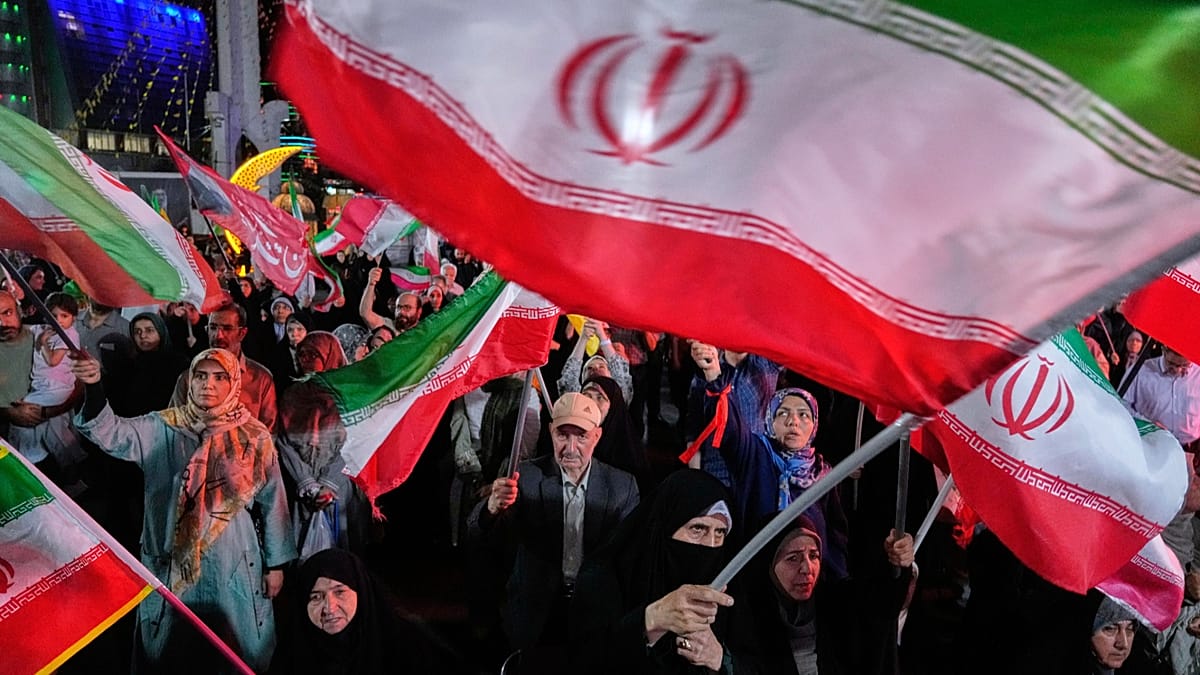
Iran's military responded with defiance. Rear Admiral Habibollah Sayyari, chief of staff and deputy coordinator of the Iranian Army, warned that any attempt to land troops on Iran's coast would mean "entering a living hell from which there would be no escape." The Khatam al-Anbiya Central Headquarters, Iran's joint military command, warned neighbouring countries providing support to US forces that they "will be considered a legitimate target for Iran's armed forces."
The IRGC claimed to have already struck 85 locations at key US military facilities in the region. Ebrahim Rezaei, spokesperson for the Iranian parliament's National Security Commission, said Tehran was "not intimidated by the bluster and threats of figures like Trump" and was prepared to confront any aggression.
Trump's decision to declare the ceasefire dead and threaten further strikes has rattled European capitals, which had cautiously welcomed the June framework deal as a step toward de-escalation. The collapse of the truce also threatens to disrupt global oil markets: oil prices surged and European markets tumbled on Wednesday as traders priced in the risk of a wider conflict in the Gulf.
At the Ankara summit, Trump also revived his long-standing interest in Greenland, telling Danish Prime Minister Mette Frederiksen that the territory was "not for sale" but that he remained interested in acquiring it. The exchange, reported by multiple European diplomats, underscored the transactional tone of Trump's engagement with NATO allies. Frederiksen rejected the overture, and EU officials later expressed frustration at what they saw as a distraction from the Iran crisis.
As the US and Iran trade threats, the European Union has called for restraint. A spokesperson for the European External Action Service said Brussels was "deeply concerned by the escalating rhetoric and military actions" and urged both sides to return to diplomacy. But with Trump vowing to hit Iran "hard" and Tehran warning of a "living hell" for any invader, the path back to negotiations appears increasingly narrow.