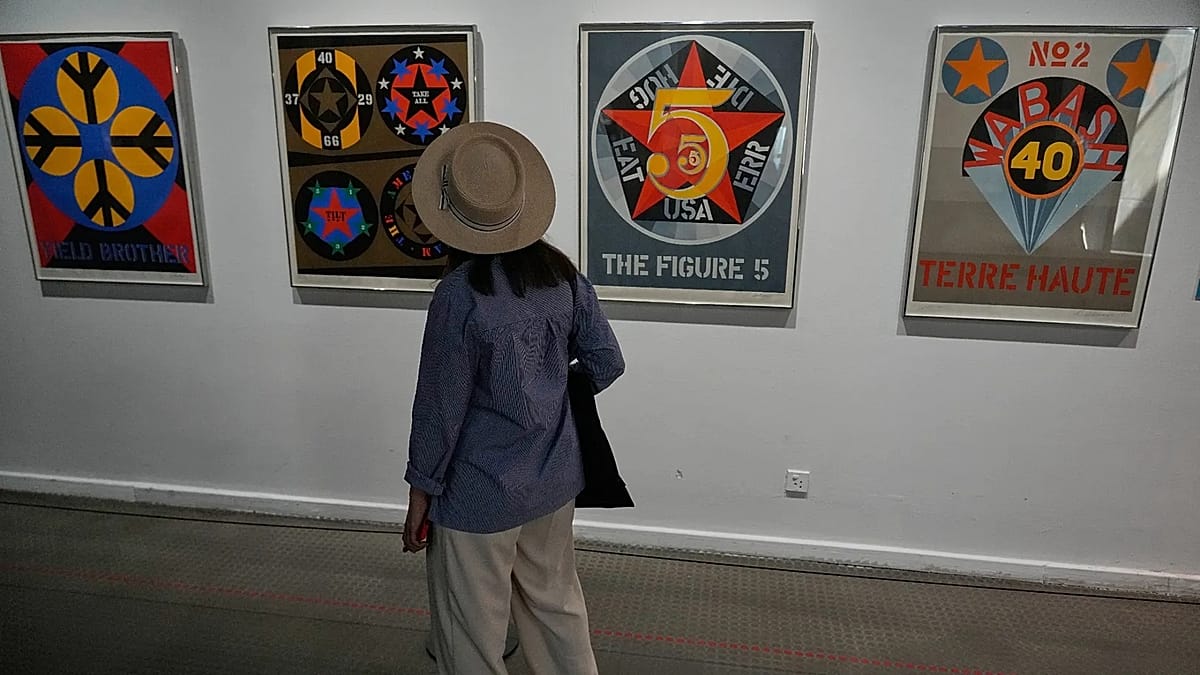
In a city where anti-American billboards line the streets, the Tehran Museum of Contemporary Art has opened an exhibition of American pop art that explicitly critiques war. Titled “Art and War,” the show features works by Roy Lichtenstein, Robert Indiana, and James Rosenquist, all created in the 1960s and selected for their anti-war messages.
The pieces belong to the museum’s major collection of modern American and European art, acquired in the 1970s by Farah Pahlavi, the former shah’s wife. Since the 1979 Islamic Revolution, much of this collection has remained in storage, largely out of public view. Now, amid a fragile ceasefire following a 40-day conflict, the museum has brought a selection back into the light.
Pop Art as Political Commentary
Visitors have been drawn to Rosenquist’s monumental collage F-111, which juxtaposes the fuselage of a warplane with a nuclear mushroom cloud and a child’s face, offering a sharp critique of America’s military-industrial complex. Nearby hangs Lichtenstein’s Brattata, a comic-book-style painting of a fighter pilot shooting down an enemy aircraft.
“American artists have always had a really interesting way of ridiculing war, and that’s always fascinated me in their work,” said Ghazaleh Jahanbin, a Tehran artist. “Maybe part of it, I don’t know, comes from their geographical distance from war itself.”
For many Iranians, the exhibition offers a rare chance to engage with Western art that speaks directly to their own experiences of conflict. Mohammad Sadegh Abbasi, a visitor, praised the timing: “Despite the war and all the hardships people are enduring, art is a way of escaping the pressure everyone is under. In other words, art is a means of survival and a way of life.”
A Deliberate Response to Current Events
Reza Dabiri-Nejad, the museum’s director, said the exhibition was conceived as a direct response to “the events unfolding around it.” He explained that the works on display “had either been shaped by the experience of war or created as a reaction to wars.”
During the 40-day conflict, museums and cultural venues across Iran were shuttered. Since the ceasefire, many have reopened, but with caution. Dabiri-Nejad noted that the number of works on display has been deliberately kept low so that, should hostilities resume, they can be quickly moved to secure storage.
The collection itself has a storied history. Under Mohammad Reza Pahlavi, Iran’s oil boom funded a cultural expansion, and the shah’s government built the museum and acquired works by Picasso, Van Gogh, Mark Rothko, and Francis Bacon. Farah Pahlavi personally selected many of the pieces. But after the revolution, the treasures were packed away in vaults to avoid offending Islamic values or appearing to cater to Western sensibilities.
This exhibition marks a rare public reappearance of that legacy. For a generation of Iranians who have grown up under theocratic rule, it offers a glimpse of a more cosmopolitan past—and a reminder that art can transcend political boundaries.