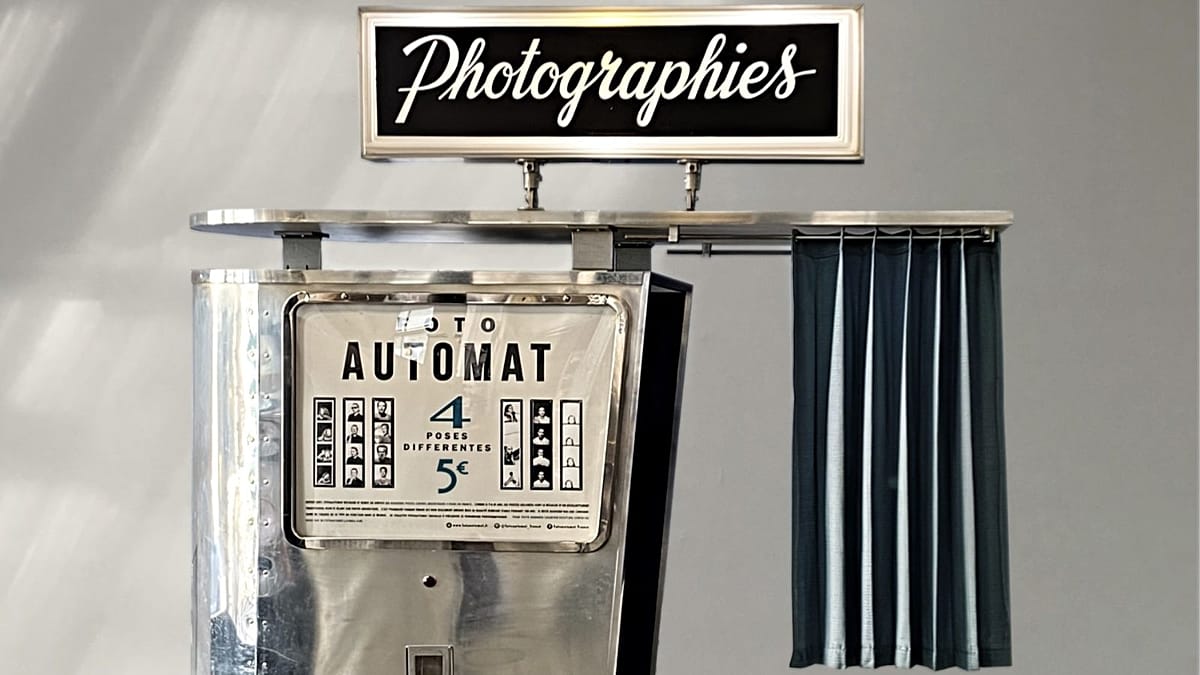
In an era dominated by polished, retouched images and endless self-promotion on social media, the old analogue photo booth stands as a quiet rebel. These machines, often tucked into forgotten corners of train stations or shopping centres across Europe, offer something increasingly rare: a space for total, unscripted freedom. As the curtain swishes shut, the outside world disappears, leaving only the subject and the camera.
The first automatic photo booth, the Photomaton, was installed by Anatol Josepho on Broadway in New York in 1925. But its appeal quickly crossed the Atlantic, finding a natural home in European cities from Paris to Berlin. Dr Michael Pritchard, a photography historian, notes that the British Journal of Photography reported the machines were 'besieged nightly by queues of amused theatre goers.' The process was simple: insert a coin, and the machine would snap eight pictures in twenty seconds, chemically processing black-and-white images onto photosensitive paper.
This immediacy was revolutionary. For the first time, photography was accessible without a professional. 'The Photomaton offered photography without a photographer. You were both the subject and the photographer,' explains Raynal Pellicer, a French filmmaker and author. 'You were now free to break with all photographic conventions: turning your back to the lens, letting yourself go and making all kinds of funny faces. Above all, it was an intimate space. A space of total freedom for couples... All kinds of couples: gay, interracial.'
Preserving a Vanishing Heritage
As digital technology took over at the turn of the millennium, most analogue booths were replaced by sleeker, internet-connected models. These new machines offered touch screens and preview options, but lost the magic of the original. Eddy Bourgeois, co-owner of the French company Fotoautomat, began restoring old booths around 2007, a time when analogue media seemed destined for extinction. He installed them in museums around Paris and noticed something unexpected: they became novel again. 'People stopped using it for identification purposes and started using it for fun, to shed their inhibitions, to experiment, and to create,' he says. 'The medium itself lends itself perfectly to this: the quality of the four-pose prints and the vertical, cinematic format invite storytelling.'
The revival is not limited to France. Collectives in major European cities like London, Berlin, and Amsterdam are restoring and operating vintage booths. Pellicer, who has collected old photo booth images for decades, observes that 'the younger generation is showing incredible enthusiasm for this old school style of self-portraiture.' He estimates that while only about fifty analogue booths were in operation worldwide fifteen years ago, today there are between 300 and 400.
Maintaining these machines has become increasingly challenging. The specialised black-and-white paper used in classic analogue booths was famously produced by a manufacturer in Slavutych, Ukraine. The war in Ukraine has disrupted supply chains, making this paper harder to source. This scarcity adds urgency to preservation efforts, as each restored booth becomes a fragile link to a pre-digital past.
The photo booth's appeal extends beyond nostalgia. It has inspired artists like Andy Warhol and Salvador Dalí, who were drawn to its liminal quality—a space free from societal rules. In films such as Buffalo '66 (1998) and Amélie (2001), the booth becomes a mechanism for exposing characters' inner lives. In Amélie, a bright red Photomaton introduces the protagonist to her love interest, a man who collects discarded photo strips, symbolising the quiet ways we connect with others.
In a world of curated digital identities, the analogue photo booth remains an antithesis. It is a place free from criticism, comparison, or overthinking. Somewhere anonymous, unpredictable, and completely human. As Bourgeois puts it, 'The [photo booth] image is never fully controlled; it retains a spontaneous, slightly accidental quality—the antithesis of the polished, retouched images seen everywhere today.'
For a deeper look at how photography captures unexpected moments, see our story on the viral Pope photo in Barcelona. And for a reflection on how images can preserve history, read about the lost photos of the 1941 Paris roundup.