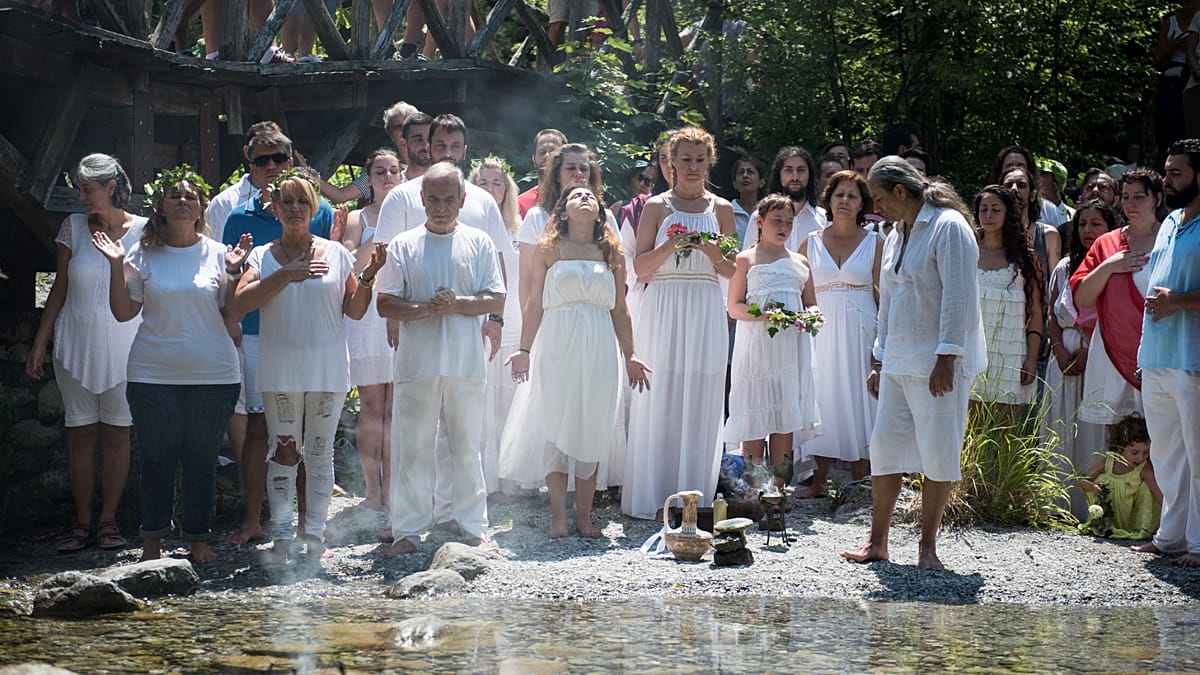
For more than three decades, the slopes of Mount Olympus have hosted an annual gathering that revives the rituals of ancient Greek polytheism. Every summer, hundreds of participants from Greece and across Europe travel to the villages of Litochoro and the Prometheus Grove to take part in a four-day celebration of Dodekatheism—the worship of the twelve Olympian gods.
The event is organized by Prometheus, the Fire Bringer, a cultural association named after the Titan who, according to Greek mythology, stole sacred fire from Mount Olympus to give to humanity, defying Zeus. The ceremonies unfold near the archaeological site of Dion, a sacred city of ancient Macedon, and include torchlight processions, symbolic rites, and theatrical performances that draw on classical mythology.
A Celebration of Nature and the Divine
Participants join processions and torch relays, often adopting names inspired by antiquity for the duration of the festival. “It is a celebration with a distinctly Greek-centred character. We honour our gods, we honour nature, as you can see around us, because for the ancient Greeks nature itself was their temple,” one attendee explained.
Triantafyllos Athanassoulas, who took part in a torchlight procession, said: “My official name is Triantafyllos, but here I’ve taken the name Hermodoros (‘gift of the god Hermes’).” Many members of the association undergo a ceremony to change their first names, using ancient-inspired names to address one another throughout the event.
The programme also includes a gathering on the banks of the Enipeas river, where symbolic events dedicated to nature, the Nymphs, and the Nereids of Greek mythology are held. These rituals emphasize the connection between the divine and the natural world, a core tenet of the ancient worldview.
Polytheism as a Worldview
Georgia Altintasiotou, president of Prometheus, the Fire Bringer, stressed that the festival is not about religion in a conventional sense. “Polytheism is not a religion. We are talking about the Greek worldview, a cosmological way of understanding how we perceive the divine around us. The divine element is present everywhere,” she said.
The event draws not only Greeks but also visitors from other European countries, reflecting a broader interest in pre-Christian spiritual traditions. Greece’s rich cultural heritage continues to attract attention, as seen in other recent developments such as the launch of its first optical microsatellite, which bolsters national space infrastructure, and efforts to protect beaches from jellyfish and pufferfish using floating barriers.
For participants, the festival on Mount Olympus offers a rare opportunity to connect with ancient traditions in a setting that has remained largely unchanged for millennia. As the torchlight flickers against the mountain’s rugged slopes, the line between past and present blurs, reminding attendees that some beliefs endure far longer than the empires that once enforced them.