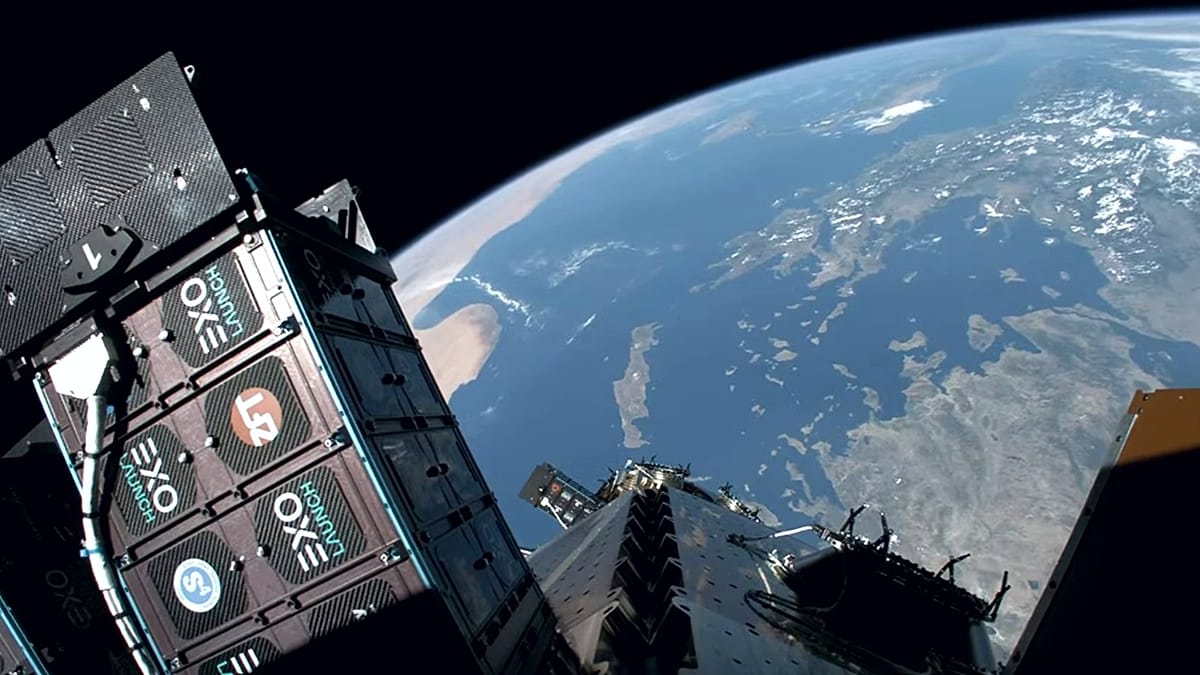
Greece has taken a significant step forward in its national space ambitions with the successful launch of Hyperion GR-1, the first optical microsatellite developed under the National Microsatellite Programme. The satellite was placed into orbit on Tuesday, 7 July, from Cape Canaveral Space Force Station in Florida aboard a SpaceX rocket.
Hyperion GR-1 is the initial component of a planned constellation of seven optical microsatellites, built in Greece by Open Cosmos Aegean. The programme is designed to create a modern satellite observation system that supports critical public-sector operations, including civil protection, environmental monitoring, maritime surveillance, precision agriculture, and the safeguarding of critical infrastructure.
Capabilities and Applications
The microsatellite can capture high-resolution multispectral images with a ground sampling distance of up to 90 centimetres, enabling detailed monitoring of changes in both natural and urban environments. It is equipped with onboard artificial intelligence (AI) for data processing and inter-satellite links to accelerate the transmission of information to ground stations.
Data collected by Hyperion GR-1 will be aggregated through the Government Geospatial Observation Hub, a central digital platform designed to manage satellite data for public administration. According to the Ministry of Digital Governance and Artificial Intelligence, the satellite's data will be used for early detection of wildfires and floods, assessing the impact of natural disasters, protecting forest and water resources, and supporting precision agriculture and aquaculture. The system will also aid maritime surveillance, shipping monitoring, and identification of marine pollution incidents.
Applications extend to urban planning, monitoring of major engineering projects, and inspection of critical infrastructure, all aimed at improving decision-making through up-to-date geospatial data. This aligns with broader European efforts to leverage space technology for environmental and security challenges, as seen in Greece's deployment of AI-powered nanosatellites for wildfire detection.
National Strategy and European Collaboration
Hyperion GR-1 is the first of seven microsatellites under the National Microsatellite Programme, financed by the Recovery and Resilience Facility “Greece 2.0”. The programme is implemented by the General Secretariat for Telecommunications and Post, with support from the Hellenic Space Centre (ELKED) and the European Space Agency (ESA). The same mission also carried the Posedònia satellite, built by Open Cosmos at its facilities in Spain.
With this launch, Greece now has a total of 18 microsatellites in orbit, according to the ministry, as part of its strategy to develop national space infrastructure. The ministry highlights the involvement of Greek industry in the satellite's construction, which has strengthened domestic know-how and created prospects for exportable space technologies and services.
The government has already outlined its next steps through the HELLAS-SPACE 2.0 programme, with a total budget of €350 million, aimed at further expanding the country's capabilities in space applications. This investment underscores Greece's commitment to becoming a more resilient state, particularly in the face of climate-related challenges such as wildfires that rage across southern Europe.
“The launch of Hyperion GR-1 marks a new era for our country. We are acquiring another powerful tool that will allow us to harness satellite data for the benefit of citizens: to protect our forests and marine areas, to support precision agriculture, to map development both within and outside approved planning zones, and to take faster decisions in times of crisis,” said Dimitris Papastergiou, Minister of Digital Governance and Artificial Intelligence.
He added that the launch is part of a broader national strategy, recalling the recent presentation of the HELLAS-SPACE 2.0 programme. “Our goal is for technology to make the state more effective, the country more resilient and citizens’ daily lives better,” he concluded.
Greece's space programme is part of a wider European trend of investing in satellite technology for public good. The country's efforts complement initiatives like selecting Adrianos Golemis for a space mission within two years, highlighting a growing ambition in the sector.