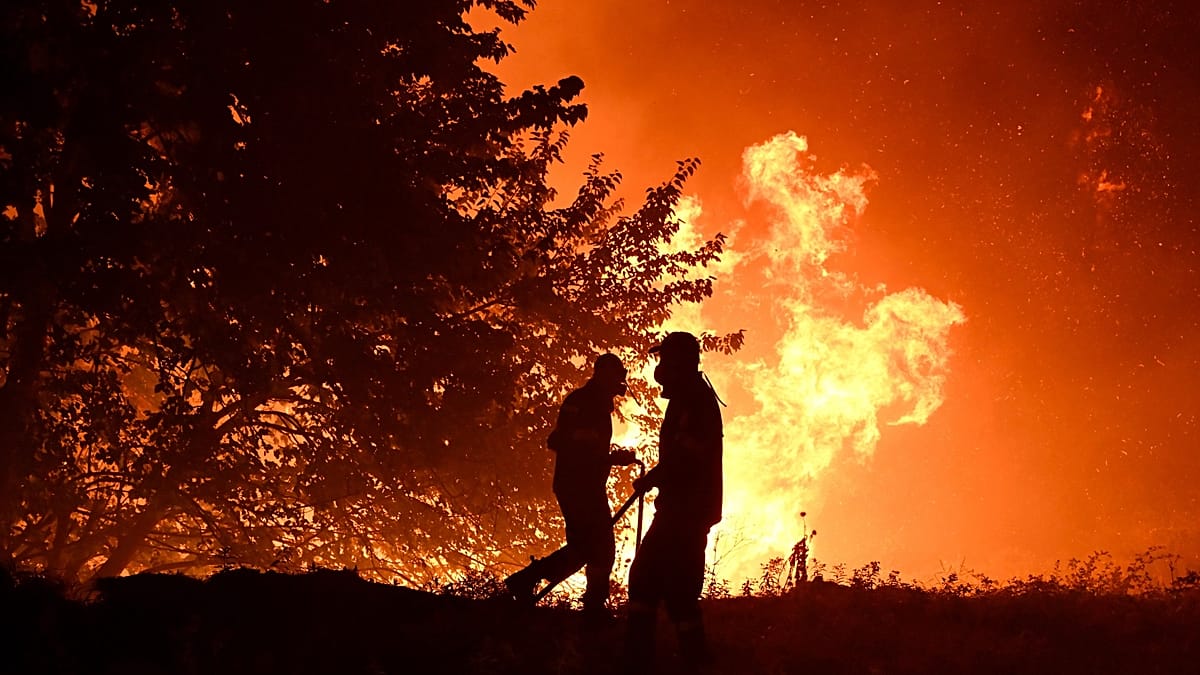
Wildfires are sweeping across southern Europe, forcing mass evacuations in Portugal, Spain, France, and Greece as authorities warn of toxic smoke and rising temperatures. The blazes have already consumed over 190 square kilometres of land—more than twice the area of Manhattan—and are expected to intensify as a new heatwave pushes temperatures toward 40°C in several regions.
France: Pyrenees Inferno Forces Evacuations and Tour de France Restrictions
In southwestern France, near Perpignan, some 700 firefighters backed by aerial units are battling a “gigantic” blaze in a remote, hard-to-reach area. More than 10,000 residents have been evacuated from villages including Trevillach, where the fire came within 300 metres of homes. “We were taken aback by how fast it spread, it was staggering, bordering on panic,” said Patrice, a 53-year-old resident who declined to give his surname. Charlotte Pignol, 30, described being woken by a town hall official at 1:00 am on Sunday: “Someone from the town hall knocked on our door to tell us to leave.”
The fire has nearly tripled in size since early Sunday, devouring 46 square kilometres and injuring a firefighter and a resident. Colonel Eric Belgioino of the French fire service warned that climate change is accelerating the wildfire season. “Climate change is here, we are living the consequences and it is only the start of July,” he said, urging the public to avoid any activity that could spark new fires. “The season is going to be long for the soldiers fighting fires. You have to help us.”
Officials have also banned spectators from Monday’s third stage of the Tour de France, which passes through the Pyrenees from Spain into France. Regional prefect Pierre Regnault de la Mothe told reporters the stage “will be limited to the passage of the riders only and the vehicles essential to organizing the race” on French territory. “The public is asked not to go near the route or to the finish area. In other words, and I regret having to say this, it will be, in France at least, a stage of the Tour de France without spectators.”
Greece: Toxic Smoke from Factory Fires in Thessaloniki
In northern Greece, a forest fire near Thessaloniki tore through two factories over the weekend, releasing a poisonous cloud that forced authorities to evacuate the surrounding area. Households have been told to keep windows closed as the smoke poses a serious health risk. The blaze is the latest in a series of wildfires that have plagued the region during an unusually early and intense summer fire season.
Spain and Portugal: Thousands of Hectares Burned
In Spain, a fire near the Costa Brava coast has burned more than 2,200 hectares in two days. Firefighters warned that rising temperatures and numerous “smoking hotspots” within the perimeter would complicate containment efforts. The blaze is part of a broader pattern: Spain’s 2026 wildfire season has already seen 50,000 hectares burned, with Cantabria among the worst-hit regions.
In Portugal, emergency services reported that they had controlled “80 percent” of a wildfire that devastated some 13,000 hectares of forest and scrubland in the north of the country. The country has mobilised over 1,000 firefighters to combat the blazes, with Spain and Italy deploying firefighting aid as the heatwave continues to fuel the flames.
Balkans and Croatia: Fires Spread Across the Adriatic
Major fires have also destroyed hundreds of hectares of forest, vineyards, and scrubland on the Croatian island of Hvar and near Tale in Albania. The fires underscore the continent-wide nature of the crisis, as southern Europe faces an early and aggressive start to the wildfire season.
Climate Context: A Heatwave Made Worse by Global Warming
The current blazes come on the heels of a record-breaking June heatwave that scientists from the World Weather Attribution group said would have been “virtually impossible” without climate change. That heatwave contributed to thousands of excess deaths across Europe. With temperatures forecast to rise again in the coming days, authorities across Portugal, Spain, and southern France have stepped up heat alerts. The latest heatwave is expected to move north and could last until next weekend.
As the continent braces for a long and dangerous summer, the message from fire services is clear: the fire season has started a month early, and the risks are higher than ever.