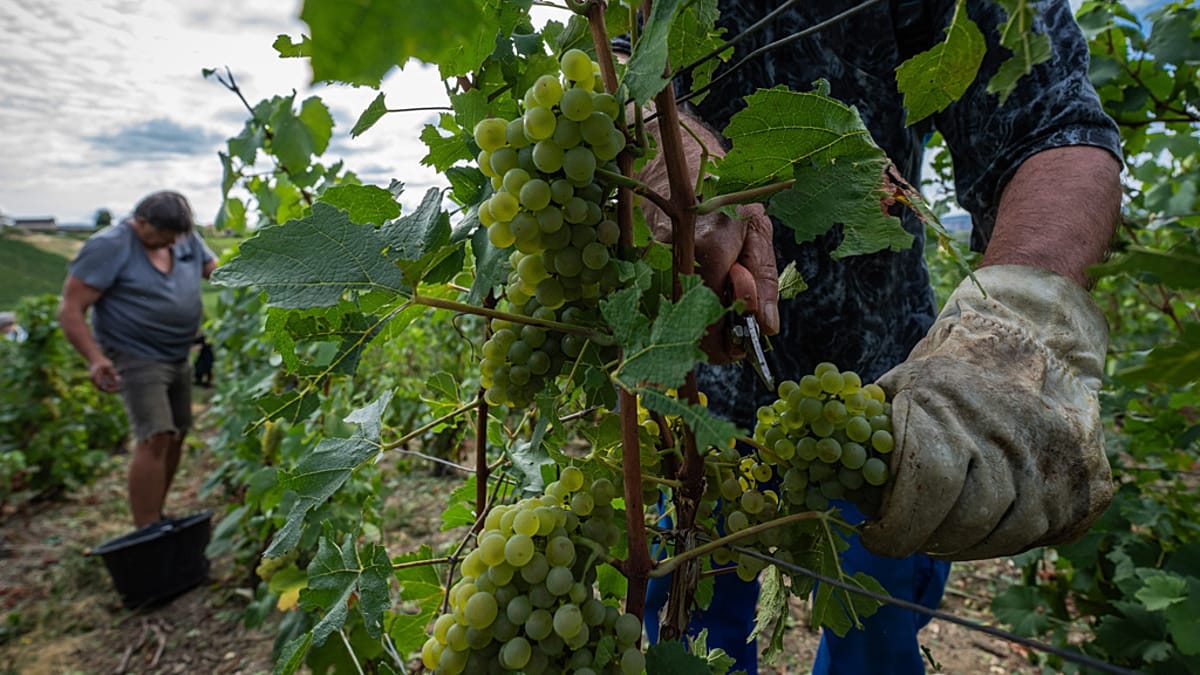
In the rolling vineyards of Champagne, the traditional summer lull has been replaced by urgent activity. On the hillsides around Hautvillers, pickers are already at work, with the first grapes being harvested between 12 and 17 August, depending on the plot and variety. This exceptionally early start is a clear signal of how the region's climate is transforming.
For Alexandre Gobillard, production director at the Gobillard & Fils house, the timing would have been unthinkable just a few decades ago. “I've been working on the estate for 30 years, and when I started my father always used to say: 'On 15 August, go on holiday.' Today it's 18 August and we're in the middle of the harvest. We've never seen anything like it,” he says.
Heat and drought accelerate ripening
The region has experienced a series of climatic shocks. A late frost at the end of March—itself a novelty—was followed by several heatwaves and a severe drought. In June, temperatures in parts of Champagne reached 40°C, accelerating the maturation of the grapes and increasing their sugar concentration.
This forces winegrowers to monitor ripeness with extreme precision, balancing sugar levels against acidity to preserve the freshness and delicacy that define champagne. The challenge is to pick at the optimal moment, a task made more difficult by the compressed timeline.
Further east, in Tours-sur-Marne, Ophélie Lapie-Lamiable, who manages Champagne Lamiable, has observed a clear trend over the past two decades. “2003 is still remembered as a landmark year. It was the first time we harvested at the end of August in Champagne. Since 2003, we've already harvested at the end of August at least ten times, and so 2026 will probably also go down in history for its frost and its earliness. Perhaps in 20 years' time we'll be saying that in the end, harvesting on 15 August has more or less become normal,” she says.
Adapting to a warming world
The shift is forcing the industry to rethink its methods. Growers are exploring grape varieties that can better withstand heat and drought, and the organisation of the harvest itself has become more complex. Traditionally done by hand, the harvest requires thousands of seasonal workers who must be housed and transported—now often in sweltering summer conditions rather than the cooler days of late September.
Despite the challenges, the first signs in the vineyards are encouraging. The grapes are being pressed in the cellars, and the initial bubbles of this very early vintage are beginning to take shape. It will take several years before the quality of the wine can be fully assessed, and whether it will earn the coveted grand cru status.
This early harvest is not an isolated phenomenon. Across Europe, agricultural calendars are shifting as the climate changes. For Champagne, the question is no longer whether to adapt, but how quickly. As Lapie-Lamiable notes, what was once exceptional may soon become the norm.
The implications extend beyond the vineyards. The earlier harvest affects tourism, with visitors arriving to see the vendanges in full swing during the peak summer season. It also raises questions about the long-term viability of certain grape varieties in a region that has built its reputation on a specific terroir.
For now, the focus is on the 2026 vintage. The combination of frost, heat, and drought has produced a unique set of conditions, and winegrowers are cautiously optimistic. As the first bottles are laid down to age, the hope is that this early harvest will yield a champagne that lives up to the region's exacting standards.