For years, the Euboean Gulf has seen seasonal influxes of jellyfish that sting swimmers and, in rare cases, trigger severe allergic reactions. Local authorities in central Greece have struggled to manage the problem, but a new initiative aims to create safe swimming zones using floating barriers.
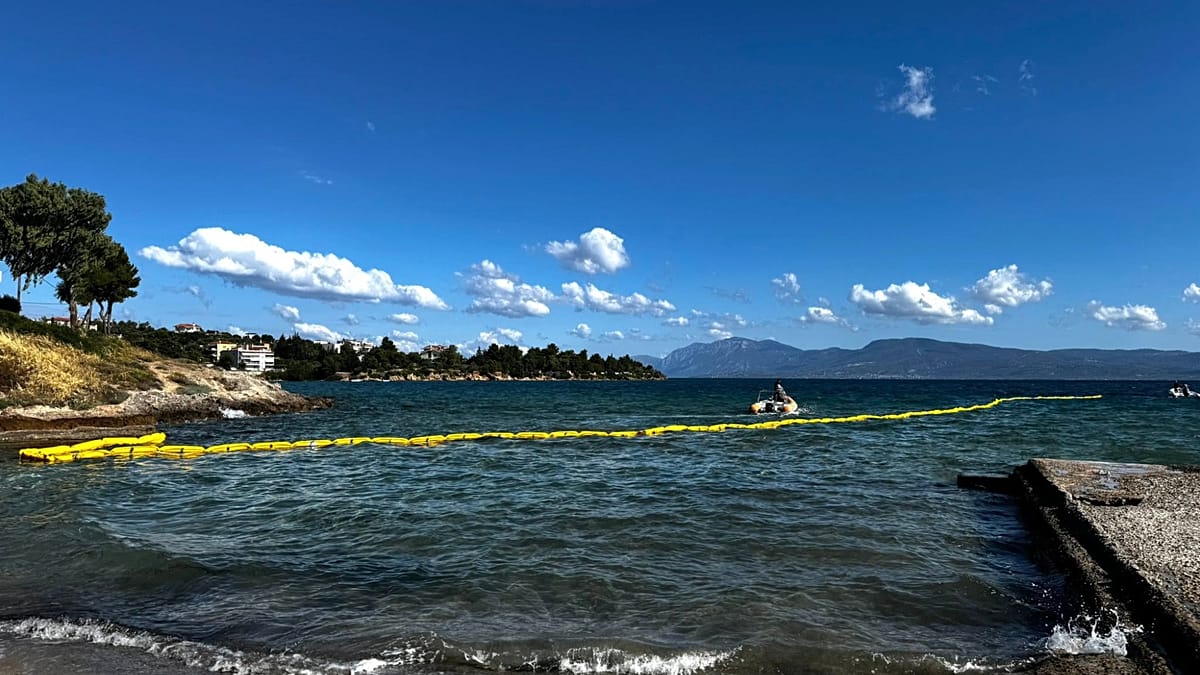
The Municipality of Chalkideon began installing these barriers in mid-June at Rodies beach in Chalkida, at a total cost of €366,950.10. Specialised divers are deploying the barriers at six beaches along the northern Euboean Gulf: Alykes, Mpourntontas, Valopoula, Kalamia, and Zephyros. Separately, the Ports Organisation of Evia (OLNE) plans to install similar barriers at Sykies, Kourenti, Souvala, and Papathanasiou beaches.
“We would like to thank the Region of Central Greece for funding such an important initiative, which enables us to limit the entry of jellyfish, as well as floating waste and surface pollution, into bathing areas, enhancing safety for swimmers and improving the image of our beaches for residents and visitors to our municipality,” said the Mayor of Chalkideon.
How the Barriers Work
The barriers are designed to enclose a semi-circular or rectangular “safety zone” that starts from the shore, extends into deeper water, and returns to land. The lower part of the net is fitted with chains or sunk weights that must rest on the seabed with minimal gaps to prevent jellyfish from slipping underneath via underwater currents. The upper part consists of reinforced floats that rise 30–50 centimetres above the water surface, stopping jellyfish from riding over the barrier even in rough seas.
According to experts, the barriers can also block pufferfish, an invasive species that has become a growing concern in Greek waters. Greece has been paying fishermen with EU funds to cull these fish, as reported in our earlier coverage. However, the barriers only protect the specific area they enclose, not the entire coastline.
The most critical factor determining effectiveness is correct positioning. If the barrier is placed in very shallow water, it may reduce the swimming area and frustrate beachgoers. Some bathers at Rodies have already complained that the barrier was installed too close to the shore, limiting space for free swimming.
Despite these challenges, the initiative represents a practical response to a recurring environmental and public health issue. The barriers also trap floating waste and surface pollution, improving beach cleanliness for residents and tourists alike. As southern Europe faces more frequent wildfires and extreme weather, such local adaptations are becoming increasingly important for coastal communities.
The project is funded by the Region of Central Greece, and the municipality hopes it will set a precedent for other affected areas. Whether the barriers prove a lasting solution or a temporary fix will depend on careful monitoring and adjustments based on local conditions.