On Sunday, either Spain or Argentina will lift the FIFA World Cup trophy after the 2026 final. But few fans know the story behind football's most coveted prize: it was designed by a 50-year-old sculptor from Milan, Silvio Gazzaniga.
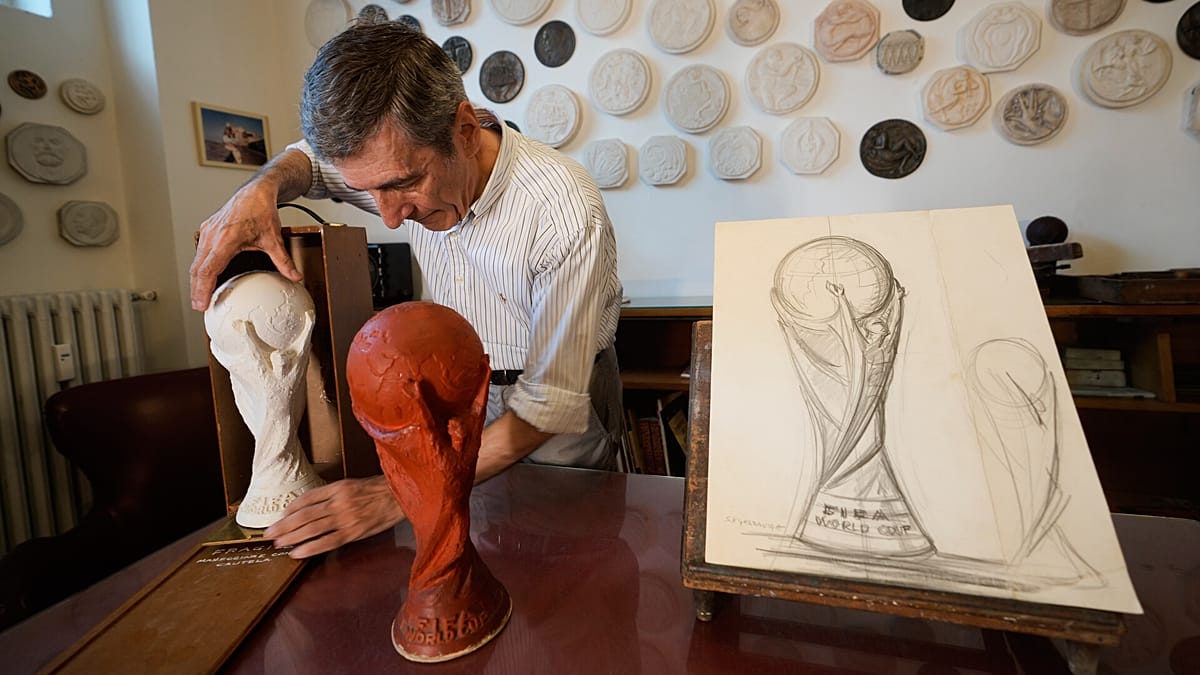
Gazzaniga's design, created in his studio in Milan's Brera neighbourhood, captures three sporting emotions in a single spiralling form: the athlete's struggle, the fan's jubilation and the moment of victory. His son, Giorgio Gazzaniga, recalls watching his father sketch countless drawings before developing the concept of two figures swirling upward toward an orb representing the Earth.
From Brera to the World Stage
Gazzaniga trained at Milan's Brera Academy of Fine Arts before joining trophy maker G.D.E. Bertoni. He later designed other iconic football trophies, including the UEFA Cup, UEFA Super Cup and Intercontinental Cup. His World Cup entry topped more than 50 submissions from artists across 25 countries. Rather than submitting sketches, Gazzaniga produced a full-size plaster prototype, allowing judges to assess the trophy as a finished object.
The original World Cup trophy, introduced in 1930, depicted Nike, the Greek goddess of victory, and was known as the Jules Rimet Trophy. Designed by French sculptor Abel Lafleur, it was made of gold-plated sterling silver on a lapis lazuli base. Under original rules, any nation winning three World Cups would keep the trophy permanently. Brazil did so in 1970, prompting FIFA to commission Gazzaniga's replacement.
The Jules Rimet Trophy had a turbulent history. It was stolen in 1966 while on public display in England, only to be discovered by a dog named Pickles under a hedge in south London. It was stolen again from the Brazilian Football Confederation headquarters in 1983 and never recovered, widely believed to have been melted down.
Capturing the Struggle for Victory
Gazzaniga's design stands 36 centimetres tall, cast in 18-carat gold, with a base featuring two rings of green malachite symbolising playing fields. His son described the design: “There is the world, which stands above all else, there is the athlete's exertion, there is the athlete's movement within the metal, and the athlete's body is rough, rugged, for it has suffered, had to fight, and struggled for victory. That victory is expressed through arms that resemble the wings of Victory, capturing not only the athlete's triumph but also the jubilation of the fan.”
The trophy was first lifted by West Germany captain Franz Beckenbauer after the 1974 final in Munich. Giorgio Gazzaniga remembers watching that game at home with his family as West Germany faced the Netherlands. “The real explosion of joy came when the German team raised the cup in Munich and the whole stadium erupted,” he said. “That was the moment an object became an icon.”
Unlike the Jules Rimet Trophy, FIFA no longer allows three-time winners to keep the original. The trophy resides at FIFA's Swiss headquarters between tournaments, with winners receiving a gold-plated replica. Gazzaniga's family has preserved his office in Pioltello, on the outskirts of Milan, including drawings, the original prototype and a wax cast. Earlier this year, Milan officials unveiled a commemorative plaque outside his former studio on Via Alessandro Volta 7.
Gazzaniga died in Milan on 31 October 2016 at age 95. In 2003, Milan awarded him the Ambrogino d'Oro, one of the city's highest civic honours. Eight years later, he received an international award from the International Association of Numismatists and Medal Designers for his lifetime contribution to medal and trophy design. His legacy continues every four years when the World Cup trophy is hoisted by champions.