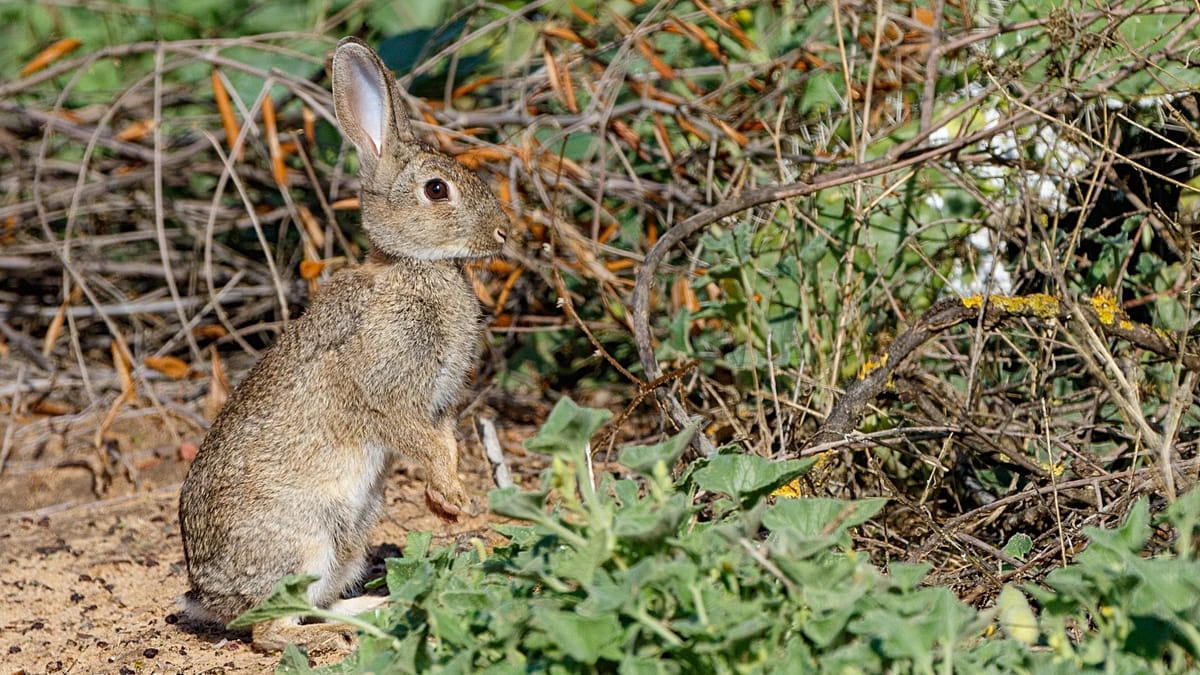
For more than a hundred years, biologists assumed that a single species of rabbit inhabited the Iberian Peninsula, at most divided into regional variants. A study published in Biological Conservation now overturns that assumption, revealing that what was long considered one animal is actually two distinct species with separate evolutionary trajectories.
Coordinated by Rafael Villafuerte and Miguel Delibes-Mateos of the Institute for Advanced Social Studies (IESA-CSIC), together with researchers from the TRAMAS group and institutions in Portugal and the United Kingdom, the paper distinguishes between the Iberian rabbit (Oryctolagus algirus) and the European rabbit (Oryctolagus cuniculus). The former is native to Portugal and western Spain, while the latter dominates the eastern part of the peninsula and is the source of populations introduced across Europe, Oceania and the Americas, where it often behaves as an invasive species.
A Split Two Million Years in the Making
The two lineages diverged roughly two million years ago, when they became isolated in different glacial refuges: one in the Ebro valley, the other in the Gulf of Cádiz. Since then, the researchers explain, they have barely interbred, despite looking very similar at first glance. The differences, however, go far deeper than appearance.
The Iberian rabbit is smaller, with darker fur, smaller litters and earlier sexual maturity than its European counterpart. They also differ in gut microbiome, meat composition and the parasite communities they harbour. As Villafuerte puts it, “the two species have always been there; what has changed is our knowledge of them.”
The study draws parallels with other cryptic species discoveries: giraffes, long grouped as a single species until genomics revealed four distinct ones, and African elephants, now divided into savannah and forest species.
Why the Distinction Matters
The most pressing concern for the researchers is conservation. While European rabbit populations remain stable or are even increasing across much of their range — to the point of causing agricultural damage in some areas — the Iberian rabbit is in marked decline in Portugal and south-western Spain. Managing both as if they were the same species has masked the severity of that fall.
The problem is compounded by game restocking operations, which typically release European rabbits — more abundant and prolific — into areas where only the Iberian rabbit previously lived. This can accelerate its replacement through competition and hybridisation. Delibes-Mateos warns: “We cannot go on managing as a single species two rabbits that have evolved separately for almost two million years.”
The implications extend well beyond the rabbit itself. It is prey for up to 40 predator species, including the Iberian lynx and the Spanish imperial eagle, so its conservation status shapes that of much of Mediterranean wildlife. Formal recognition of the two species would, according to the authors, enable tailored monitoring programmes, recovery plans and hunting regulations for each lineage, rather than applying criteria devised for just one.
This discovery also has broader relevance for European biodiversity policy. The Iberian Peninsula is a biodiversity hotspot, and the misclassification of a keystone prey species could have cascading effects on ecosystem management across the region. As European Union conservation frameworks increasingly emphasise genetic diversity, this case highlights the need for updated taxonomic assessments.
The study is a reminder that even well-known animals can harbour hidden diversity, and that taxonomy — the science of naming and classifying organisms — must keep pace with evolution if conservation efforts are to be effective.