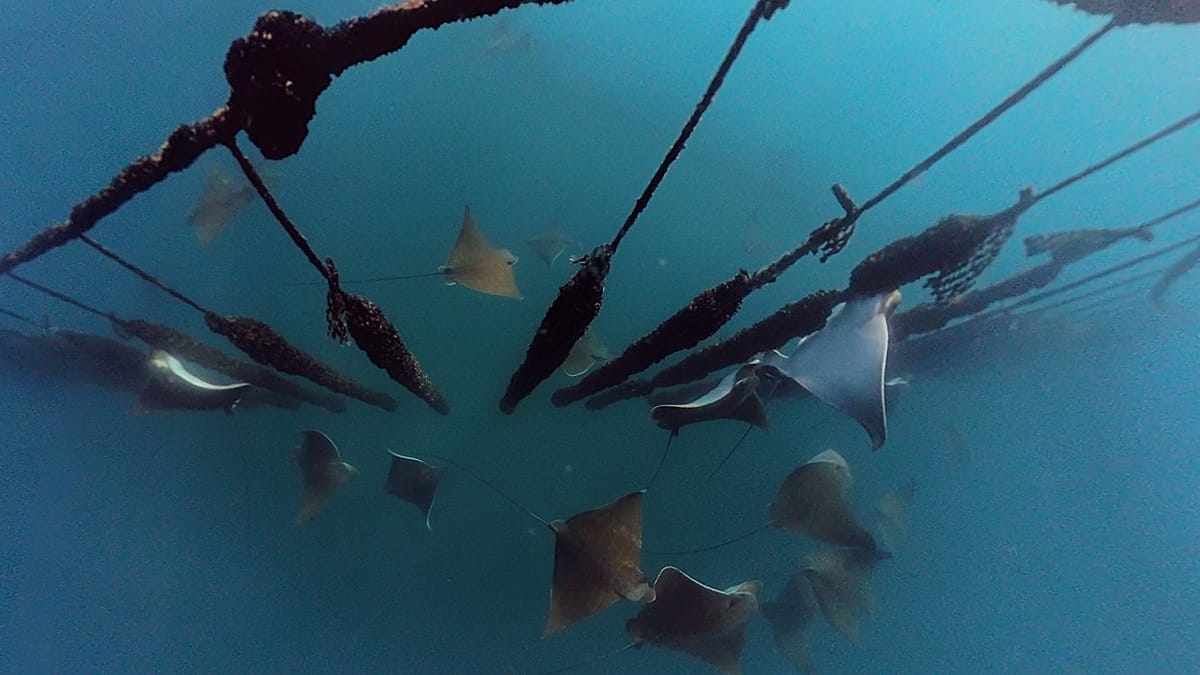
In the Gulf of Trieste, a phenomenon unseen elsewhere in the Mediterranean is unfolding. Over the past three years, bull rays—known locally as vaccarelle—have been gathering in numbers that astonish marine biologists. Aggregations of up to 50 individuals are now sighted weekly during summer, a scale and frequency that researchers describe as unique.
“This is the first year we’ve recorded such high numbers grouped together,” says Saul Ciriaco, head of monitoring at the WWF Miramare Marine Protected Area (MPA) and vice-president of the Shoreline cooperative. “The aggregations are thought to be linked to feeding, but also to reproduction, as males and females come into contact.”
While the sightings delight conservationists and marine enthusiasts, they pose a growing problem for local mussel farmers. The animals have discovered that mussel lines offer an easy meal, and reports of damage have risen in tandem with the ray population.
“Such interaction between bull rays and human activities had never been seen before,” explains Simona Clò, a marine biologist and scientific director of MedSharks, an association dedicated to Mediterranean species conservation. She stresses the need for non-invasive solutions that protect farmers’ livelihoods without endangering the rays, which are protected under the Barcelona Convention and the UN Bonn Convention on migratory species.
Why Now? Warmer Waters and Tighter Fishing Rules
Bull rays are large cartilaginous fish, reaching up to two metres across, and are listed as seriously at risk on the IUCN Red List. Historically, they were caught as bycatch in the Adriatic, but stricter EU fisheries policies have reduced accidental captures. “More selective fishing rules have improved their reproductive performance,” Ciriaco notes.
Climate change also plays a role. Winter water temperatures in the Gulf of Trieste no longer drop below 10°C, the lower tolerance threshold for bull rays, which prefer 11–28°C. “The Gulf used to be a place they passed through on migration,” Ciriaco adds. “Now it has become suitable for them to stay.”
Similar incidents have been reported in Greece, Turkey, and off Olbia in Sardinia, but Trieste is the first site where the phenomenon has reached such a scale.
Magnetic Deterrents and Drone Surveillance
The Miramare MPA is leading efforts to manage the conflict, supported by two EU Life programme projects: Life Eu Sharks and Life Prometheus. Researchers are testing magnetic deterrents to gently guide rays away from mussel farms without harming them.
Monitoring relies on drones supplied by Italy’s Environment Ministry. “The largest group sighted so far numbered about 50 animals, all adults and sub-adults, but the real figures could be much higher,” says Clò. Each ray has a distinctive stripe pattern on its back, allowing photo-identification via a shared database. “This will give us an estimate of the actual population in the Gulf of Trieste,” she explains.
The coastline under surveillance stretches roughly 20 kilometres, from Grignano to Monfalcone. The goal is to develop a coexistence model that could be applied elsewhere in the Mediterranean as bull ray numbers continue to recover.