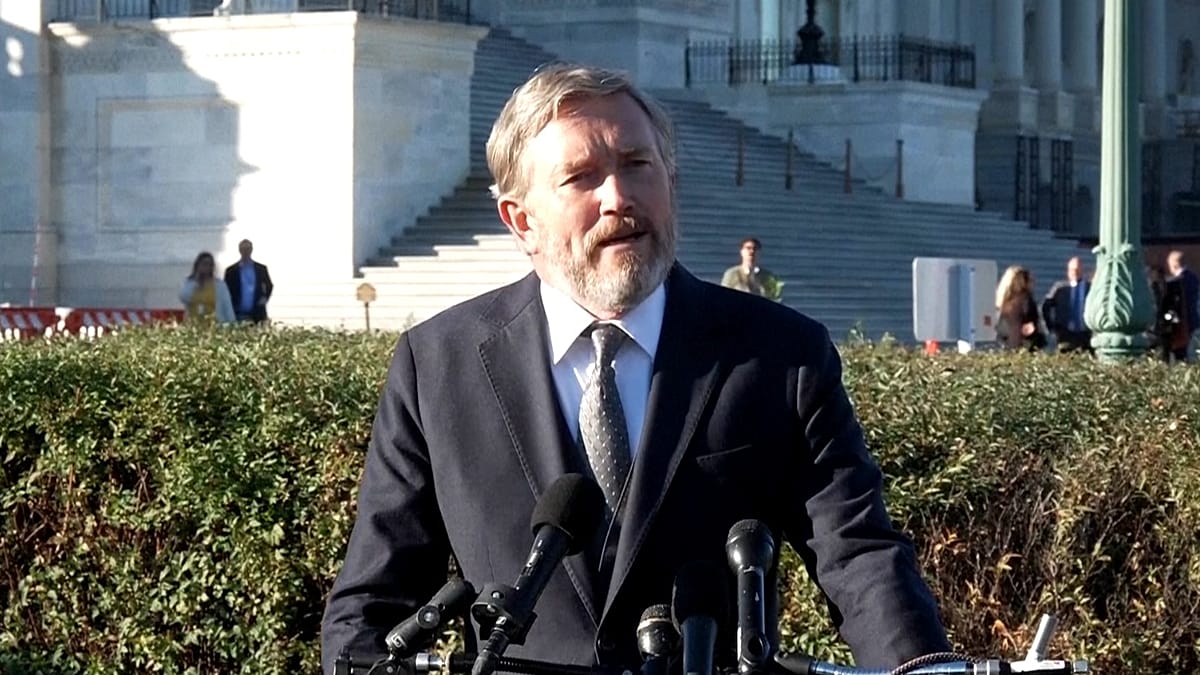
A Republican congressman is seeking to impeach US Defence Secretary Pete Hegseth, accusing him of breaching the Constitution by ordering sustained military operations against Iran without the approval of Congress. The move has drawn a sharp response from President Donald Trump, who has vowed to stand by his embattled Pentagon chief.
Representative Thomas Massie of Kentucky filed eight articles of impeachment on Monday, arguing that Hegseth violated the War Powers Resolution by continuing strikes on Iranian targets for more than 90 days without authorisation from the House or Senate. Massie contends that the defence secretary's actions amount to an unconstitutional war, and he is pressing for a vote in the House this week.
Massie's initiative is also a calculated political manoeuvre. He has said that forcing a vote now would pressure Trump to replace Hegseth before Democrats can launch their own impeachment proceedings, which could prove more damaging to the administration. By acting first, Massie hopes to control the narrative and give the president a chance to reset his national security team.
The impeachment push comes amid escalating US military engagement in the Middle East. Recent strikes on Iranian air defences and the island of Qeshm have raised concerns in European capitals about the risk of a wider conflict. The situation has also complicated diplomatic efforts, with Qatar and other mediators trying to restart nuclear talks. For European allies, the prospect of an unchecked US military campaign in Iran is a source of deep unease, as it could destabilise the region and trigger new waves of migration and energy price shocks.
Trump, however, has dismissed Massie's move as a distraction. In a series of posts on his social media platform, the president called Massie "a stone-cold loser" and questioned his motives, suggesting the congressman was seeking attention rather than upholding the Constitution. Trump reiterated his full confidence in Hegseth, praising him as a "patriot" and a "fighter" for the armed forces.
The White House has not commented on the specific articles of impeachment, but officials have indicated that the president views the effort as a nuisance rather than a serious threat. Hegseth, a former Fox News host and combat veteran, has defended his actions, arguing that the strikes were necessary to protect US personnel and deter Iranian aggression. He has also insisted that he kept congressional leaders informed, though not to the extent required by the War Powers Resolution.
Constitutional clash over war powers
The dispute highlights a long-standing constitutional tension between the executive and legislative branches over the use of military force. The War Powers Resolution of 1973 requires the president to notify Congress within 48 hours of committing armed forces to hostilities and to obtain approval within 60 days, with a 30-day withdrawal period. Massie argues that Hegseth has exceeded that limit, making the operations illegal.
Legal scholars are divided on the issue. Some argue that the resolution is unconstitutional and that presidents have historically ignored it, while others insist that it remains a binding check on executive power. Massie, a libertarian-leaning Republican, has long been a vocal critic of US military interventions, and he has framed his impeachment effort as a defence of the Constitution rather than a partisan attack.
The timing of the vote is uncertain. House Speaker Mike Johnson has not indicated whether he will allow a floor vote, but Massie has the right to force one through a procedural motion. Even if the articles pass the House, conviction in the Senate is highly unlikely, as it would require a two-thirds majority. Still, the vote could embarrass the administration and expose divisions within the Republican Party over foreign policy.
For European observers, the episode underscores the volatility of US politics and the challenges of relying on Washington for security guarantees. The Trump administration's approach to Iran has already strained transatlantic relations, with European governments preferring diplomacy over military confrontation. The impeachment push, while a domestic matter, adds another layer of unpredictability to an already fragile geopolitical landscape.
As the week unfolds, all eyes will be on the House floor. Massie has vowed to press for a vote, and Trump has promised to fight back. The outcome will not only determine Hegseth's fate but also signal how far Congress is willing to go to reclaim its war powers from a president who has shown little patience for institutional constraints.