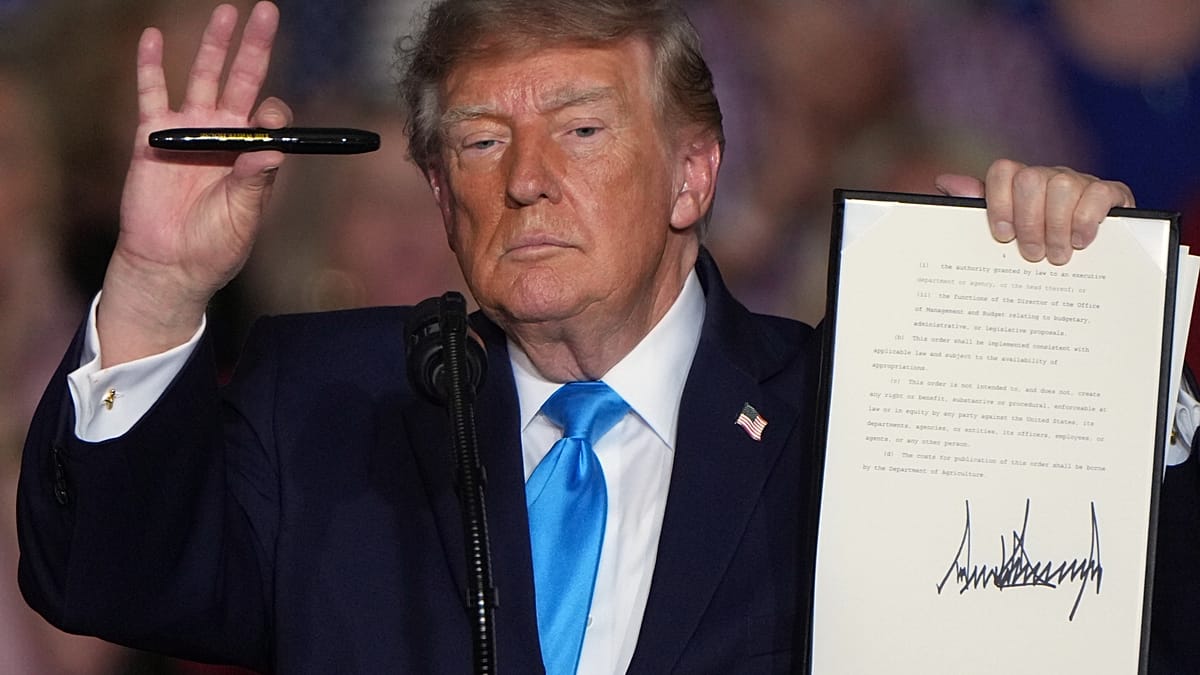
With US midterm elections just weeks away, President Donald Trump has signed an executive order to defer tax payments on red-dyed diesel used on public roads, a move aimed at easing the financial strain on truckers and farmers as fuel prices hover near record levels. The order, signed at a campaign rally in Grand Island, Nebraska, on Monday, allows anyone to purchase tax-free red-dyed diesel for any reason, a fuel normally reserved for off-road machinery and exempt from highway taxes.
Trump told supporters the order would "officially waive the off-road requirement and allow anyone to purchase tax-free red-dyed diesel for any reason." He also joked about his unfamiliarity with the fuel, saying, "I don't know what the hell it is, but whatever it is, it's supposed to be very good."
The federal diesel tax is 24.4 cents per gallon, or about $60 on a 250-gallon fill, according to a White House press release. Savings could exceed $100 per fill if states follow suit. At Monday's average diesel price of $6.32 per gallon, a 250-gallon fill costs about $1,580 including tax.
However, the executive order is narrower than Trump's rhetoric suggests. It does not abolish the tax but postpones payment on dyed diesel used on roads between 5 October and 31 December, free of interest and penalties. It also directs Treasury Secretary Scott Bessent to explore ways, including legislation, to "eliminate the obligation to pay the amounts deferred." The order relies on a law allowing the Treasury to postpone tax deadlines for those affected by disasters or military action, with Bessent given five days to determine eligibility in consultation with Secretary of War Pete Hegseth.
Unless the administration finds a way to cancel the deferred amounts, the tax will still be owed after the relief period ends on 31 December. While the White House has pitched the measure at truckers and farmers, the order does not single them out, and in practice it mainly benefits those running diesel trucks and farm vehicles, as most American cars run on petrol.
Diesel squeeze and political pressure
The average US diesel price stood at $6.32 a gallon on Monday, just below the record $6.53 set on 22 September and more than 70% higher than a year ago, according to motoring group AAA. Prices have soared since the Iran war began in February, disrupting shipping through the Strait of Hormuz, while Russia has curbed fuel exports after Ukrainian attacks on several of its refineries.
The White House announcement did not mention Iran, instead blaming "the Russia-Ukraine war and a lack of refining capacity around the world," as well as "Democrat-led states that chose to shut down their refineries in the name of 'Green Energy' policies." Trump also pointed to the G7 deal struck last week to release 100 million barrels of refined diesel from strategic stocks over the next four months, after he had threatened to ban US diesel exports.
American farmers, who are in the middle of the harvest, welcomed the order. "Every cent per gallon matters when you're running a fleet of grain trucks or hauling cattle hundreds of miles," said Zippy Duvall, president of the American Farm Bureau Federation, the country's biggest farm lobby.
Oil prices eased further on Tuesday as oil exports from the Gulf excluding Iran recovered towards pre-war levels. Brent crude, the international benchmark, dropped below $100 a barrel in early trading, down roughly 2.5%, while the US benchmark West Texas Intermediate also fell 2.5% to under $88.
For European readers, the US diesel crunch echoes similar pressures across the Atlantic. In Italy, hauliers are warning of strikes as fuel tax relief ends and diesel prices jump. Meanwhile, the G7's coordinated release of strategic reserves, including 100 million barrels of oil, is a global effort to stabilise markets. The situation underscores how energy policy in Washington can have ripple effects on European fuel costs and supply chains.