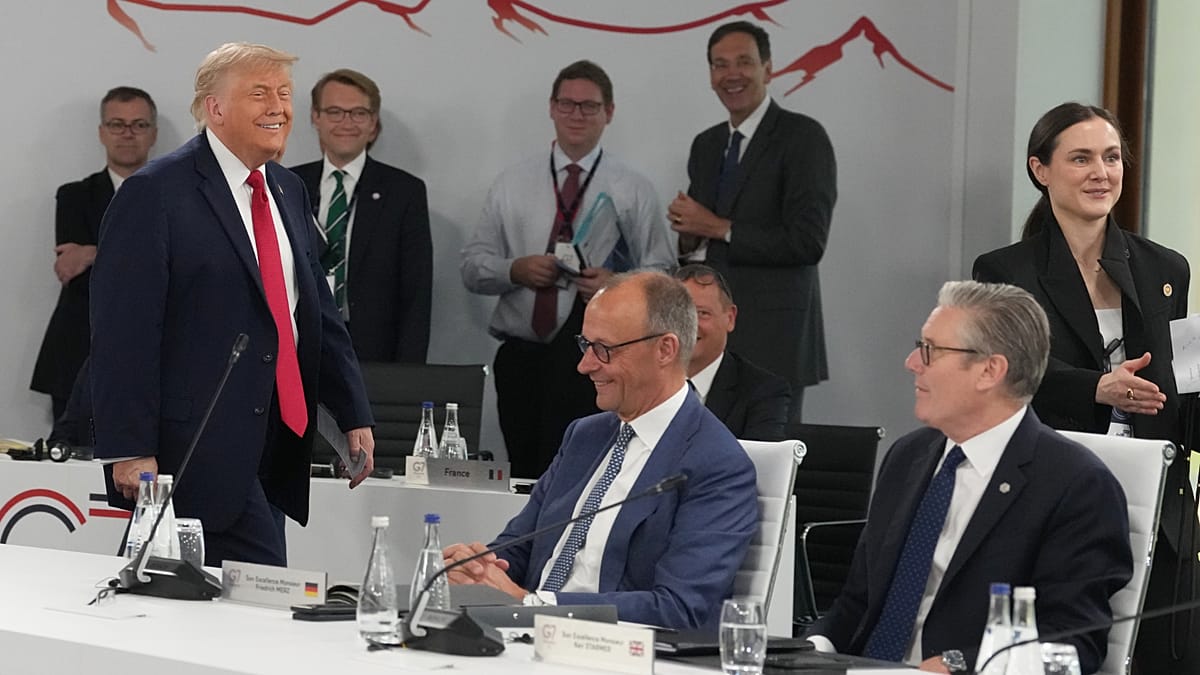
Donald Trump arrived at the G7 summit in Évian, France, on Wednesday with a characteristic quip, telling reporters he was “the boss” as he stepped out of his motorcade. The remark, delivered with a grin, set a deceptively casual tone for a gathering that is anything but routine.
The summit, hosted by France at the Hôtel Royal in Évian, brings together leaders from Canada, France, Germany, Italy, Japan, the United Kingdom, and the United States, alongside representatives from the European Union and other partner nations. For European capitals, the meeting is a critical moment to gauge the direction of transatlantic relations under a second Trump presidency.
Trade and Tariffs Dominate the Agenda
Behind the banter, the agenda is packed with contentious issues. Trade remains the most immediate flashpoint. Trump has recently threatened a 100% tariff on French wine in retaliation for France’s digital services tax, a move that could escalate into a broader trade war with the EU. The European Parliament has already approved a new EU-US trade deal, but the specter of renewed tariff threats hangs over the talks.
European leaders, including Italian Prime Minister Giorgia Meloni, have worked to repair relations with Trump after weeks of tension. Meloni and Trump patched up their rift during bilateral talks on the sidelines of the summit, according to sources familiar with the discussions. The détente is seen as crucial for maintaining unity on issues like Iran and AI regulation.
Iran, AI, and Security Concerns
The summit is also a platform for addressing global security challenges. Trump has claimed that a US-Iran nuclear deal is imminent, a statement that has drawn skepticism from European diplomats who remember the collapse of the 2015 Joint Comprehensive Plan of Action. The EU has been pushing for a renewed framework that includes stricter monitoring and addresses ballistic missile programs.
In a separate development, Trump urged Israeli Prime Minister Benjamin Netanyahu to curb strikes on Lebanon and suggested that Syria should handle Hezbollah, according to reports from the summit. This intervention reflects the administration’s desire to reshape Middle Eastern dynamics, with potential consequences for European security and migration flows.
Artificial intelligence regulation is another key topic. The G7 is expected to issue a joint statement on AI governance, with European nations advocating for a risk-based approach similar to the EU’s AI Act. Trump’s team has signaled a preference for lighter regulation, creating a potential rift.
European Perspectives
For the 27 EU member states, the G7 is a reminder of the bloc’s dependence on US security guarantees and market access. The UK, now outside the EU, is also navigating its own trade negotiations with Washington. Switzerland and Norway, as non-EU members, are watching closely, particularly on issues like drug pricing and health policy.
The EU Health Commissioner is assessing the impact of Trump’s drug pricing policies on European markets, a move that could affect pharmaceutical exports from countries like Germany and France. Meanwhile, former National Security Advisor John Bolton has criticized Trump’s approach to Iran, arguing that the administration prioritized oil prices over strategic coherence.
As the summit continues, the mood in Évian is one of cautious optimism mixed with underlying anxiety. Trump’s “boss” joke may have lightened the atmosphere, but the real work lies in navigating the complex web of interests that define the G7. For Europe, the outcome will shape not just trade and security, but the very architecture of the Western alliance.