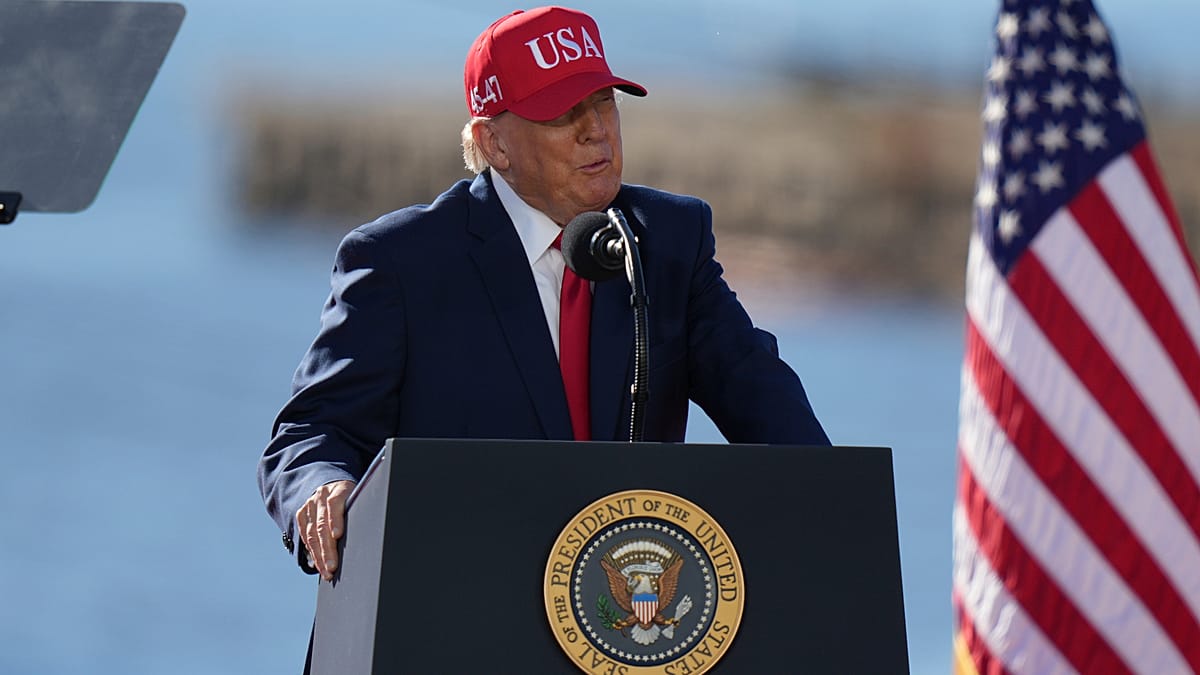
US President Donald Trump has again stirred transatlantic and regional tensions by mocking Mexican President Claudia Sheinbaum over his decision to rename the Gulf of Mexico as the 'Gulf of America'. Speaking at a Navy event in Baltimore on Tuesday, Trump recounted a phone call he claims took place with Sheinbaum, in which she pleaded with him to reconsider.
Trump, addressing the audience, imitated Sheinbaum's alleged reaction: "No, no, Mr President. Please, please, tell me that isn't the case." He described her as "a very nice woman, beautiful, with a lovely voice," but insisted the decision was already made. The remarks, delivered in a mocking tone, drew laughter from the crowd.
The renaming, which Trump signed into effect via executive order in January, has been met with firm opposition from Mexico. Sheinbaum has repeatedly stressed that the internationally recognised name remains the Gulf of Mexico, and has even suggested, with irony, that the United States could be renamed 'Mexican America' in response.
Data dispute
Trump defended the change by claiming that the United States accounts for 93% of the Gulf's coastline, compared with just 7% for Mexico. However, available data do not support that assertion. According to Mexico's National Commission for the Knowledge and Use of Biodiversity (Conabio), which uses geospatial data from the Flanders Marine Institute, Mexico holds 47.67% of the Gulf's maritime area, while the United States holds 44.75%. The US National Oceanic and Atmospheric Administration (NOAA) also provides figures that suggest a far more balanced split than Trump's claim.
The discrepancy has drawn criticism from experts and officials, who point out that the Gulf's coastline is shared by the US, Mexico, and Cuba, and that any unilateral renaming has no standing in international law. The International Hydrographic Organization, which standardises maritime names, has not recognised the change.
European observers have noted the broader implications of the dispute, as it touches on issues of sovereignty, international norms, and the use of geographic names as political tools. The European Union has traditionally supported multilateral approaches to such matters, and the renaming has been seen as a departure from established practice.
Meanwhile, the controversy has also sparked a lighter side: a rush on Slovenian internet domains after Trump's 'super intelligence' rebrand, and a similar move by Elon Musk to rename SpaceXAI to SpaceXSI. These developments, while seemingly unrelated, highlight the ripple effects of Trump's naming decisions.
Sheinbaum has not directly responded to Trump's latest mockery, but her office reiterated that the Gulf's name is a matter of international agreement, not unilateral decree. The Mexican government has also said it will continue to use the traditional name in all official communications.
As the dispute continues, it remains to be seen whether Trump's rhetoric will escalate or whether diplomatic channels will prevail. For now, the Gulf of Mexico remains the Gulf of Mexico to most of the world, including Europe.