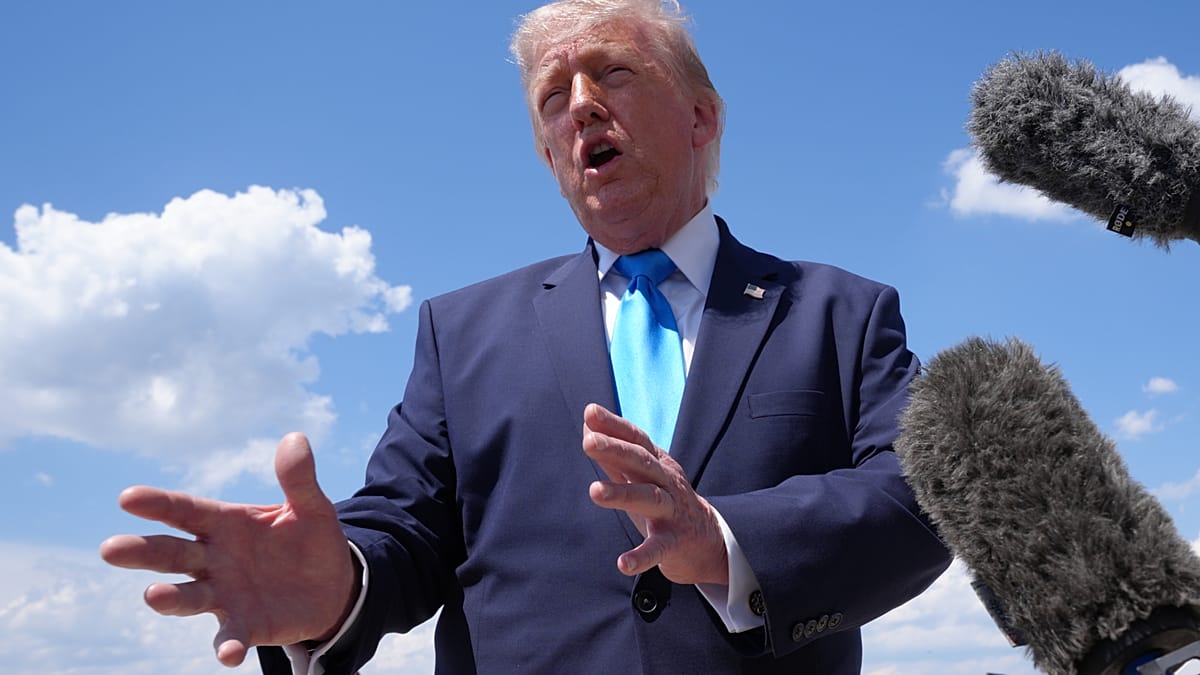
US President Donald Trump has announced he will speak directly with Taiwan's leader Lai Ching-te, as he evaluates a potential multi-billion-dollar arms deal for the island. The planned conversation marks a significant departure from diplomatic protocol: no US president has spoken with a Taiwanese leader since Washington switched recognition to the People's Republic of China in 1979 and severed formal ties with Taipei.
Speaking to reporters on Wednesday, Trump said: "I'll speak to him. I speak to everybody. We have that situation very well in hand." He added: "We'll work on that, the Taiwan problem." Taiwan's foreign ministry confirmed on Thursday that Lai would be happy to speak with Trump.
The announcement follows Trump's state visit to Beijing last week, where Chinese President Xi Jinping emphasised the centrality of the "Taiwan issue." China considers Taiwan, which has its own democratically elected government, a breakaway province that must eventually be reunified under Beijing's control. Xi has not ruled out using military force to achieve that goal.
A Delicate Balancing Act
After his meeting with Xi, Trump issued a public warning to Taiwan against formally declaring independence from China. He also appeared to question the rationale for US military intervention in the event of a Chinese invasion. "I'm not looking to have somebody go independent and, you know, we're supposed to travel 9,500 miles to fight a war. I'm not looking for that," he said in an interview. "I want them to cool down. I want China to cool down."
In response, Taiwan's foreign ministry thanked Trump for his support of regional peace but reiterated that the island is a "sovereign democratic country." The statement underscores the delicate position of Taipei, which relies on US security assurances while facing increasing pressure from Beijing.
The potential arms deal, reportedly worth billions of dollars, would include advanced weaponry such as F-16 fighter jets, missile systems, and naval equipment. Such a sale would likely provoke strong condemnation from China, which has repeatedly warned against foreign arms sales to Taiwan.
For European capitals, the Trump administration's approach to Taiwan carries significant implications. The EU maintains a one-China policy but has deepened economic and cultural ties with Taiwan. The bloc's member states, including France, Germany, and the Netherlands, have increased their diplomatic presence on the island in recent years, while carefully avoiding official recognition. Any escalation in the Taiwan Strait could disrupt global supply chains, particularly in semiconductors, where Taiwan's TSMC is a dominant player. European companies, especially in the automotive and electronics sectors, rely heavily on Taiwanese chips.
Trump's transactional style—mixing threats of withdrawal with offers of arms deals—creates uncertainty for European allies who have long supported a status quo that balances deterrence with dialogue. The situation also tests Europe's ability to maintain a unified stance on China, as some member states, notably Hungary, have pursued closer ties with Beijing.
The broader geopolitical context includes Trump's ongoing trade war with China, which has split US firms and opened opportunities for European competitors. Meanwhile, Russian President Vladimir Putin visited Beijing shortly after Trump, testing China's diplomatic tightrope between its partners.
As Trump prepares to speak with Lai, the world watches whether this direct contact will become a new norm or a one-off gambit. For Europe, the stakes are clear: stability in the Taiwan Strait is not just an Asian concern but a global one, with direct consequences for trade, technology, and security.