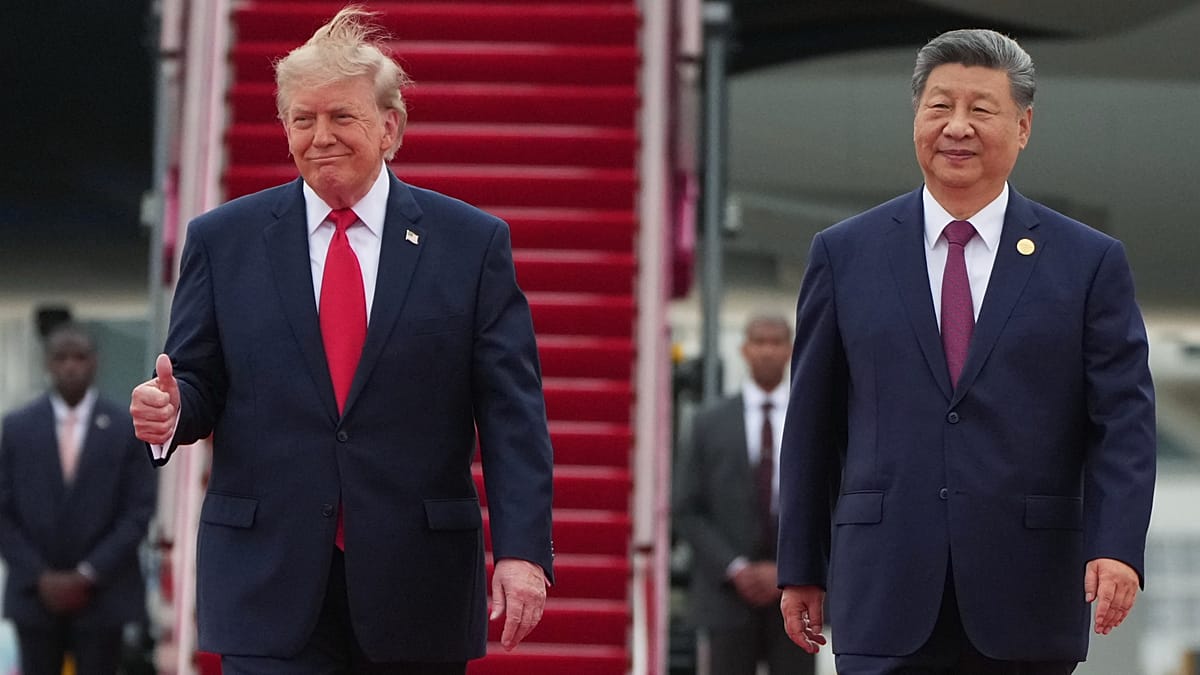
US President Donald Trump touched down in Shenzhen on Tuesday, where Chinese leader Xi Jinping greeted him with a warm embrace and a red-carpet welcome at the airport. The meeting sets the stage for an unprecedented trilateral summit involving Trump, Xi, and Russian President Vladimir Putin, with Ukraine and nuclear security high on the agenda.
The carefully choreographed arrival, broadcast live on Chinese state media, underscored the significance Beijing attaches to the talks. Shenzhen, a tech hub in southern China, was chosen as the venue, a symbolic nod to the country's economic ambitions and its role as a global player in technology and trade.
A summit with global implications
The trilateral meeting, the first of its kind, brings together the leaders of the world's three largest nuclear powers. European observers are watching closely, as the discussions are expected to touch on issues that directly affect the continent, including the war in Ukraine and arms control.
According to diplomatic sources, the leaders are expected to discuss a potential framework for nuclear security, building on existing treaties but adapting them to modern challenges. The presence of Putin, who has been largely isolated by Western leaders since the invasion of Ukraine, adds a layer of complexity to the proceedings.
European Union officials have expressed cautious optimism about the summit, but also concern that any agreement reached in Shenzhen might sideline European interests. The bloc has been a key player in supporting Ukraine, both financially and militarily, and any shift in US or Russian policy could have significant repercussions.
In a recent call with European allies, Trump reportedly challenged Europe's approach to Ukraine aid, suggesting that the continent should bear a greater share of the burden. This has raised questions about the unity of the Western alliance, even as the Shenzhen talks unfold.
Meanwhile, Berlin is hosting separate Ukraine security talks, indicating that Europe is not waiting for the outcome of the Shenzhen summit to push its own agenda. The German government has been a vocal advocate for a diplomatic solution to the conflict, and these talks are seen as a complement to the trilateral discussions.
The Shenzhen Declaration, expected to be issued at the end of the summit, is being closely scrutinized. Initial reports suggest it may fall short of the comprehensive peace plan that some had hoped for, focusing instead on confidence-building measures and a commitment to further dialogue.
Putin, for his part, has called the Shenzhen talks a new diplomatic chapter, signaling a potential thaw in relations between Russia and the West. However, European leaders remain skeptical, pointing to Russia's continued aggression in Ukraine and its unwillingness to compromise on key issues.
As the summit progresses, the world will be watching to see whether the personal rapport between Trump and Xi, evident in their warm greeting, can translate into concrete outcomes. For Europe, the stakes are high, as the continent's security architecture could be reshaped by decisions made in Shenzhen.
The trilateral summit is also being seen as a test of the global order, with China and Russia seeking to challenge US dominance. European policymakers are keen to ensure that the continent's voice is heard in these discussions, and that any new agreements take into account the interests of the EU and its member states.
With the summit set to conclude later this week, the focus now shifts to the negotiations themselves. Whether the leaders can bridge their differences on Ukraine, nuclear security, and other contentious issues remains to be seen, but the red-carpet welcome in Shenzhen has set a tone of cautious optimism.