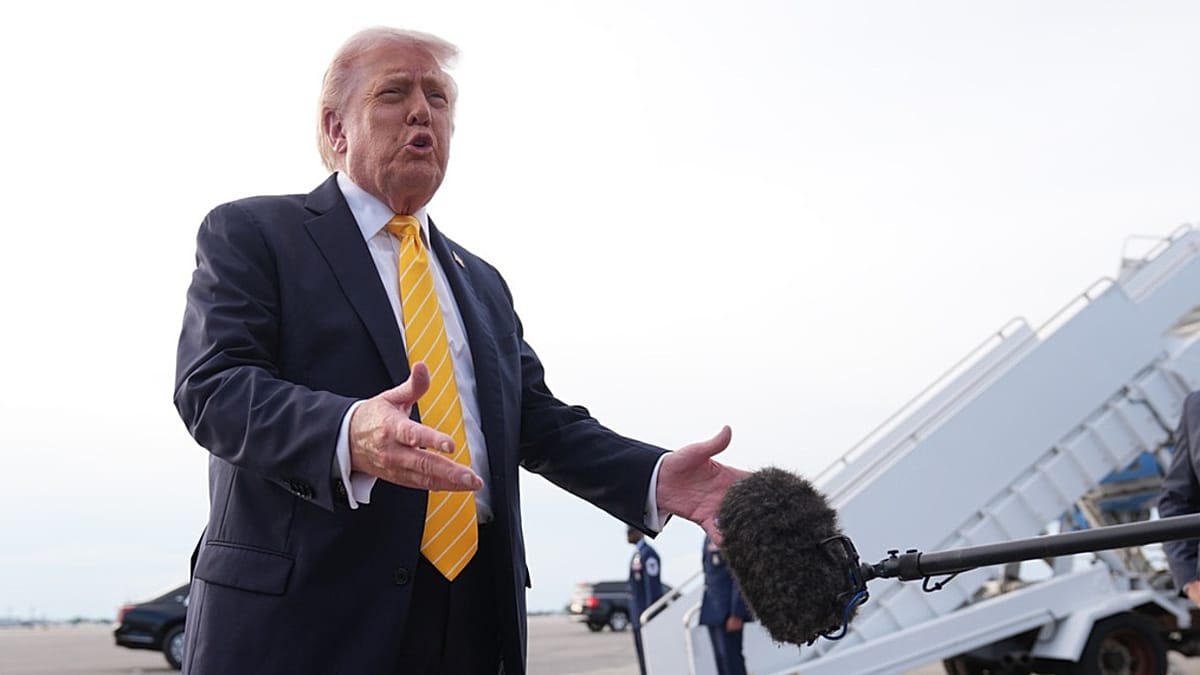
US President Donald Trump said on Saturday that he is examining a fresh proposal from Iran aimed at ending the ongoing conflict, though he voiced early doubts about its viability. Speaking before boarding Air Force One, Trump stated, “I’ll let you know about it later,” adding that officials would provide him with the exact wording of the plan.
In a subsequent post on his Truth Social platform, the Republican president reiterated his scepticism without disclosing specifics of the proposal or the obstacles that might prevent a deal. “I will soon be reviewing the plan that Iran has just sent to us, but can’t imagine that it would be acceptable in that they have not yet paid a big enough price for what they have done to Humanity, and the World, over the last 47 years,” he wrote.
Two semi-official Iranian news outlets, Tasnim and Fars—both believed to be close to the Islamic Revolutionary Guard Corps (IRGC)—reported that Tehran has submitted a 14-point proposal via Pakistan in response to a nine-point US proposal. Iran’s state-run media have not confirmed the development. Pakistan has previously hosted in-person negotiations between the two countries in Islamabad, though those talks broke down after Iranian delegations withdrew, citing logistical issues.
Trump rejected an earlier Iranian proposal this week, but conversations have continued, and the three-week fragile ceasefire appears to be holding for now. The conflict, which began on 28 February, has effectively closed the Strait of Hormuz—a chokepoint through which roughly one-fifth of the world’s oil and natural gas trade typically passes—to maritime traffic.
Strait of Hormuz and the Naval Blockade
The US president has floated a new plan to reopen the strategic waterway. In recent days, Iran suggested it would allow vessels to pass through the strait in exchange for a fee, a proposal that drew an angry response from Washington. The US has warned shipping companies that they could face sanctions for making such payments, whether in cash, digital assets, offsets, informal swaps, or other in-kind forms, including charitable donations or payments at Iranian embassies. Washington reiterated that it would not allow Tehran to “bully the global economy.”
Trump launched a naval blockade of all Iranian ports several weeks ago in response to Iran’s refusal to permit maritime traffic in the strait. The US Navy reported that it has forced nearly 50 vessels attempting to enter or leave Iran to turn back, effectively strangling the country’s economy. The US president has claimed the blockade is costing Iran $500 million (€426 million) a day, adding to the strain on an economy already battered by years of US and international sanctions over its nuclear programme and human rights record.
The standoff has significant implications for European energy markets, as the disruption in the Strait of Hormuz has contributed to volatility in global oil and gas prices. European capitals, particularly in Berlin, Paris, and Rome, have watched the crisis with concern, given the continent’s reliance on energy imports. The US has also threatened troop cuts in Spain and Italy over disputes related to the Iran war, further straining transatlantic ties. Meanwhile, the UK has seen a rise in heat pump adoption as geopolitical tensions drive gas price volatility.
As the ceasefire holds and diplomatic channels remain open, the coming days will be critical in determining whether the new proposal can bridge the gap between Washington and Tehran. For now, Trump’s public stance suggests that any deal will require significant concessions from Iran, which he believes has not yet paid a sufficient price for its actions over the past 47 years.