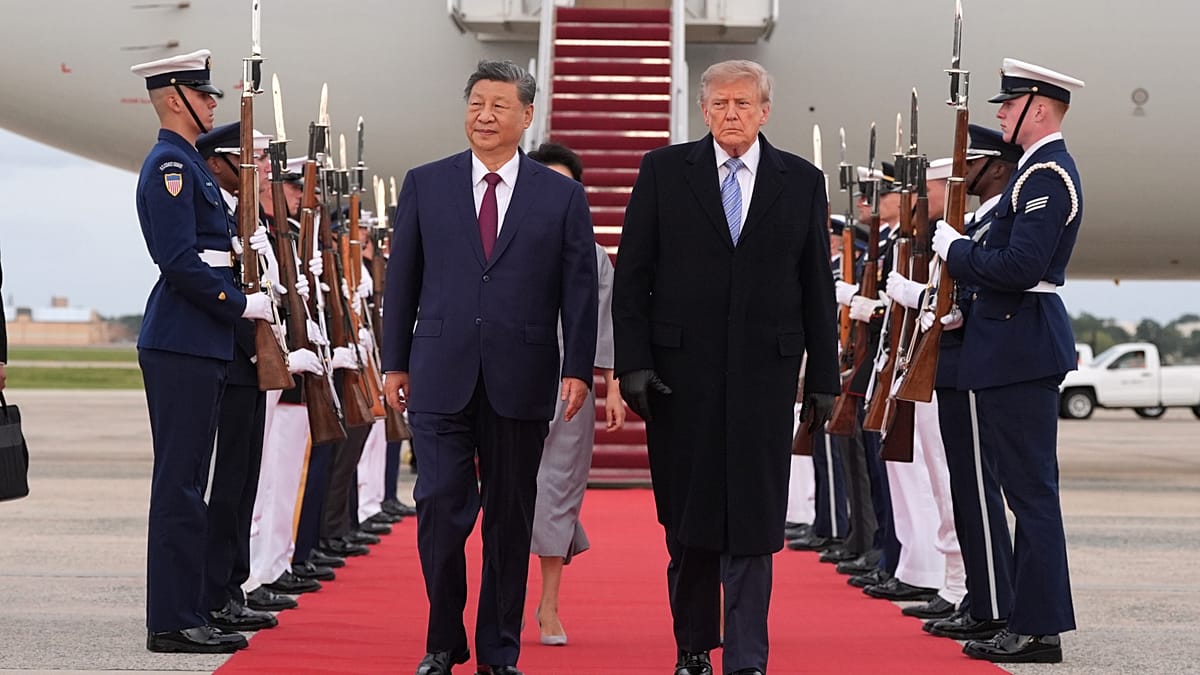
Washington pulled out all the stops on Wednesday as President Donald Trump welcomed his Chinese counterpart, Xi Jinping, for a three-day state visit. The Chinese leader and his wife, Peng Liyuan, touched down at Joint Base Andrews outside the US capital, where they were greeted personally by the Trumps on the tarmac — a gesture reserved for the closest of allies.
The visit comes at a delicate moment in US-China relations. Hours before the arrival, Treasury Secretary Scott Bessent confirmed that the two governments had agreed to extend the current trade truce until January. Speaking on Fox News, Bessent said the deal would involve scaling back tariffs and holding off on new trade restrictions, though he left the door open for a more comprehensive agreement. “I don’t know whether a bigger deal can be done. I don’t know whether we will just roll the current deal,” he said.
Bessent also pointed to upcoming international summits — one in China in November and another in Florida in December — as potential venues for further talks. For European observers, the timing is significant: any US-China rapprochement could reshape global trade dynamics, with ripple effects for EU exporters and manufacturers who have been caught between the two giants.
Partners, not rivals
In a statement released upon his arrival, Xi struck a conciliatory tone, saying that China and the United States “should be partners, not rivals.” He added that “achieving the great rejuvenation of the Chinese nation and making America great again can go hand in hand,” and that the two countries could “contribute to each other’s success, thereby benefiting the wider world.”
Chinese state media also quoted Xi as looking forward to “in-depth exchanges with President Trump on major issues concerning our bilateral relations and the global situation.”
Trade is not the only item on the agenda. Artificial intelligence, Trump’s confrontational stance toward Iran, and China’s position on Taiwan are all expected to feature in the Oval Office talks. Yet many analysts believe the visit is more about symbolism than substance — a chance for both leaders to project strength and stability ahead of their respective domestic political challenges.
The spectacle has not been without controversy. Senator Roger Wicker, the Republican chairman of the Senate Armed Services Committee, criticised the “lavish welcome,” arguing on the Senate floor that Trump should not have invited Xi “based on all of the troubling issues we have with President Xi and the Chinese Communist Party.”
Secretary of State Marco Rubio, however, defended the engagement, noting that the US and China are “the two largest economies in the world” and “probably the two most powerful militaries in the world,” making high-level dialogue essential.
For Europe, the stakes are considerable. A stable US-China relationship could ease pressure on global supply chains, but it could also lead to new trade arrangements that sideline European interests. As Europe watches the superpowers set the agenda, EU capitals will be hoping that any deal does not come at their expense.
The visit will culminate in a formal state banquet at the White House on Thursday, following a flyover and talks in the Oval Office. It is Xi’s first state visit to the United States in more than a decade, underscoring the significance both sides attach to resetting the relationship.
Yet the underlying tensions remain. Washington continues to press Beijing on technology transfers and intellectual property, while China seeks assurances on market access and the treatment of its firms. The trade truce buys time, but it does not resolve the structural competition that defines the world’s most important bilateral relationship.