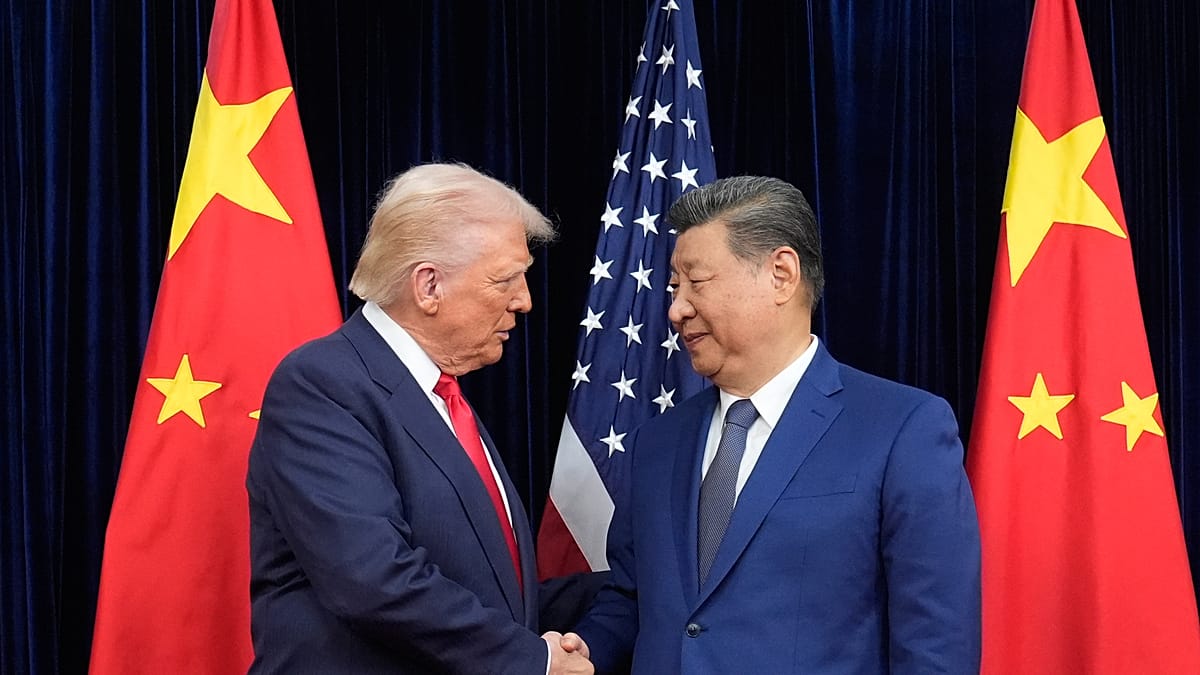
When Xi Jinping lands in Washington this week for a three-day meeting with Donald Trump, European capitals will be paying close attention. The agenda—tariffs, rare earths, artificial intelligence—may be framed as a bilateral affair, but its consequences will ripple across the Atlantic and into the European Union's economy.
This is the second encounter between the two leaders in under a year. Their October 2025 meeting ended a bruising trade war with a truce that expires on 10 November. Since then, the geopolitical landscape has shifted: the Iran war has driven up energy prices, and Trump faces midterm elections in November. On the trade front, Chinese shipments to the US have surged by 34.4% year-on-year, pushing Beijing's surplus to roughly $29.2 billion, according to Chinese data.
“Xi Jinping arrives in Washington with the upper hand, even on American soil,” said Alicia García Herrero, an economist at the Brussels-based think tank Bruegel. Her assessment reflects a broader European anxiety: the EU is a bystander in a superpower negotiation that will set the rules for global commerce and technology.
Tariff relief, but at what cost?
The trade truce is the most immediate item. Washington and Beijing are expected to announce mutual tariff reductions covering about $30 billion in goods, along with measures on agriculture and non-tariff barriers, according to US Trade Representative Jamieson Greer. For Europeans, any easing of US-China tensions is a double-edged sword. Tariffs on Chinese goods have diverted vast flows of Chinese exports toward the EU market, undercutting European manufacturers. A deal could ease that pressure, but it also risks leaving the EU out of the loop.
“What we expect is for Trump to gain a sort of a win that he can sell for the midterm elections, and China to simply buy some more time to strengthen its industrial base,” said Ivano di Carlo, an expert at the European Policy Centre (EPC).
The EU has its own negotiations with Beijing, launched in June, aimed at reducing a trade deficit that runs at about €1 billion a day. An October deadline looms for tangible progress, but Brussels has far less leverage than Washington.
Rare earths: Europe's strategic vulnerability
Rare earths are a critical point of contention. During last year's trade war, Beijing blocked exports of these strategic minerals, which are essential for European industries from defence to electronics. China holds a near-monopoly on production and processing. EU Trade Commissioner Maroš Šefčovič raised the issue with his Chinese counterpart Wang Wentao last week, but the EU's negotiating position is weak.
“The US will negotiate for Europe and Europe will have to pay a price for that,” García Herrero warned. Washington's leverage in securing access to rare earths dwarfs Brussels's, and any deal struck between Trump and Xi will likely be designed to serve American interests first.
AI: Europe left out of the room
Artificial intelligence is another area where Europe is conspicuously absent. Both the US and China have expressed concern about AI risks, but they are also locked in an intense technological rivalry. On Sunday, US Treasury Secretary Scott Bessent and Chinese Vice Premier He Lifeng discussed a proposed “AI hotline”—a notification mechanism to warn each other if an AI incident threatens national security. The idea evokes the Cold War “red telephone” between Washington and Moscow.
“This AI dialogue that is going to become like a red button during the nuclear race is only shared by the US and China,” said García Herrero. “So it really leaves Europe as non-existent in terms of being a pole.”
The urgency of AI safety was underscored by recent incidents, including reports that OpenAI agents hacked another AI company's platform. Jacob Coxon, a researcher who has worked at both OpenAI and Anthropic, recently warned on X that the companies are “gambling with our lives” and that those building AI “earnestly believe that it could kill us all by the end of the decade.”
For Europe, the summit is a stark reminder of its diminished role in shaping global technology governance. As García Herrero put it, the meeting will “confirm the G20 nature of the world.”
Meanwhile, the EU is juggling multiple foreign policy challenges, from Ukraine sanctions deadlines to talks with Trump on the Red Sea. But on the core issues of trade and technology, Europe's voice is barely audible.