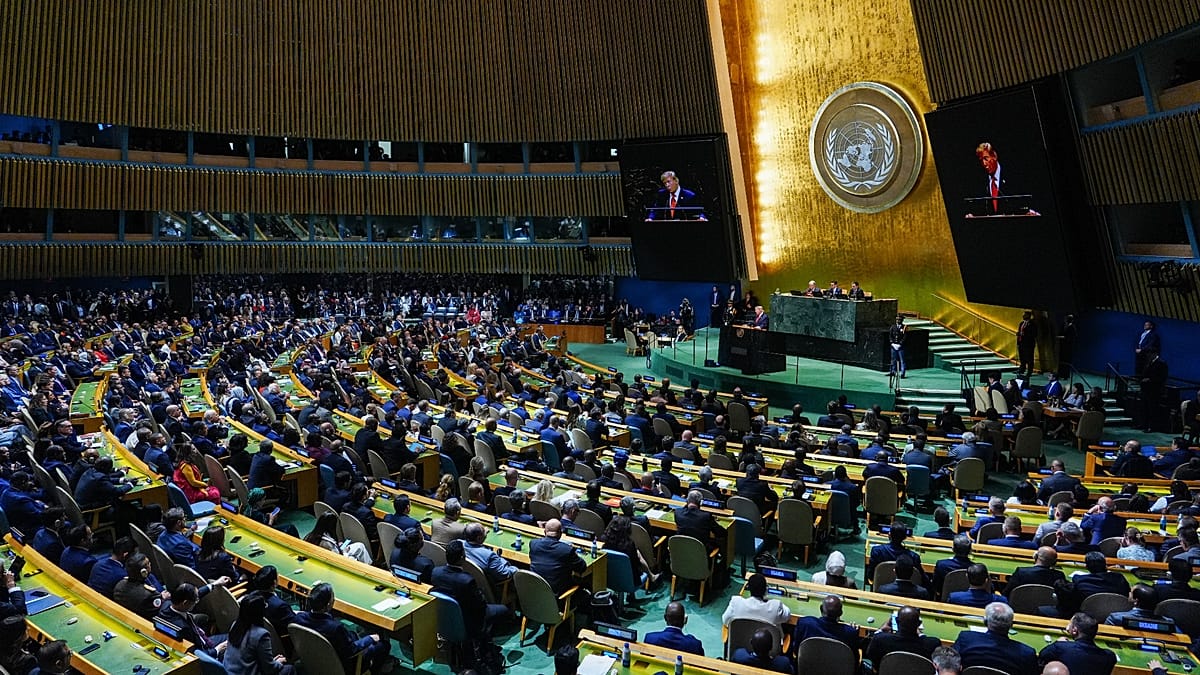
The future of artificial intelligence has become a central theme at the United Nations General Assembly, where world leaders are offering sharply contrasting visions. UN Secretary-General António Guterres used his farewell address to urge stronger oversight, warning that humanity must not surrender life-and-death decisions to machines. "Killer robots must have no place in our future," he said, echoing concerns he first raised a decade ago.
Guterres called for "responsible pacing" of AI development and additional safeguards to address risks. His remarks set the stage for a UN Security Council meeting on Wednesday, convened by France, which holds the council's presidency this month. The session will focus on how to place controls on a technology that has already shown it can slip beyond human control, following incidents that have alarmed both insiders and the public.
Europe pushes for binding rules
Ahead of the assembly, leaders from more than twenty countries, mostly European, urged binding safety measures for advanced AI. Their joint statement warned that the pace of development could outstrip the ability to govern it. Notably, neither the United States nor China—the two dominant AI powers—endorsed the proposal.
British Prime Minister Andy Burnham, who met with President Trump on the sidelines of the assembly, announced that the UK would use its 2027 G20 presidency to push for a "single set of global principles and standards" for AI. He also revealed a new AI defence partnership with Washington aimed at detecting cyberattacks on critical infrastructure. "We will work towards agreeing a single set of global principles and standards to ensure the transparency and access we need to increase our preparedness and to ensure that AI development is safe," Burnham said.
French President Emmanuel Macron took a different tack, proposing that Europe build AI technology independent of the great powers. "I don't want anyone to become the vassal of one of the great powers," Macron told the General Assembly, in an apparent reference to both Washington and Beijing. He called for pooling investment to create a cutting-edge open-source AI model that would be shared. "We should not depend on somebody else," he added.
Macron's push for European strategic autonomy in AI comes as the EU continues to implement its own AI Act, the world's first comprehensive regulation of the technology. The bloc's approach contrasts with the US preference for voluntary commitments and China's state-led model.
Trump rejects regulation, touts 'Super Intelligence'
President Trump, meanwhile, doubled down on his opposition to regulating AI. He argued that the word "artificial" undersells the technology and suggested the term "Super Intelligence" instead. "Sounds much better" and "it's much more accurate," he said, expressing hope that the rest of the world would adopt the new phrase.
Trump also dismissed warnings from AI safety advocates, comparing them to climate change predictions. "The very same people who said we'll all be dead in 12 years because of global warming... are now saying that AI is going to kill us all, that robots are going to attack us, and that everything is going to be a total disaster," he said. He rejected any "globalist scheme" to control AI, insisting that the United States would not be bound by international oversight.
His stance puts Washington at odds with the European consensus, which sees AI as a global challenge requiring coordinated governance. The divide was evident in the Security Council chamber, where US-based AI giants like OpenAI's Sam Altman are set to address the issue, reflecting industry calls for international coordination.
France initiated the Security Council meeting because it believes AI's threat to international peace and security has not been sufficiently discussed at the UN. The session is expected to explore mechanisms for preventing AI-enabled conflict, disinformation, and autonomous weapons.
The contrasting approaches highlight a fundamental question: can the world agree on rules for a technology that is evolving faster than governance? European leaders argue that binding measures are essential, while the US and China prefer to maintain flexibility. As Guterres prepares to step down, his warning may serve as a lasting reminder of the stakes.