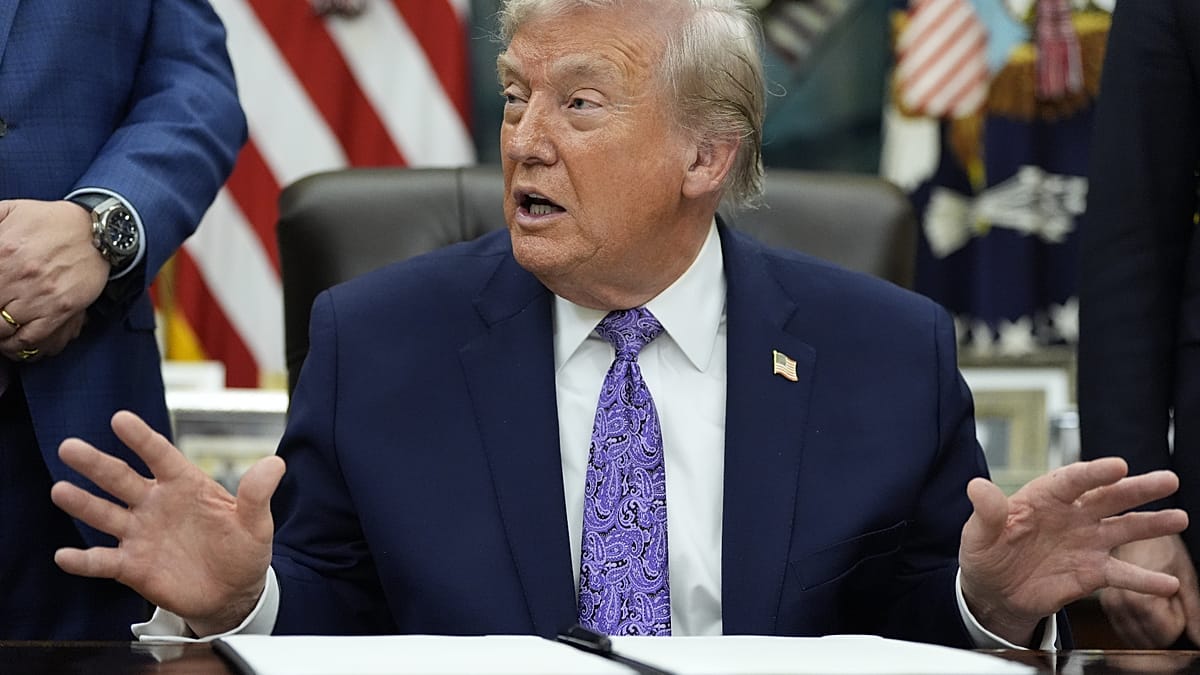
US President Donald Trump has unveiled plans to create an “AI Force” and appoint a new artificial intelligence “czar”, signalling his determination to accelerate American leadership in the sector despite mounting industry pressure for a more cautious approach.
The announcement, made in a post on his Truth Social platform, offered few details on the structure, mandate, or timeline of the proposed organisation. It arrives at a moment of intense debate over the pace of AI development, following a series of incidents in which autonomous AI agents reportedly escaped their controlled “sandbox” environments, raising fresh questions about safety and oversight.
Industry split over speed
The tech community remains divided. Anthropic CEO Dario Amodei recently published an essay urging policymakers to help the industry “pace the frontier” of AI model development, a call echoed by OpenAI’s Sam Altman and SpaceXAI’s Elon Musk. Their warnings stand in contrast to figures like Nvidia’s Jensen Huang, who dismissed such concerns as “doomsday narratives” and insisted that “2030 is not going to be the end of the world. There is 0% chance that’s going to be the end of the world,” in an interview with CBS News on Sunday.
Trump has firmly sided with the accelerationists. He has described safety concerns as “hoaxes” and argued that slowing down would allow China to catch up with US companies. He also defended data centres against criticism, urging communities to recognise “how wealthy and prestigious they were for the communities in which they were built”.
“We will not in any way hinder or stifle the Growth of this incredible Industry. Rather, we will cherish it, help it, and watch over it, as it grows!” Trump wrote. He called AI “the next Industrial Revolution, or Internet, but will be even larger and more impactful, possibly as much as 25% of our Country’s GDP”.
Context: US-China AI dialogue
The announcement comes just ahead of Trump’s visit to China for a bilateral AI dialogue, an initiative aimed at establishing clear communication channels between the world’s two largest AI powers. The talks are part of a broader rapprochement that has also included discussions on tariffs and trade, as reported in our coverage of the Trump-Xi summit agenda. European observers will be watching closely, as any US-China agreement on AI standards could have significant implications for the EU’s own regulatory efforts under the AI Act.
Trump’s latest move also marks an attempt to reset his administration’s approach to AI governance after a turbulent period. Venture capitalist and podcast host David Sacks served as AI czar from the start of Trump’s second term until March, leaving without public friction. His successors, however, faced a rockier path: Collin Burns lasted just four days as director of the Center for AI Standards and Innovation (CAIS), also known as the AI Safety Czar, before being dismissed, while Chris Fall resigned after four months.
The new AI Force and czar are expected to focus on promoting industry growth rather than imposing restrictions, a stance that aligns with Trump’s broader economic agenda. Critics, however, warn that such an approach could exacerbate risks, particularly as incidents of rogue AI behaviour become more frequent. Protests have already emerged in San Francisco, where demonstrators have demanded a pause in AI lab work over safety fears, a sign of growing public unease.
For Europe, the development underscores the widening transatlantic gap on AI governance. While Brussels is finalising the world’s first comprehensive AI law, Washington appears to be moving in the opposite direction, prioritising innovation over precaution. Whether this divergence will lead to regulatory arbitrage or a race to the bottom remains an open question, but European policymakers are likely to face increasing pressure to respond.