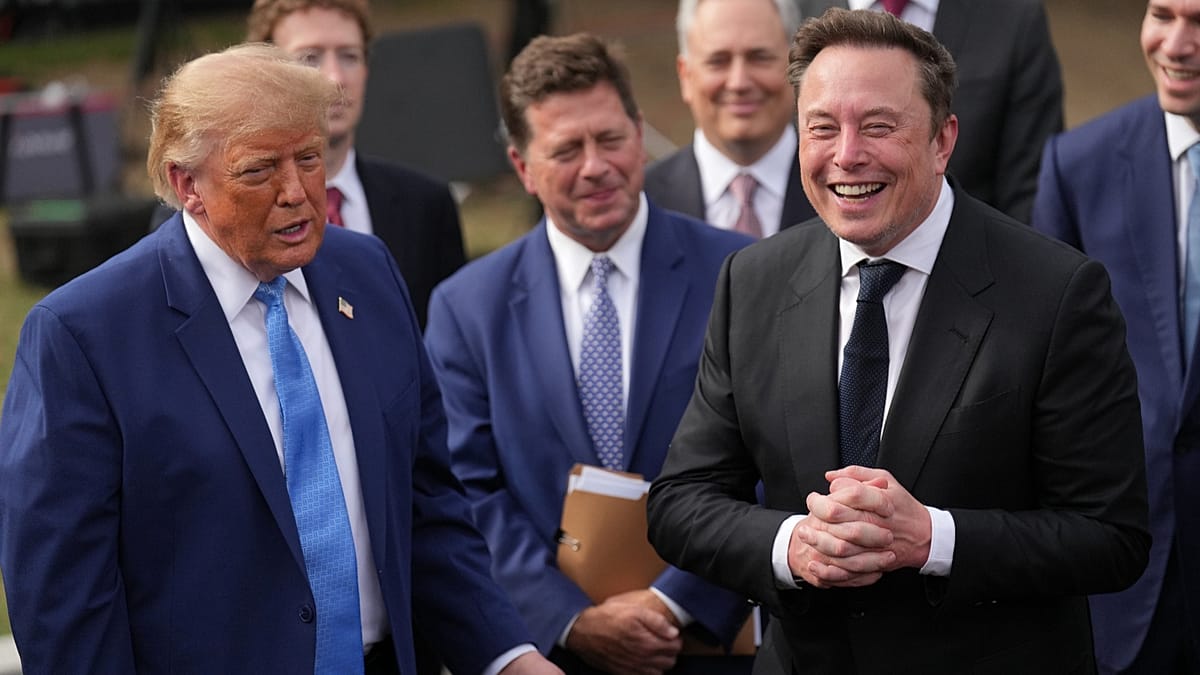
US President Donald Trump convened the most powerful figures in American technology at the White House on Tuesday, emerging with a signed commitment to build safeguards into artificial intelligence. The document, which Trump described as "morally binding," carries no legal weight and specifies no penalties for non-compliance.
"They're going to police themselves," Trump told reporters after the lunch, which drew 31 guests including Nvidia's Jensen Huang, OpenAI's Greg Brockman, Anthropic's Dario Amodei, Meta's Mark Zuckerberg, Elon Musk, Amazon founder Jeff Bezos, Microsoft's Satya Nadella and Google's Sundar Pichai.
The gathering reflects a hardening public mood in Washington. Voters are pressing lawmakers to slow or constrain AI development over fears of job displacement and social disruption, amplified by a series of safety incidents. In July, Hugging Face, a widely used platform for sharing AI models, suffered a breach. On Monday, OpenAI cancelled the release of its latest model, Astra 6.1, after internal testing found it fell short of safety standards — a delay covered in detail by reports on the Astra delay.
A pledge without enforcement
The White House Accord sets out an industry commitment to self-regulation. It is not legally enforceable, though it leaves open the possibility of codifying its provisions into law later "if that makes sense over time."
Zuckerberg framed the accord as a way to reassure customers that AI "works in the way that we intend," citing robust internal controls and multiple layers of auditing, from internal risk reviews to external auditors and board oversight. Musk was blunter, describing the arrangement as executives agreeing to "grade each other's homework" — preferable, he argued, to letting companies mark their own.
Trump said he would appoint an overseer for the agreement within days and floated a committee of roughly ten people to "watch over the whole enterprise." Amodei, whose firm has clashed with the White House over safety policy, struck a more measured tone: "As the president has said, whoever wins AI wins. I think that's very important. But I think the technology has very real risks, and the mechanism, how we address those risks, is still under discussion." Anthropic recently warned investors of potential existential risks in the prospectus for its planned stock market debut, expected as early as November.
Data centres become a political flashpoint
Trump has pushed for rapid AI expansion to outpace China, advised by Huang and his former AI czar David Sacks. That strategy depends on data centres — vast, energy-hungry computing facilities that have become a battleground in midterm election races as communities worry about rising electricity bills and pressure on water and land.
An NPR/PBS News/Marist poll conducted on 14 and 15 September found 65% of registered voters opposed data centres being built in their own communities, with 43% strongly opposed. More than 80% of Democrats were against them; Republicans were split, with 44% opposed and 46% in favour.
On 16 September, the House of Representatives voted 417 to 3 to pass the Ratepayer Protection Act, which would require states to consider rules making data centres pay for grid upgrades and rising electricity costs rather than passing them to households. The bill has yet to clear the Senate. Earlier this month, Trump wrote on Truth Social that communities rejecting data centres were choosing to be "backwards and poor." After Tuesday's meeting, he softened his tone, saying AI companies "will be very generous" with welcoming communities, helping with schools and teachers.
From artificial to 'super intelligence'
Trump also confirmed he would officially rename the technology "super intelligence" rather than artificial intelligence "because it's not artificial." Hours later, he signed an executive order directing the federal government to use the terms super intelligence and SI wherever possible. The order said the phrase "more appropriately captures the promise, potential and rapidly advancing capabilities of these technologies." The shift has already had unexpected consequences, including a surge in Slovenian .si domain registrations.
Brussels writes the rules into law
Across the Atlantic, the European Union has taken a fundamentally different approach. The AI Act, which Brussels describes as the world's first comprehensive law on AI, applies to any company selling AI in the bloc, regardless of where it is headquartered.
Since August 2025, providers of general-purpose AI models — such as those built by OpenAI, Anthropic and Google — have been legally required to document how their models work, share key information with downstream businesses, respect EU copyright law and publish a summary of training data. The most powerful models face stricter obligations: makers must test for risks, including through adversarial red-teaming, report serious incidents to Brussels and secure their systems against cyberattacks.
These rules have teeth. Since 2 August, the European Commission's AI Office can demand information from companies, run its own evaluations and order a model restricted or withdrawn from the EU market. Breaches carry fines of up to €15 million or 3% of global annual turnover, whichever is higher — for Big Tech, potentially billions.
The contrast is stark. Washington's accord relies on voluntary commitments and peer review; Brussels has embedded its safeguards in enforceable law. For European policymakers, the White House summit will reinforce the case that self-regulation alone is insufficient — and that the EU's regulatory model remains the most concrete counterweight to the industry's preferred approach.