The White House has reportedly turned down a proposal from Tehran that would have reopened the Strait of Hormuz within a week, a waterway critical to global oil shipments and a focal point of US-Iranian tensions since late February. According to The Wall Street Journal, citing US officials, President Donald Trump dismissed the plan for a seven-day ceasefire and the reopening of the strait, telling aides he expects to resume a bombing campaign against Iran after the US midterm elections in November.
Trump later posted on his Truth Social platform an image of the strait renamed the “Trump Strait,” a move that analysts read as a signal of his continued hard line. The rejection comes despite a public offer from Iran’s foreign minister, Abbas Araghchi, who said on Friday that “if the necessary conditions are met, the strait can be reopened, and normal maritime traffic can resume within seven days.” He added that “the choice now rests with the United States.”
Tehran’s seven-day roadmap
According to the Associated Press, the Iranian proposal is built on a series of reciprocal steps: Washington would lift its naval blockade of Iranian ports, cancel sanctions on Iranian oil sales, and observe a ceasefire that also covers Lebanon. In return, Tehran would reopen the Strait of Hormuz within seven days and resume negotiations on its nuclear programme. Araghchi outlined the timeline: the initial measures would take four to five days, the strait would reopen on the sixth day, and “on the seventh day, negotiations with the US will begin to reach a final agreement on issues agreed upon by both sides.”
The plan closely mirrors the memorandum of understanding signed in June between the two countries, but with a far more compressed schedule. The June MoU had allowed 60 days for a final deal. Araghchi also suggested it would be “better” if an agreement were reached before the US midterm elections, a remark that underscores the political stakes in Washington.
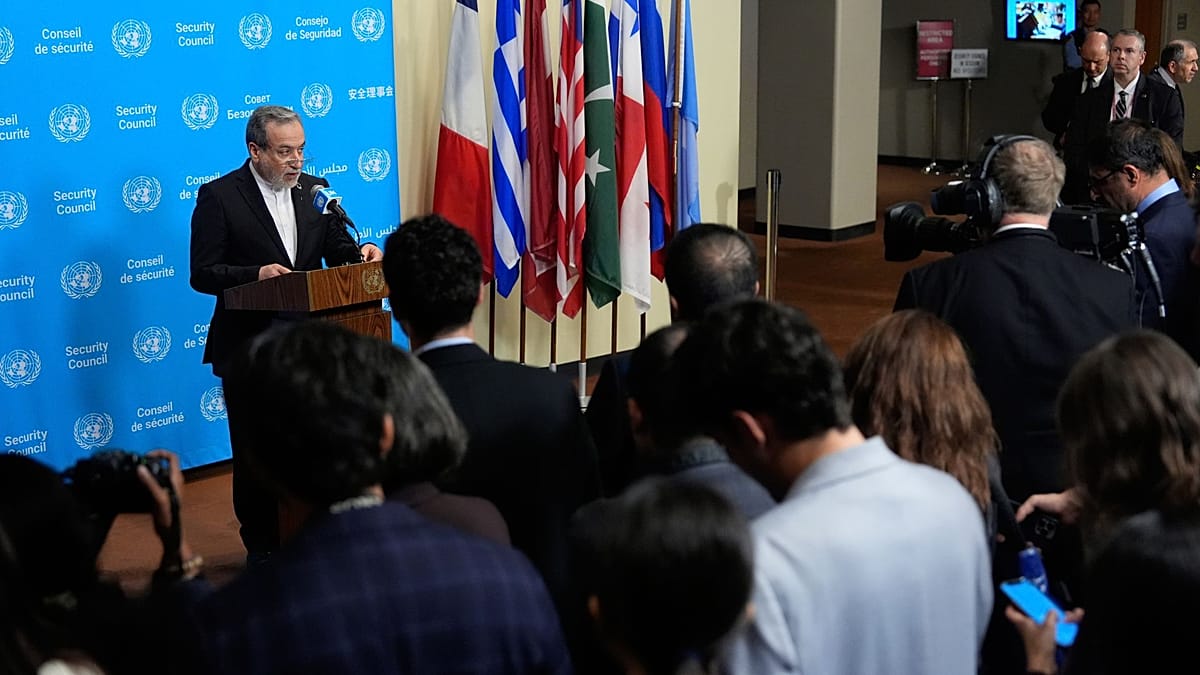
Iranian President Masoud Pezeshkian, speaking to CBS on Friday evening, reiterated that if the US accepted the seven-day proposal, Tehran would honour all its commitments. His comments came after his address to the UN General Assembly in New York, where he said Iran was not afraid of continuing the war but remained ready for diplomacy.
European stakes in the Gulf standoff
The standoff has direct consequences for Europe, which relies heavily on Gulf oil and gas transiting the Strait of Hormuz. Any prolonged closure would send energy prices soaring across the continent, compounding the economic strain from the war in Ukraine. European capitals, particularly Paris and Berlin, have been watching the US-Iranian talks with unease, mindful that a renewed US bombing campaign could trigger a wider regional conflict and a fresh wave of refugees towards Europe.
Diplomatic efforts have continued, with Qatari Prime Minister and Foreign Minister Mohammed bin Abdulrahman Al Thani meeting Pezeshkian in Tehran on Friday. Qatar has acted as a mediator between Washington and Tehran, and its involvement reflects the broader international interest in de-escalation. However, the Trump administration’s reported rejection suggests that the window for a negotiated settlement may be closing.
An American official familiar with the talks said the US government was conducting “positive and constructive” discussions through mediators but would not rush to an agreement. Another US official confirmed to Reuters that talks on “nuclear issues” were ongoing. Yet the president’s apparent preference for military action after the midterms casts doubt on the sincerity of those diplomatic channels.
Internal Iranian divisions
Within Iran, the diplomatic push has exposed fissures. Hardliners have criticised Pezeshkian and Araghchi for engaging with the US, which they label the “aggressor enemy.” Ebrahim Rezaei, a member of the Iranian Parliament’s National Security and Foreign Policy Commission, wrote on X that “the Ministry of Foreign Affairs is an executor, not a policymaker.” He demanded that Araghchi explain under what authorisation his meetings with US representatives took place, adding that “illegal meetings under the pretext of conditions yield nothing but a sign of weakness.”
Pezeshkian has defended the approach, explaining that foreign policy decisions are made by a six-member team representing various institutions, including the security forces, parliament, and government bodies. But the public rebuke from a parliamentary figure highlights the fragility of the reformist president’s position.
Ali Vaez, Iran project director at the International Crisis Group, described the Iranian proposal as “a clever move.” He noted that it offers Trump a way out of an unpopular war and a chance to lower energy prices before the midterms, while also reviving an agreement that largely benefits Tehran. “The condensed timeline to reach the nuclear issue should also be attractive to a president who is in a hurry,” Vaez said.
For Europe, the coming weeks will be critical. The EU has repeatedly called for restraint and a return to diplomacy, but its leverage over Washington is limited. As the US and Iran remain at odds, the risk of a new conflict in the Gulf—and its knock-on effects on European energy security and migration—looms larger than ever.