US President Donald Trump has waded into the growing controversy over data centre development, suggesting that companies should pay a financial 'dividend' to the communities that host their facilities. In a post on his Truth Social platform on Wednesday, Trump said he had been 'watching data centers very closely' and had reached a 'very strong conclusion': that unpopular projects become 'extremely popular' once a deal is struck to address local concerns.
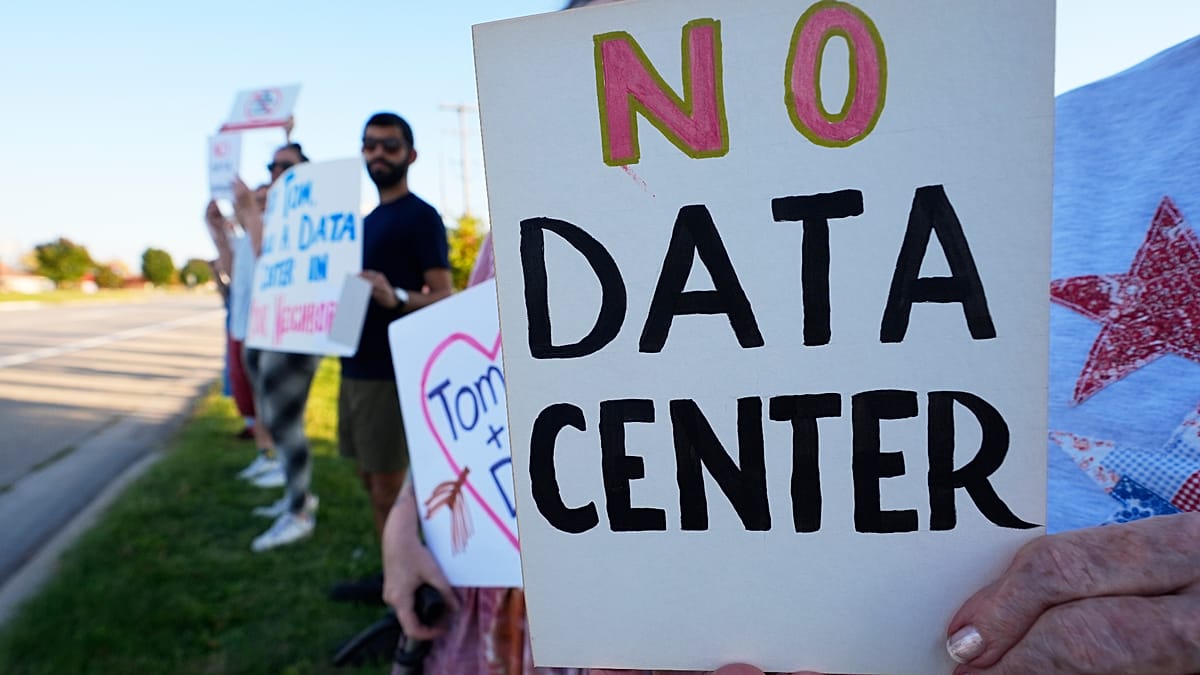
The remarks come as a wave of opposition sweeps across the United States and Europe over the massive water and energy demands of AI infrastructure. From rural Texas to the outskirts of Dublin, residents and local officials are pushing back against projects that they say strain electricity grids, drive up prices, and threaten water supplies.
A carrot-and-stick approach
Trump's proposal is twofold. On the one hand, he wants developers to negotiate 'Community Benefits Agreements' (CBAs) that would channel direct payments to local residents. On the other, he said he has personally mandated that data centres 'make their own electricity and give or sell any excess back to the local community, or grid' to offset energy price increases. If they do so, he argued, there 'could be a substantial decrease' in costs.
The idea is gaining traction in the US, where at least 47 large-scale projects have been delayed in 2026 alone, and more than 1,000 local communities have formally proposed moratoria, zoning caps, or strict environmental limits on new AI infrastructure, according to financial site Investing Live. Yet the pace of development shows no sign of slowing: Investing Live analysts project US AI infrastructure spending will exceed $10 trillion (€8.9tn) between 2025 and 2032, roughly 3.6% of GDP per year.
Some projects have moved forward after CBAs were signed, but public opinion has not always shifted. In Texas, Meta struck a deal with Governor Greg Abbott over a controversial data centre campus in El Paso, originally a $1.5 billion (€1.3bn) investment that ballooned to $14 billion (€12.5bn). The project sparked widespread backlash, and in June the local council voted 5-3 against cancelling it. Abbott's agreement includes requirements for Meta to pay for its own electrical infrastructure, reuse its own water, and 'eliminate reliance on outdated taxpayer-funded incentives'. Critics, including Democratic gubernatorial nominee Gina Hinojosa, argue the deal lacks binding conditions on the tech giant. Meta has not commented on the specifics.
In Pennsylvania, the Lancaster City Council signed the first fully executed CBA for a US data centre project in September, covering a $6-10 billion (€5.3-€8.9bn) cloud computing and AI complex. The agreement includes a $10 million (€8.9mn) economic development fund, another $10 million for sustainable development and clean energy, a $250,000 (€222,500) planning fund, and $10 million in credit to protect the city if the developer defaults on its environmental and financial promises.
More controversially, developer Digital Realty won initial approval for a 280-acre campus in De Soto, Kansas, in October by bypassing local rules and paying citizens directly. The company is offering residents $1,000 (€890) in utility and property tax credits for ten years, as part of a $20 million (€17.8mn) investment package that it says will bring recurring tax revenue and jobs.
European echoes
The 'cash for communities' model is also making inroads in Europe, where data centre growth has become a flashpoint. In Ireland, home to one of the continent's largest data centre clusters, OpenAI said in October that future facilities could come with direct payments to local communities to address concerns over their environmental impact. The country already imposes strict requirements, including a mandate that data centres supply electricity to the grid.
The debate over data centres is part of a broader transatlantic tension over technology and energy policy. As the EU pushes for digital sovereignty and AI leadership, it must balance those ambitions with the realities of limited water and power resources. The approach Trump is now championing—turning opposition into a financial transaction—may offer a pragmatic path, but it raises questions about whether communities are being fairly compensated or merely bought off.
For now, the pressure is on both sides of the Atlantic. In Europe, where public consultation and environmental scrutiny are often more rigorous, the 'dividend' model could face a tougher test. But with AI investment surging, and local resistance growing, the idea of paying communities for their patience is likely to become a standard feature of data centre development.