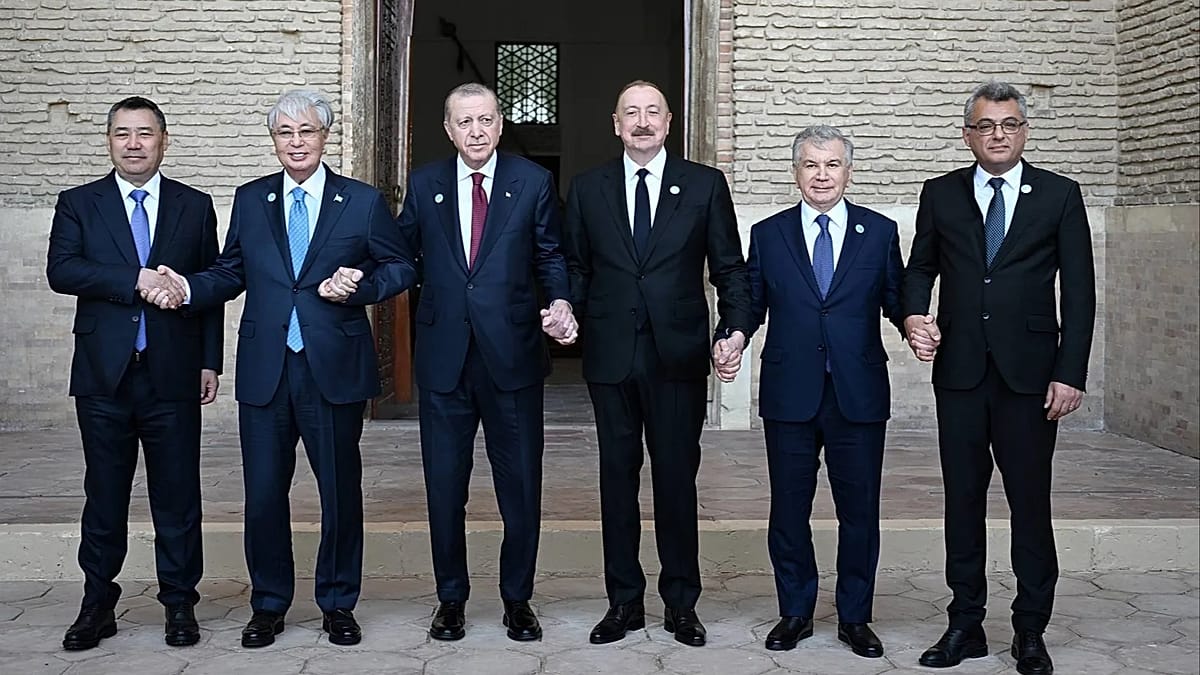
Leaders of the Organisation of Turkic States (OTS) gathered in the historic Kazakh city of Turkistan on 15 May 2026 to accelerate their alliance’s digital and economic integration, positioning the bloc as a significant player in global technology and trade. The summit, hosted by Kazakhstan’s President Kassym-Jomart Tokayev, brought together his counterparts from Turkey, Azerbaijan, Uzbekistan, and Kyrgyzstan, alongside OTS Secretary General Ambassador Kubanychbek Omuraliev.
The meeting, themed “Artificial Intelligence and Digital Development,” underscored the OTS’s ambition to leverage its combined economic heft—estimated at $2.4 trillion in 2025, according to Uzbekistan’s President Shavkat Mirziyoyev—to drive regional connectivity and technological innovation. The leaders announced a series of initiatives, including the establishment of joint AI centres, a cybersecurity cooperation framework, and a new Artificial Intelligence University for Turkic students.
Digital Silk Road and Regional Connectivity
A key focus was the development of alternative global supply routes, particularly the Middle Corridor, which aims to link Europe and Asia via the Caucasus and Central Asia. Azerbaijan’s President Ilham Aliyev confirmed that the Digital Silk Road project between Europe and Asia is underway, with the Trans-Caspian fiber-optic cable line between Azerbaijan and Kazakhstan expected to become operational in the coming months. This infrastructure is designed to mitigate disruptions to global energy routes and enhance data exchange across the region.
Tokayev stressed the importance of digital transformation, warning that Turkic states must “avoid remaining on the sidelines of progress.” He announced the “E-Permit” project to simplify cargo transportation among member states, a move that could strengthen trade flows along the historic Silk Road. The OTS foreign ministers also met separately to refine plans for transport corridors, with the Middle Corridor at the centre of regional focus.
AI and Education Initiatives
Mirziyoyev unveiled the “Five Million AI Leaders” programme, aimed at preparing youth for future jobs in digital fields. He also proposed a joint venture fund with Kazakhstan to support start-up projects, part of broader education initiatives. The creation of a “Digital Turkic Corridor” for regional data exchange was another highlight, designed to foster a unified digital space across the Turkic nations.
Turkey, Kazakhstan, and Azerbaijan are jointly developing a CubeSat scientific satellite, scheduled for launch next year, signalling a push into space technology. These efforts align with the OTS’s broader strategy to become a hub for AI and digital innovation, as noted by Secretary General Omuraliev, who told Euronews that “with each sector now connected to AI and digital development, nobody can go it alone.” He confirmed cooperation in at least 58 areas of digital and AI.
Non-Military Stance
Tokayev was emphatic in countering speculation that the OTS might evolve into a military or geopolitical alliance. “The Organisation of Turkic States is not a geopolitical project, not a military organisation. This is a unique platform for strengthening trade, economic, high-tech, digital, cultural and humanitarian cooperation between fraternal countries,” he said. This stance reflects Kazakhstan’s diplomatic preference for an open, non-exclusive format that complements broader Eurasian mechanisms.
The leaders reinforced their unity by posing in front of the mausoleum of Khoja Ahmed Yasawi, a 14th-century spiritual landmark in Turkistan. The site symbolises the Turkic heritage of trade and cultural cooperation along the Silk Road, a legacy the OTS seeks to revive in a modern, digital context.
As the world grapples with rapid technological change and geopolitical shifts, the OTS is positioning itself as a cohesive bloc capable of addressing “critical issues” through cooperation rather than competition. For Europe, the development of the Middle Corridor and digital links could offer alternative trade routes, reducing dependence on traditional chokepoints. The OTS’s push for AI and digital integration also mirrors broader trends, such as the surge in European AI investments, though the Turkic states aim to carve out their own niche.
With a combined population of over 170 million and growing economic clout, the OTS is emerging as a force to watch. Whether it can translate its digital ambitions into tangible influence remains to be seen, but the summit in Turkistan marked a clear step towards that goal.