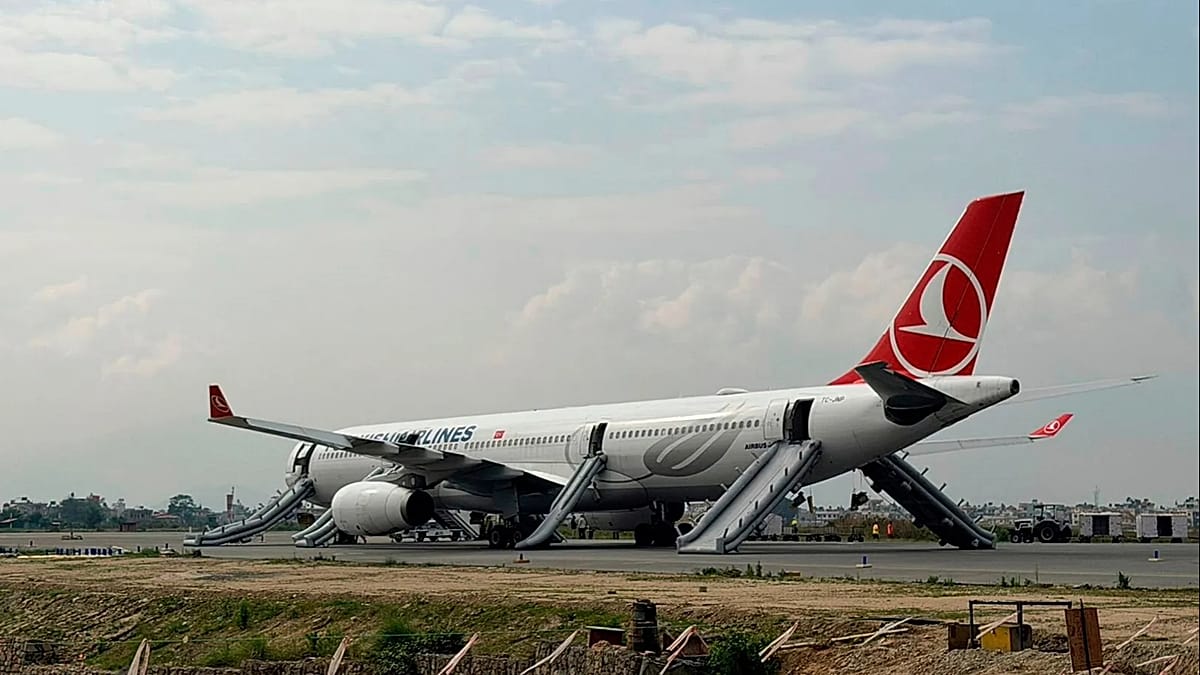
Kathmandu's Tribhuvan International Airport temporarily shut down its sole runway on Monday morning after a Turkish Airlines aircraft experienced a landing gear fire upon arrival. The Boeing jet, which had departed from Istanbul, was carrying 277 passengers and 11 crew members when the right landing gear ignited during the landing sequence, according to Gyanendra Bhul, a spokesman for Nepal's civil aviation authority.
“Fire was visible during the landing. Investigations are ongoing. All passengers are safe,” Bhul told the AFP news agency. The runway closure lasted nearly two hours before operations resumed.
Evacuation and Technical Malfunction
Turkish Airlines confirmed that passengers were evacuated via emergency slides after “smoke was observed coming from the landing gear during taxi.” Yahya Ustun, a spokesperson for the carrier, stated on social media that “a technical inspection of our aircraft has been initiated by our authorised teams. Initial examinations indicate that the smoke was caused by a technical malfunction in a hydraulic pipe.” The airline has arranged an additional flight for the return leg of the service.
The incident underscores the operational challenges at Kathmandu airport, which is surrounded by snow-capped peaks and features one of the world's most demanding runways. Nepal's aviation sector has faced scrutiny following a series of crashes, leading the European Union to blacklist all Nepalese airlines. In response, government officials announced plans last year to install new radar and weather monitoring systems.
This is not the first time a Turkish Airlines aircraft has encountered trouble in Kathmandu. In 2015, a Turkish Airlines plane with 224 passengers on board skidded off the runway, causing a four-day closure and the cancellation of scores of international flights. No injuries were reported in that incident either.
The European aviation industry has been grappling with broader safety and operational issues, including EASA warnings about potential jet fuel shifts that could affect airline safety protocols. Meanwhile, the EU has also moved to ban airlines from adding fuel surcharges after ticket purchase, a policy aimed at protecting consumers from unexpected costs.
Turkish Airlines, a major European carrier based in Istanbul, operates an extensive network across the continent and beyond. The airline's response to the Kathmandu incident will be closely watched by regulators and passengers alike, as it highlights the importance of rigorous maintenance and emergency preparedness in challenging environments.