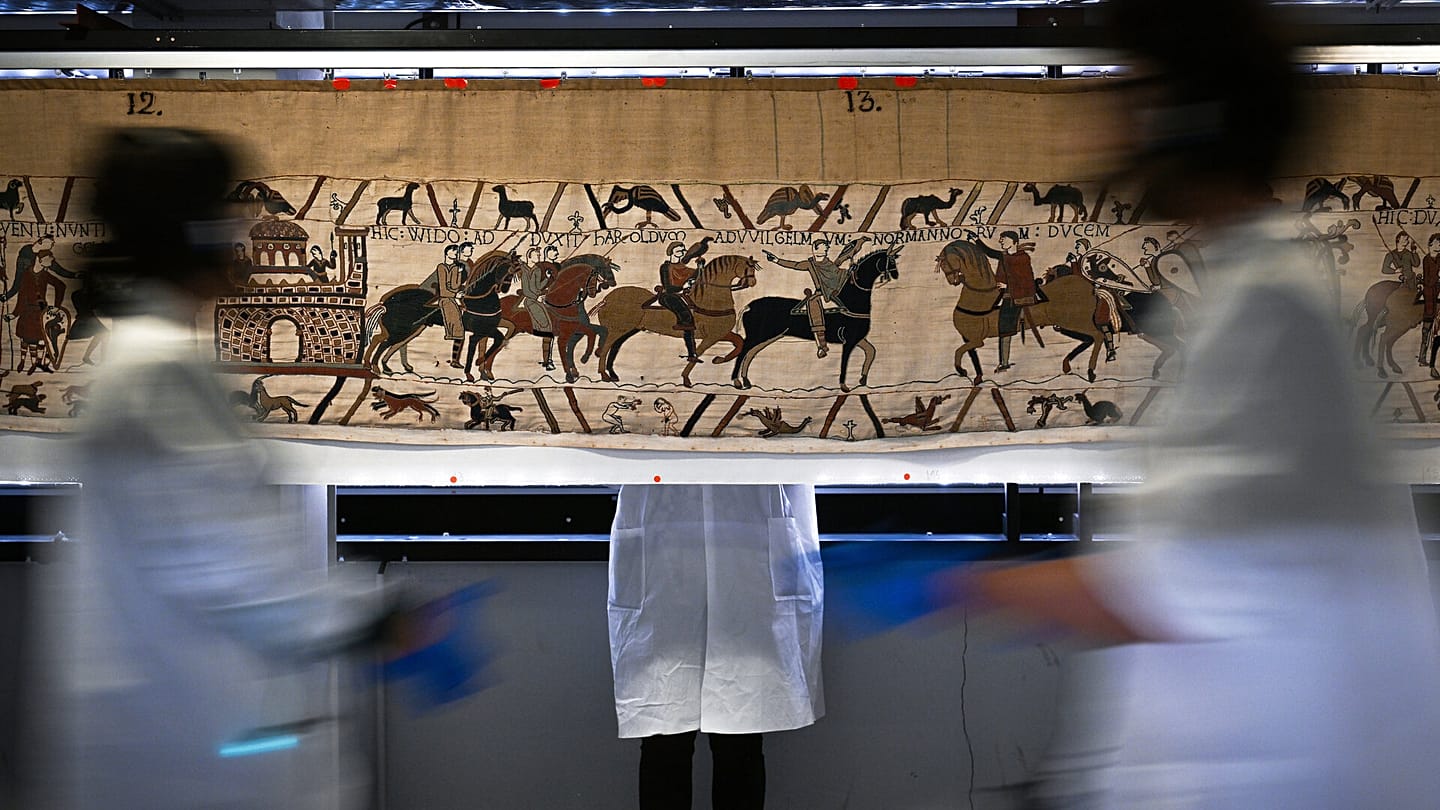
Nearly a millennium after its creation, the Bayeux Tapestry has returned to English soil, and with it comes an unusual invitation: UK schoolchildren are being asked to invent the ending that history never recorded. The famous embroidered narrative, which chronicles the Norman Conquest and culminates in the Battle of Hastings in 1066, is traditionally thought to have been cut short. Now, a new educational initiative seeks to fill that gap with the imaginations of a younger generation.
A medieval masterpiece returns home
The tapestry, which is actually an embroidery measuring nearly 70 metres in length, was likely commissioned in the 1070s by Bishop Odo of Bayeux, William the Conqueror's half-brother. It has spent most of its existence in Normandy, France, where it is displayed in a dedicated museum in the town of Bayeux. Its return to England—where it was probably created by Anglo-Saxon embroiderers—marks a rare homecoming, albeit a temporary one.
The original work ends abruptly with the death of King Harold II and the flight of the English, leaving the final scenes—perhaps depicting William's coronation—lost to time. The new project, titled 'A Better Tomorrow', invites pupils across the UK to design what they believe should come next. The best entries will be exhibited alongside the tapestry when it goes on display in the UK, offering a contemporary counterpoint to a medieval masterpiece.
Organisers hope the exercise will do more than teach history. By asking children to think about how a story ends, they aim to encourage reflection on themes of conflict, resolution, and national identity—subjects that remain as relevant today as they were in the eleventh century. The initiative also ties into broader efforts to make heritage accessible to younger audiences, a challenge many European museums and cultural institutions are grappling with.
For educators, the project offers a rare opportunity to bring a tangible piece of European history into the classroom. The tapestry is not just a British or French artefact; it is a shared European document, depicting a moment that reshaped the continent's political map. Its narrative—of ambition, betrayal, and conquest—resonates across borders, and the project's organisers are keen to stress that the exercise is about understanding, not glorifying, the past.
The UK tour, which begins later this year, will see the tapestry displayed in several venues, including the British Museum in London. It is the first time the artefact has left France since the 1960s, and its loan has been described as a symbol of the close cultural ties between the two countries. The schoolchildren's contributions will be displayed in a separate gallery, offering a dialogue between the medieval and the modern.
While the project is centred on the UK, its European dimension is unmistakable. The tapestry itself is a product of a cross-Channel world, and the questions it raises about power, memory, and storytelling are shared by all nations. As Europe's cultural destinations continue to draw visitors seeking deeper connections with history, initiatives like this remind us that heritage is not a static relic but a living conversation.
For the children taking part, the task is both simple and profound: imagine what comes after the last stitch. Some may depict a coronation, others a peace treaty, and still others a more imaginative leap. The only rule is that the ending must offer 'a better tomorrow'—a phrase that, in an era of uncertainty, carries a particular weight.
The project has already drawn praise from historians and educators, who see it as a creative way to engage with primary sources. It also aligns with a broader trend in European education, where schools are increasingly using cultural heritage to teach critical thinking and empathy. As one organiser put it, 'The tapestry is not just about the past; it's about how we choose to remember it.'
With entries due by the end of the school year, the initiative is expected to attract thousands of submissions. The winning designs will be announced in the autumn, just as the tapestry itself goes on display. For the young participants, it is a chance to leave their own stitch in history—a reminder that every ending is also a beginning.