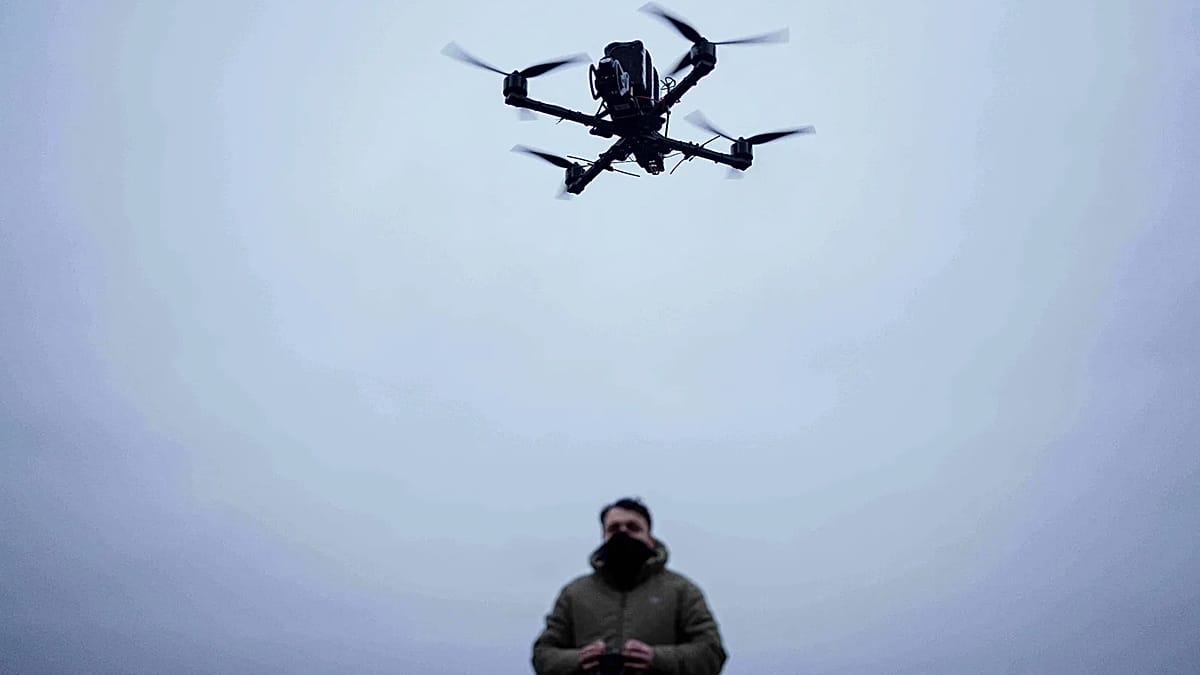
Since Russia launched its full-scale invasion of Ukraine in February 2022, Moscow's primary advantage has been its sheer size: a large standing army, deep reserves, and the legacy of a Soviet-era military machine. Yet more than four years into the war, that advantage is being systematically eroded by a technological revolution centred on unmanned systems.
Ukraine's forces have demonstrated that mass alone no longer guarantees battlefield success. Drone technology has helped offset Russia's demographic weight and is reshaping the dynamics of modern warfare—not just in Ukraine, but across the continent.
From Wedding Drones to Robotic Warfare
What began in 2022 as a desperate effort by Ukrainian soldiers and volunteers to adapt civilian 'wedding drones' for military use has culminated in a historic first: an enemy position was captured using only robotic systems, forcing Russian soldiers to surrender without a single Ukrainian soldier entering the zone.
President Volodymyr Zelenskyy stated in April that ground robotic systems performed more than 22,000 missions on the front line in the first three months of 2026. 'In other words, lives were saved more than 22,000 times when a robot went into the most dangerous areas instead of a warrior. This is about high technology protecting the highest value—human life,' he said.
According to Kyiv officials, Russia now loses approximately 30,000–35,000 military personnel—killed and critically injured—every month. Crucially, 'up to 90% of Russian losses are caused by Ukrainian drones,' Zelenskyy noted.
The Middle-Strike Campaign
The critical shift lies in Ukraine's increasingly effective middle-strike operations, targeting areas between 20 and 200 kilometres from the front line. 'The number of middle strikes has grown significantly,' Zelenskyy admitted in early May. 'There are now twice as many strikes at distances of 20-plus kilometres compared with March, and four times as many compared with February. And there will be even more. This is a priority area.'
Kyiv's forces are specifically targeting ammunition depots, fuel stores, and Russian command posts. This strategy forces Moscow's troops to move further from the front line, straining already overstretched logistics and complicating command and control. Defence Minister Mykhailo Fedorov described this as a 'logistics lockdown' aimed at 'increasing pressure on the Russian military in the rear and denying the enemy the ability to conduct sustained offensive operations.'
Combined with long-range strikes on Russia's oil infrastructure, Ukraine is causing a fuel crisis with far-reaching military consequences. As of May, nearly 40% of Russia's primary oil refining capacity has been disabled, according to Zelenskyy.
Deep Strikes into Russia
Kyiv has significantly escalated its deep-strike campaign into Russian territory, focusing on oil infrastructure to reduce the Kremlin's ability to profit from surging oil prices amid the Iran war. On 17 May, Ukraine attacked the Moscow region, targeting military production sites and oil facilities. 'This time, Ukrainian long-range capabilities reached the Moscow region. We clearly tell the Russians: their state must end its war,' Zelenskyy said.
The targets were located more than 500 kilometres from Ukraine's border and overcame heavy concentrations of Russian air defences around Moscow. 'Territory 1,500 to 2,000 km inside Russia is no longer a peaceful rear,' said Robert 'Magyar' Brovdi, commander of Ukraine's Unmanned Systems Forces.
Between January and May, Ukraine struck 15 Russian oil refineries, contributing to a growing fuel crisis. This strategy mirrors broader European concerns about energy security and the weaponisation of oil, as seen in recent French detention of a tanker linked to Iranian networks moving Russian oil.
Defending Against the Shahed Threat
Soon after the invasion, Russia became heavily reliant on Iranian-designed Shahed-type drones. Launched in waves, these cheap, one-way attack UAVs—now manufactured in Russia based on Tehran's blueprints—have remained a major threat. As the war entered its fifth year, Ukraine's drone interception rate stands at around 90%.
Kyiv has developed a multi-layered air defence system against these drones, including mobile fire groups using pickup trucks armed with heavy machine guns, electronic warfare systems, and domestically developed interceptors. As of 7 January, units of the Armed Forces receive more than 1,500 specialised anti-Shahed interceptor drones per day. Their widespread use helps preserve high-value surface-to-air missiles, which are costly and limited in supply. Ranging from €1,000 to €4,000, these interceptors are a cost-effective solution.
This drone race has implications beyond Ukraine. As drone incursions become a persistent reality across Europe, the lessons from Ukraine's battlefield innovations are being studied by defence ministries from Warsaw to London.