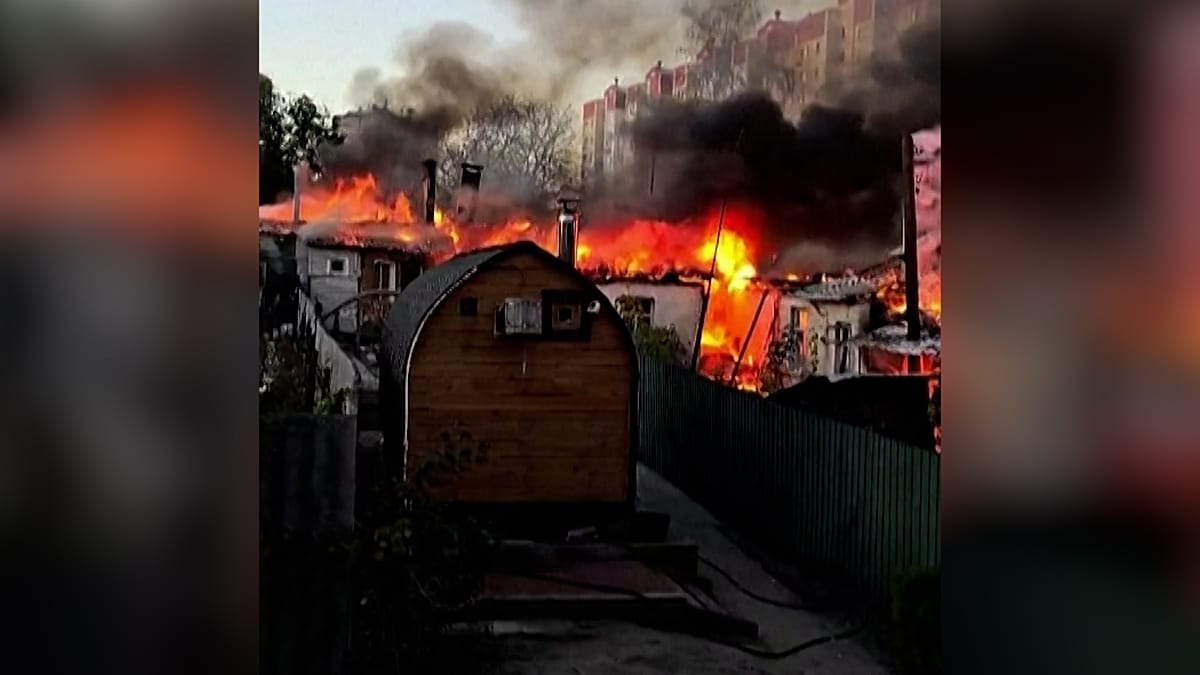
A Ukrainian drone attack on Russia's Voronezh region has left at least two people dead and 17 injured, according to regional officials. The strike, which took place overnight, set buildings ablaze and sent debris crashing into a commuter train, underscoring the escalating cross-border exchanges that have become a grim feature of the war.
Governor Alexander Gusev said on Telegram that emergency services were battling fires at several sites, including a residential area. Video footage shared on social media showed large flames and thick smoke rising above structures, while local railway authorities reported that a train had been hit by falling wreckage, though no passengers were seriously hurt.
The attack comes as diplomatic efforts to end the conflict show tentative signs of movement. Ukrainian President Volodymyr Zelenskyy has confirmed that trilateral talks involving Ukraine, Russia, and the United States are scheduled for November, raising hopes for a possible de-escalation even as both sides continue to strike deep into each other's territory.
Civilian toll and infrastructure damage
Voronezh, a city of about one million people roughly 500 kilometres south of Moscow, has been a frequent target of Ukrainian drone raids. The region hosts several military airbases and logistics hubs that support Russian operations in eastern Ukraine, making it a priority for Kyiv's long-range strike campaign.
In this latest incident, the regional health ministry reported that 17 people were receiving treatment for injuries, with several in serious condition. The commuter train, which was travelling near the outskirts of the city, sustained damage to its windows and exterior, but railway officials said all passengers were evacuated safely.
Residents described hearing a series of explosions shortly before midnight. "We saw a bright flash, then the whole sky turned orange," one local told independent Russian media. "Within minutes, the sirens started and we could see smoke from our windows."
The Russian defence ministry claimed that its air defences had intercepted and destroyed more than a dozen drones over the region, but acknowledged that some debris had fallen on civilian infrastructure. Such statements have become routine as both sides report daily interceptions and strikes.
Broader escalation across the front line
The Voronezh attack is part of a wider pattern of intensifying aerial warfare. In recent weeks, Ukrainian drones have struck targets in Oryol, where a factory blaze killed three people, and in other border regions. Meanwhile, Russian overnight strikes have continued to exact a heavy toll on Ukrainian cities, with four people injured in Zaporizhzhia and fires breaking out in Odesa.
In Dnipro, a separate Russian attack killed four people and wounded 28 others, according to local officials. The repeated strikes on residential areas have drawn condemnation from European leaders, who have called for greater air defence support for Ukraine.
The timing of the Voronezh attack is politically sensitive. With talks reportedly set for November, some analysts see the escalation as a bid by both sides to strengthen their negotiating positions. "Neither Kyiv nor Moscow wants to appear weak at the table," said Olena Prokopenko, a defence analyst at the European Council on Foreign Relations. "These strikes are as much about signalling as they are about military effect."
For European capitals, the continued cross-border attacks raise questions about the durability of any ceasefire. The European Union has repeatedly urged restraint, but has also pledged sustained military and financial support for Ukraine. The bloc's foreign policy chief, Josep Borrell, said this week that "peace cannot be achieved through more bombs," while acknowledging that Ukraine has the right to defend itself.
As the war enters its third year, the human cost continues to mount. The United Nations has documented thousands of civilian casualties on both sides, and the displacement crisis shows no sign of abating. For the people of Voronezh, the latest attack is a stark reminder that the conflict is not confined to the front lines.
Local authorities have announced compensation for the families of the deceased and for those whose homes were damaged. But for many residents, the psychological toll is harder to quantify. "We never thought we would see this here," said one woman, standing outside her damaged apartment block. "This is not a war we asked for."
The coming weeks will test whether the planned talks can translate into a meaningful reduction in violence. Until then, the skies over both countries are likely to remain dangerous, and the toll on civilians will continue to grow.