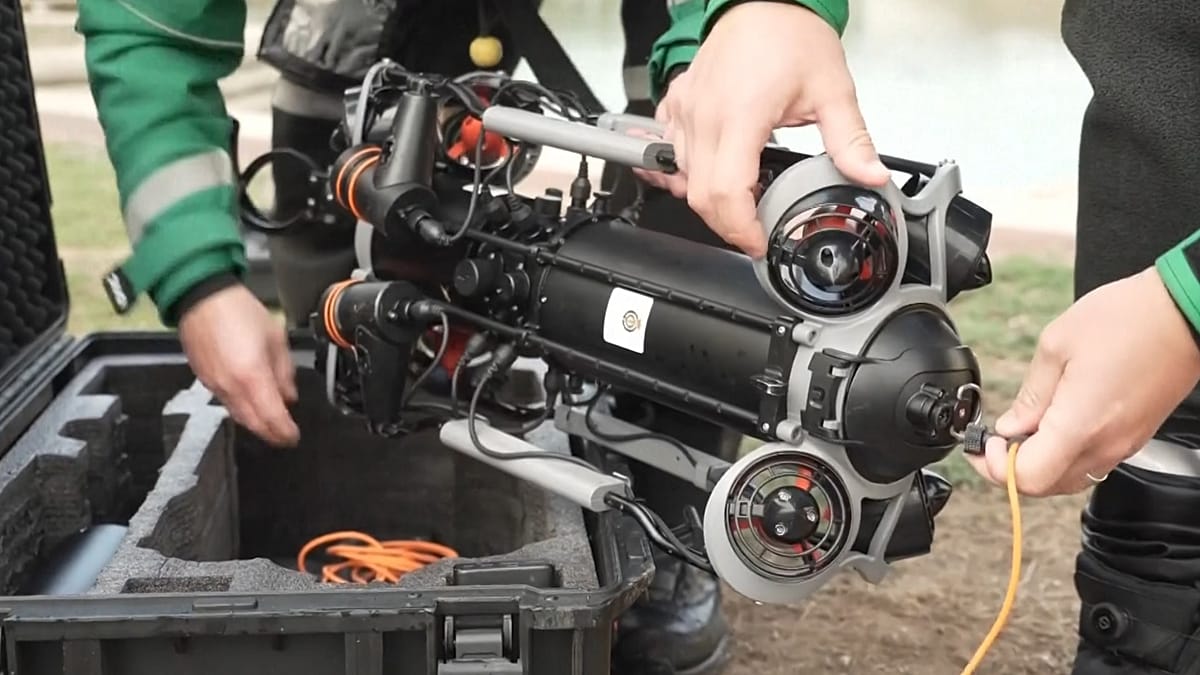
When someone slips beneath the surface of a river, canal or reservoir, every second counts. In London, paramedics are now turning to a new tool to find them faster: remotely operated underwater drones.
The London Ambulance Service has acquired four of these submersible devices for its Hazardous Area Response Team (HART), the unit trained to operate in high-risk environments. Equipped with cameras, lights and sonar, the drones can be launched from the bank in under two minutes and travel up to 200 metres from the operator, sending back live video and data on water depth and temperature.
Perhaps most importantly, a grab arm on the drone can attach to a casualty and help pull them back to shore, giving crews a way to intervene without entering the water themselves.
Speed is critical in drowning cases
Paramedics stress that rapid response is vital. A person can survive without oxygen for only a few minutes, and cold water can quickly sap a swimmer's strength. The drones are designed to shorten the search phase, which is often the most time-consuming part of a water rescue.
“The sooner we can locate someone, the better their chances,” said a spokesperson for the London Ambulance Service. “These drones give us an extra set of eyes underwater, and they help keep our crews safe.”
The service notes that around 400 people drown in the UK each year, with many incidents occurring in inland waters such as lakes, rivers and canals. The drones are not a complete solution—they cannot remove all the risks of water rescue—but they offer a safer way to search for casualties while reducing the danger to rescuers.
The move reflects a broader trend across Europe, where emergency services are increasingly adopting drone technology. In the Netherlands, for example, police have used aerial drones for search and rescue, while other countries are experimenting with underwater vehicles for inspections and salvage. The London initiative is one of the first to integrate such devices into routine ambulance operations.
For Londoners, the drones are a quiet addition to the city's emergency toolkit. They are stored on HART vehicles and can be deployed quickly to any waterway in the capital. The service plans to train more operators and expand the fleet if the technology proves effective.
While the drones are a local innovation, they highlight a wider European interest in using robotics to protect first responders. As climate change increases the frequency of floods and extreme weather, such tools may become even more essential.
For now, the focus is on the immediate benefit: giving rescue teams a better chance to reach someone before it's too late.