Uzbekistan and Kazakhstan have reopened one of Central Asia's busiest border crossings after nearly two years of reconstruction. The upgraded Gishtkuprik–Zhibek Zholy checkpoint, located just outside Tashkent, is designed to handle up to 100,000 travellers a day during peak periods, a significant increase from the roughly 30,000 daily crossings recorded in 2024.
The reopening comes as the European Union pushes for stronger transport and trade links with Central Asia. On 16 November, EU and Central Asian officials met in Brussels to advance cooperation on transport, energy, and digital infrastructure. A key priority is the development of the Middle Corridor, which connects Central Asia to European markets via the Caspian Sea and the South Caucasus. The European Commission aims to triple trade flows along this route and cut freight transit times by 2030.
Easing pressure on regional freight routes
Although the reopened checkpoint serves pedestrians, passenger cars, and buses rather than trucks, its modernisation is expected to benefit freight transport. During the closure, passenger vehicles were diverted to the neighbouring Navoi checkpoint, which was originally built for cargo traffic. Truck access there was temporarily restricted. According to Uzbekistan's Customs Committee, the reopening of Gishtkuprik will allow freight traffic to resume through Navoi, easing pressure on other crossings along the border.
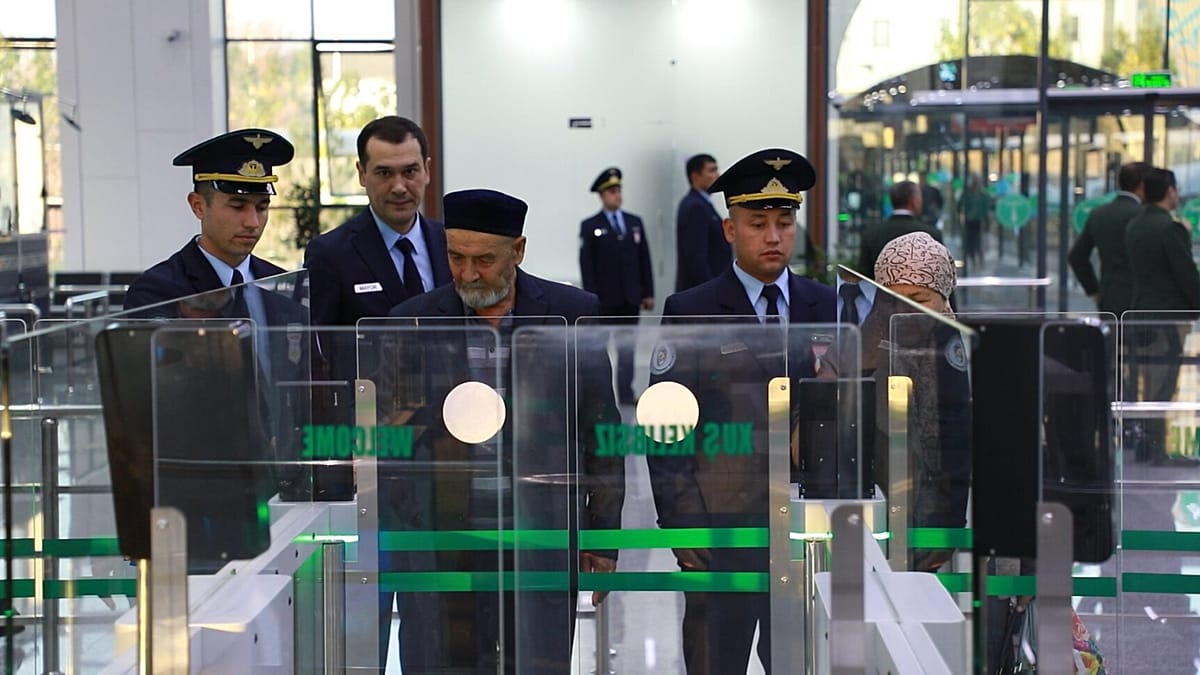
The upgraded facility has expanded from six to nine hectares on the Uzbek side. Pedestrian lanes have doubled from four to eight, vehicle inspection lanes have increased from four to 18, and parking capacity has risen from 20 to 200 vehicles. On the Kazakh side, two new passenger terminals covering approximately 10,000 square metres separate arrivals from departures, featuring 82 passport control booths and 20 automated gates.
“We have also introduced advanced inspection technologies, including X-ray scanners, body scanners, radiation detection systems and modern surveillance equipment,” said Iroda Isoqova, a senior inspector at Uzbekistan's Customs Committee. “One of the key innovations is the Smart Customs Border system, which will help streamline customs procedures, reduce waiting times and improve the overall passenger experience.”
The crossing is designed to accommodate up to 3,000 passenger cars and 400 buses daily. For travellers, the wait times have improved dramatically. Asqarjon Mahmudov, deputy chairman of the Uzbek Cultural Association in Kazakhstan's Saryagash district, recalled: “Previously, when crossing by car, we would wait three or four hours, sometimes even 12 hours. There were times when we spent the entire night waiting.”
Growing tourism and trade
Uzbekistan recorded more than 11.6 million foreign visitor arrivals for tourism purposes in the first ten months of 2026, up 19.4% compared with the same period last year. Kazakhstan was the second-largest source of visitors, accounting for more than 2.7 million arrivals. Visitor numbers from Germany and the United Kingdom each rose by 26%, while arrivals from France increased by 20%.
For international travellers, the reopened checkpoint restores a direct road connection between Tashkent and Shymkent, a major city in southern Kazakhstan. Bilateral trade reached $4.4 billion (€4bn) in the first ten months of 2026, according to Uzbekistan's state news agency, UzA. “In the first ten months of this year, foreign trade between Uzbekistan and Kazakhstan increased by 20% compared with the same period last year,” said Uzbekistan's Deputy Prime Minister and Minister of Economy and Finance Jamshid Kuchkarov.
The two countries aim to increase annual bilateral trade to $10bn (€9.1bn) by 2030. “To achieve this, we are also upgrading our border checkpoints to meet modern standards,” Kuchkarov added.
Connecting Central Asian economies
Kazakhstan's trade with its Central Asian neighbours increased by 28.1% to $5.1bn (€4.6bn) in the first half of 2026, while Uzbekistan's regional trade grew by 29.6% to $4.4bn (€4bn), according to the Centre for Economic Research and Reforms (CERR). The reopened checkpoint also lies on the route of a proposed economic corridor linking Shymkent, Tashkent, and Khujand in northern Tajikistan.
The modernisation of this border crossing is a concrete step towards deeper regional integration, with clear benefits for European businesses seeking more efficient routes to Central Asian markets. As the EU looks to diversify its supply chains, the Middle Corridor and improved border infrastructure will play a crucial role in facilitating trade and travel between Europe and Central Asia.