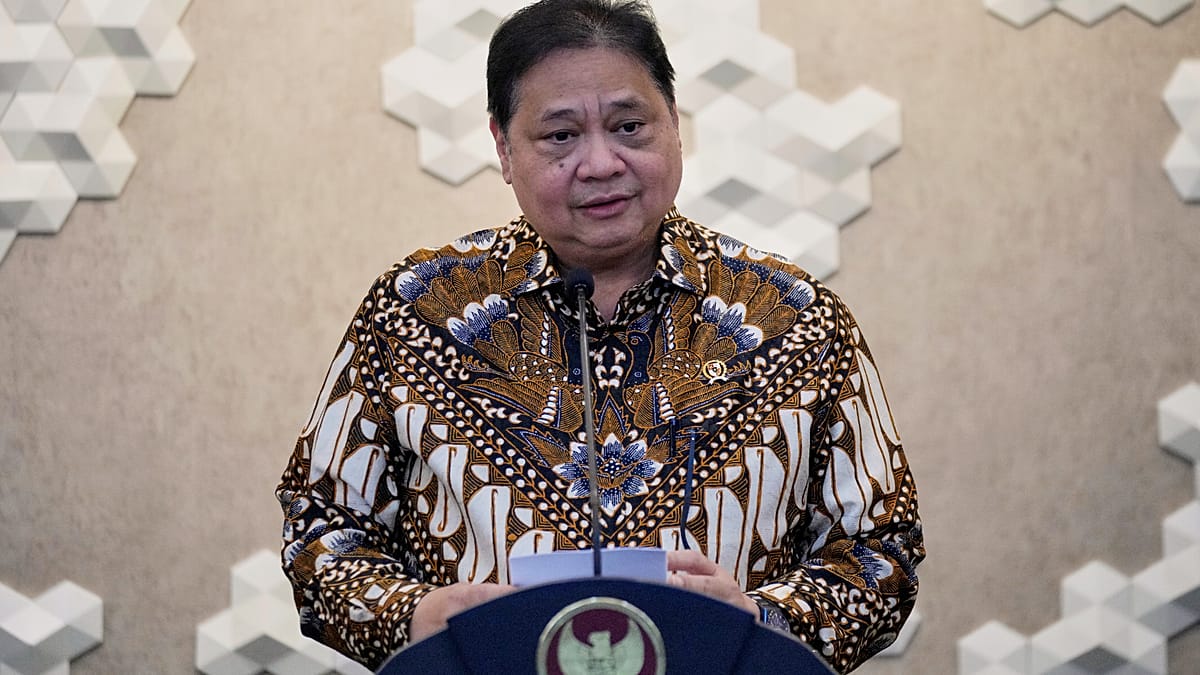
Washington's aggressive tariff policy has inadvertently drawn Brussels and Jakarta closer together, according to Indonesia's Coordinating Minister for Economic Affairs, Airlangga Hartarto. In an exclusive interview with Euronews, he said the pressure from US tariffs helped break a decade-long deadlock in EU-Indonesia trade negotiations.
The two sides signed a trade agreement in Brussels on Saturday, and Hartarto expects it to increase bilateral trade by 50% within three years. Asked directly whether President Donald Trump's sweeping tariffs had facilitated the breakthrough, Hartarto acknowledged: "I think there is an impact of the parallel negotiation with the US." Jakarta has been simultaneously negotiating tariff terms with Washington, a process that has been fraught with uncertainty.
The EU and Indonesia reached a political agreement in July 2025, just two days before Trump announced a 19% US tariff on Indonesian goods. This week, Washington proposed new tariffs on goods from 14 trading partners, including the EU and Indonesia, further underscoring the volatility of transatlantic trade relations. For more on this, see the latest US tariff proposals.
Bilateral goods trade between the EU and Indonesia was worth €28.9 billion last year, according to the European Council. Hartarto stressed that the two economies are "not competing but compatible," as they produce different goods and can meet each other's needs. He said the 50% growth target was discussed with EU partners and business groups from both sides.
Investor confidence and market concerns
Hartarto also sought to downplay a warning from MSCI, the index provider whose benchmarks are tracked by global funds. In October, MSCI proposed downgrading Indonesia from "emerging" to "standalone" status, which would remove Indonesian shares from its emerging markets indices. The decision is expected by the end of June 2027.
Jakarta's benchmark IDX Composite index has fallen roughly 38% this year, reflecting investor jitters. The minister likened the MSCI warning to a broken window. "So basically this is an issue of a window that is broken by somebody, right?" he said. When asked if he meant that investors see everything through a broken lens, he agreed and insisted Indonesia's economy is in better shape than the warning suggests.
Indonesia's economy grew 5.45% in the first nine months of 2026 compared with the same period a year earlier, according to Statistics Indonesia. Hartarto described this as "one of the highest" growth rates in the G20. He added that Jakarta is reforming its capital market to improve transparency.
Investment forum and chip ambitions
Next week, the New Asia Forum, an investment conference in Bali, could generate deals worth up to $30 billion (€27.4 billion), Hartarto said. "I think the potential of $30 billion is there," he told Euronews. The figure is the forum's target for the whole region, with the Indonesian sovereign wealth fund Danantara expecting 40-50% to go to Indonesia.
Indonesia plans more such events, including one with the EU that Hartarto has discussed with EU trade commissioner Maroš Šefčovič. Meanwhile, the country is pushing to join the OECD by 2028. This week, OECD Secretary-General Mathias Cormann launched two reports in Jakarta, one on how Indonesia can benefit from the digital economy by developing semiconductors, and the other an economic survey warning that growth would slow to about 3.5% on current productivity trends.
The minister said the government's target of 5.8% average growth for 20 years, needed to become a high-income country by 2045, is in line with its plans. Chips play a big part: "Indonesia has already made a contract with Arm," he said, referring to a framework agreement signed in February with the British chip designer. Through that deal, Indonesia is training up to 15,000 engineers in AI and semiconductors and will acquire six pieces of chip-design intellectual property.
Year-end deadlines for exporters
Indonesian exporters face two critical deadlines. From 30 December, the EU's deforestation regulation (EUDR) will require large and medium-sized companies to prove that palm oil, coffee, cocoa, rubber and other goods sold in the EU were not produced on land deforested after 2020. Hartarto said the rules were discussed separately from the trade deal, and Indonesia is ready to comply, but has asked for its own national certification schemes, such as ISPO, to count towards compliance. That request is still under discussion.
On 1 January, Indonesia will leave the Generalised Scheme of Preferences (GSP), under which the EU grants tariff cuts to developing countries. Exports currently benefiting from the scheme will face standard EU duties until the trade agreement takes effect. Hartarto is confident the deal will be in place in time, saying it is being brought to the European Parliament "so that on the first of January next year it will be implemented."
Indonesia's embassy in Brussels has been in contact with several MEPs, who have given strong support, according to the minister. The Parliament's legislative tracker lists 14 December as a provisional date for the vote, though the file is still at the preparatory stage. The ratification process will be closely watched, as it could set a precedent for other trade deals in a world increasingly shaped by tariff battles. For more on how tariffs are reshaping global trade, see this analysis from a Brussels trade expert.