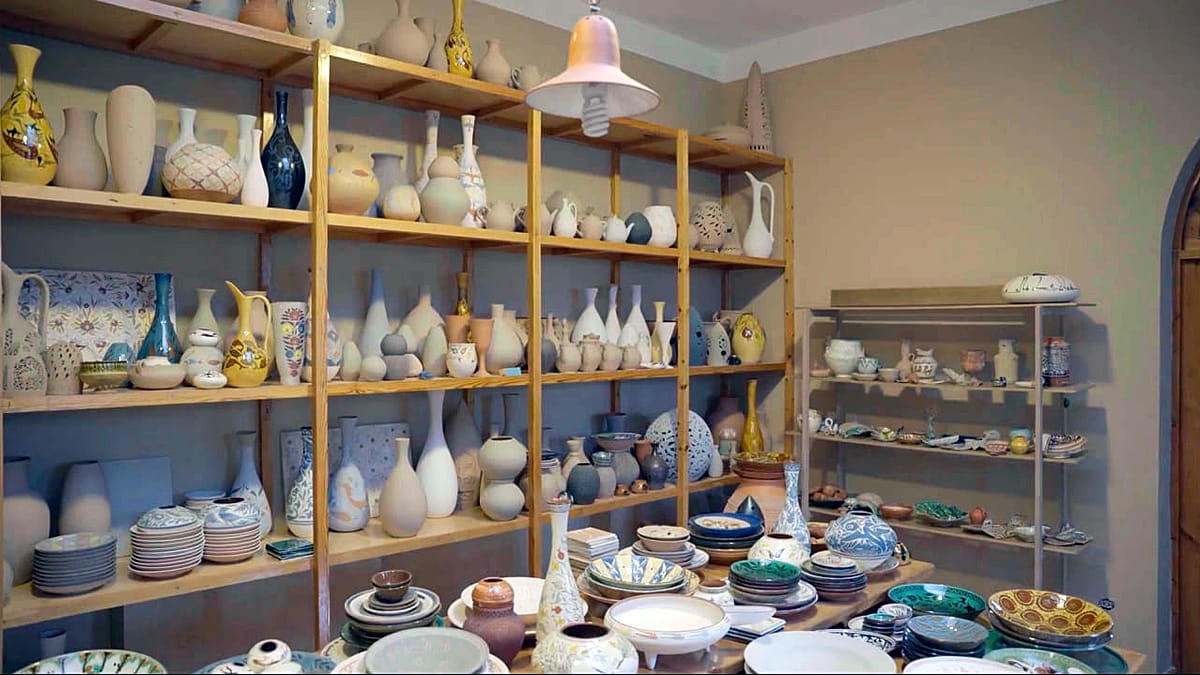
In Uzbekistan, the workshop is more than a place of production—it is a classroom, a family archive, and a bridge between generations. Across the country, master artisans are passing on skills in woodcarving, ceramics, and embroidery to younger apprentices, ensuring that centuries-old techniques survive in a rapidly modernising society.
The learning process is slow and deliberate. Apprentices start with basic tasks, gradually mastering materials, tools, and patterns under the close supervision of experienced craftsmen. For some families, the craft has been a continuous thread for five, six, or even seven generations. For others, workshops have become centres of vocational training and economic opportunity.
Woodcarving in Fergana: a five-generation legacy
In the Furqat district of the Fergana region, Muhammadali Yunusov is a fifth-generation woodcarver. He began working independently at 15, later honing his skills at vocational schools. Today, his sons are the sixth generation in the trade, and his grandchildren are already learning the craft.
Yunusov's workshop has trained more than 2,000 apprentices over the years. Many have worked alongside him on decorative carvings and the construction of traditional ayvons—open-air verandas adorned with intricate wooden elements. He insists that becoming a master requires patience and determination. Some small areas of a carving can take a full day; larger pieces may demand weeks of handwork with fine chisels called naqshqalam.
The timber itself demands preparation. Walnut, elm, mulberry, and plane-tree wood are soaked in water for six months or longer before being dried and shaped into gates, columns, doors, or traditional wooden platforms. The workshop currently works with nearly 100 apprentices.
Yunusov's designs draw on geometric and Islamic patterns, each carrying distinct meanings. He works in what he calls the Fergana style, one of five major regional traditions—alongside Tashkent, Samarkand, Bukhara, and Khorezm. For him, the most valuable works are those built to last for generations, becoming part of a building's physical history. He is particularly drawn to architectural elements like ayvons and gates, which can endure for decades or centuries.
Technology has also entered the workshop. Yunusov says artificial intelligence has helped him rediscover designs and techniques that had faded from memory, offering new sources of inspiration. This blend of tradition and innovation is part of a broader trend in Uzbekistan, where the government is promoting tech hubs and digital investment—see Tashkent's ambitions as a tech gateway.
Empowering women through craft in Fergana
In another Fergana workshop, Sadokat Mirzayeva runs a handicraft centre that doubles as an educational institution. Over six years, it has trained more than 500 women and girls, with over 100 now working with the enterprise either from home or as permanent employees.
The artisans produce more than 100 types of products—traditional dolls, folk toys, bags, headwear, chapan robes, and other clothing. These items are sold at tourist centres, regional markets, and duty-free shops at Tashkent International Airport, and are exported to other Central Asian countries. Mirzayeva sees the preservation of craft as inseparable from creating economic opportunities for women.
Products are made from natural materials like silk and cotton, with traditional embroidery and patterns remaining central. Individual orders allow customers to request adaptations, and the showroom brings together the full range of work, giving visitors a tangible sense of the craft.
Seven generations of ceramics in Tashkent
In Tashkent, the Rakhimov family has worked with ceramics for seven generations. For ceramist Shokhrukh Rakhimov, inheriting that knowledge carries responsibility. Each new generation must first learn what came before, then develop its own ideas.
The family has a distinct visual identity, including a green-and-black colour combination associated with Tashkent ceramics. Yet Rakhimov encourages younger craftsmen to experiment with new shapes and approaches. He describes working with clay as a collaboration: rather than imposing control, the craftsman responds to the material's behaviour and guides it towards the desired form.
The family's ceramics reflect influences from different cultures and periods. Colours, ornaments, and symbols carry meanings—flowers, birds, and fish evoke paradise, freedom, happiness, and life. International exhibitions and biennials have allowed the workshop to collaborate with artists from abroad, experimenting with contemporary styles while retaining traditional techniques.
Learning the craft remains a long process. Young apprentices may spend years maintaining the studio and handling tools before progressing to preparing clay, glazes, and colours—and eventually making their own pieces. Patience, Rakhimov says, is essential to continuing the family tradition.
A shared approach to teaching
Though the three workshops differ in materials and techniques, their teaching methods share common ground. Yunusov recalls that his father first taught him how to think, stay focused, and approach work with determination. His apprentice, Samandar Tokhirov, joined the workshop at 14 and says his interest in woodcarving grew through learning from the master.
For Tokhirov, the next step is clear: to master the craft and, in turn, pass it on. As Uzbekistan modernises and its economy diversifies—with new financial centres and tech zones emerging—these artisans ensure that the country's cultural heritage remains a living, evolving tradition. Their work is not just about preserving the past; it is about equipping a new generation with skills that are both timeless and adaptable.