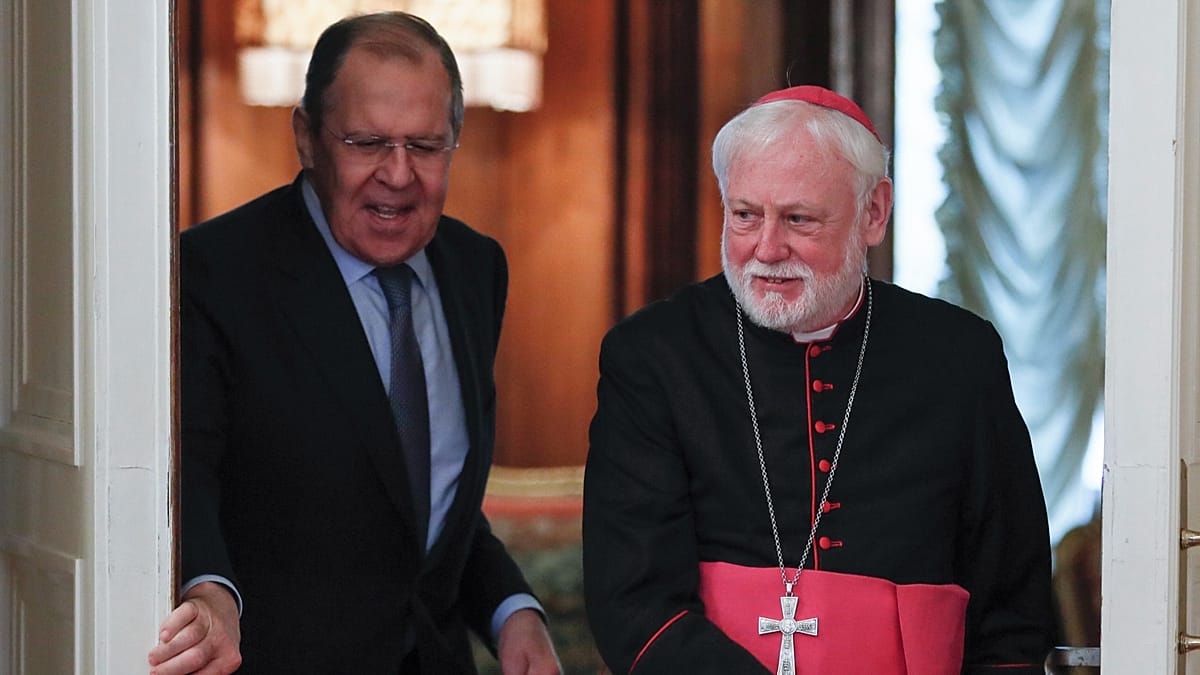
Archbishop Paul Richard Gallagher, the Vatican's secretary for relations with states, arrived in Moscow on Monday for a three-day visit aimed at preserving dialogue with Russian authorities against a backdrop of sharply deteriorating international relations. It is the highest-level Vatican visit to Russia since the full-scale invasion of Ukraine began in February 2022.
On Tuesday, Gallagher is scheduled to meet Russian Foreign Minister Sergei Lavrov. The programme also includes discussions with representatives of the Moscow Patriarchate and with the small Catholic community in the Russian capital. This is Gallagher's first trip to Moscow since November 2021, before the outbreak of the war.
The visit reflects the Holy See's long-standing diplomatic tradition of active neutrality and its refusal to sever contact with parties to a conflict. The Vatican has repeatedly stressed the importance of keeping communication lines open, even when political and military tensions are high.
Humanitarian priorities and delicate ties
The Holy See has been pushing for humanitarian initiatives from both sides, including prisoner exchanges and the repatriation of Ukrainian children, while quietly exploring possibilities for peace negotiations. However, bilateral relations remain fragile, largely because of the close alignment of the Russian Orthodox Church and Patriarch Kirill with the Kremlin.
Tensions were exacerbated in 2022 when the late Pope Francis, in an interview with the Italian daily Corriere della Sera, warned that Patriarch Kirill should not become Putin's "altar boy." That remark drew sharp criticism from Moscow and further complicated Vatican-Russian ties.
In July, the Vatican's envoy to Ukraine, Italian Cardinal Matteo Zuppi, travelled to Kyiv, where he conveyed a message of solidarity from Pope Leo XIV and met with Russian prisoners. That visit underscored the Vatican's continued engagement with both capitals, even as diplomatic efforts to end the conflict have stalled.
With both sides having escalated attacks in recent weeks, civilian casualties have risen, and prospects for a negotiated settlement appear distant. The Vatican's quiet diplomacy, while limited in scope, remains one of the few channels still open between Moscow and the West.
Possible follow-up visit by Cardinal Zuppi
Gallagher's mission may not be the only step by Vatican diplomacy toward Moscow. Russia's ambassador to the Holy See, Ivan Soltanovsky, recently indicated that Moscow is preparing a new invitation for Cardinal Matteo Maria Zuppi, who has already visited the Russian capital in 2023 and 2024. According to Soltanovsky, that visit could take place in September.
Such a visit would build on the Vatican's efforts to maintain a presence in Moscow while also supporting humanitarian causes. The Holy See has consistently argued that dialogue, however difficult, is preferable to isolation, particularly when the human cost of war continues to mount.
Observers note that the Vatican's role is constrained by the Orthodox Church's support for the Kremlin's narrative, but the mere fact that Gallagher is in Moscow signals that the Holy See is not willing to give up on communication. As the conflict grinds on, the Vatican's diplomatic manoeuvring remains a rare example of sustained engagement with Russia from a Western-aligned institution.