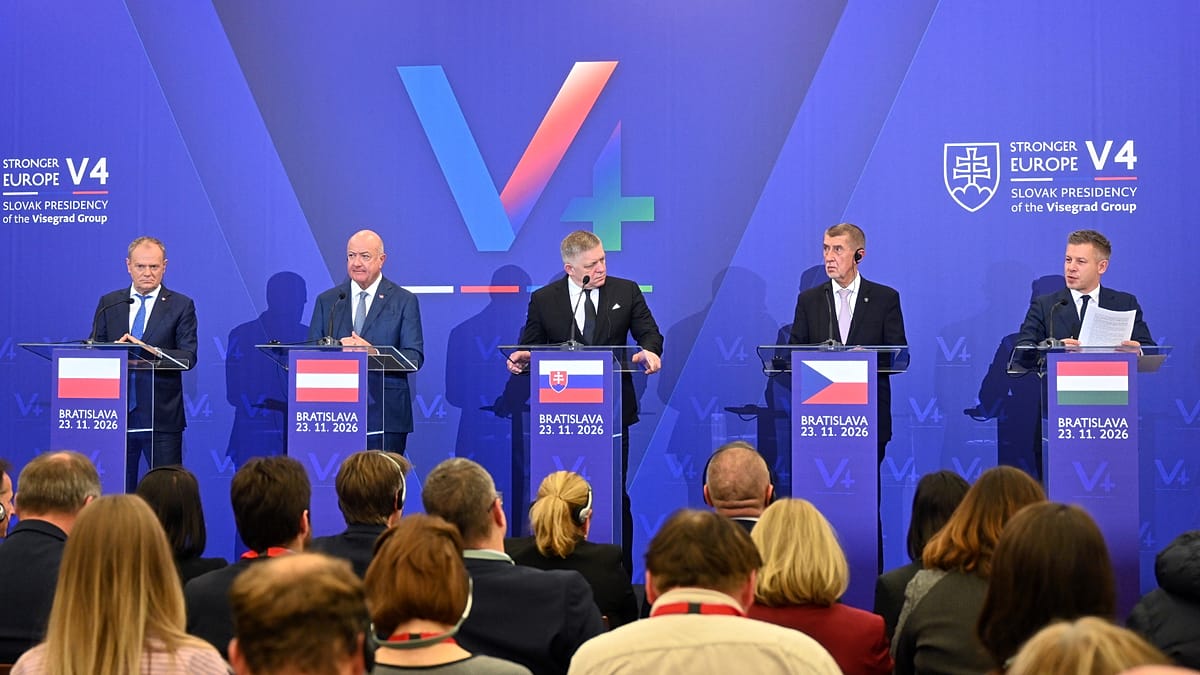
The prime ministers of the Visegrád Group — the Czech Republic, Hungary, Poland, and Slovakia — gathered in Bratislava on Monday to discuss the European Union's next long-term budget, and their differences over it were on full display. Hosted by Slovak Prime Minister Robert Fico, the meeting also included Austrian Chancellor Christian Stocker, reflecting the region's shared interests on migration, cohesion policy, and agriculture.
Hungarian Prime Minister Péter Magyar was the most outspoken critic of the European Commission's proposal for the 2028–2034 multiannual financial framework. He told reporters that Budapest does not consider the plan "an acceptable starting point for negotiations" and has written to European Council President António Costa to express his view. Magyar said he sees little point in attending the special summit scheduled for later this week in Brussels, arguing that "there is no point spending two days in Brussels not agreeing on anything."
Czech Prime Minister Andrej Babiš echoed the scepticism, saying he had hoped the Commission would show at least some willingness to cut spending. He singled out the European Parliament's three working locations — Strasbourg, Brussels, and Luxembourg — as an unnecessary and costly arrangement. Babiš also raised concerns about the level of member state contributions, suggesting that the budget's overall size and priorities need a rethink.
Fico, for his part, said the leaders had not adopted a joint position on the budget, as that was not the purpose of the meeting. Still, he acknowledged that the four countries and Austria are "broadly aligned" on the key issues, including the need for strict migration rules and support for cohesion and agricultural policies.
Ukraine funding divides the room
The most contentious topic was how to finance support for Ukraine. Polish Prime Minister Donald Tusk, whose country has been a staunch ally of Kyiv, stressed the strategic importance of continued assistance. "Poland is committed to peace," he said, "but recent events show the impact of Russia's invasion on our country." Tusk argued that Ukraine's ability to defend itself is of "strategic significance for Europe's security."
Magyar took a different line. While acknowledging that Ukraine deserves solidarity and noting that Hungary already provides various forms of assistance, he insisted that "support for Ukraine should not be included in the EU budget." He argued that making contributions mandatory for all member states would be unacceptable. Tusk also expressed reservations about financing Ukraine aid through joint EU borrowing, a mechanism Hungary has already ruled out.
The divide reflects a broader tension within the bloc: how to balance solidarity with Kyiv against the fiscal concerns of net contributors and the political objections of some member states. The EU budget plan has already drawn fire from frugal capitals, and the V4's stance adds another layer of complexity to the negotiations.
At the post-meeting press conference, the leaders sought to project unity on regional cooperation. Fico praised a proposal by some EU states to establish immigration return hubs in Rwanda, a plan that has drawn criticism from human rights groups but found favour among several Central European governments. Stocker said Austria wants to be an "ally" of the V4 and stressed the importance of working with its neighbours on migration and economic issues.
The meeting came as the EU faces a series of budgetary and political challenges, including labour unrest over spending cuts in Belgium and warnings from tech leaders that the bloc risks falling behind the US and China. The V4's objections are likely to complicate efforts to reach a consensus on the next budget, which will shape EU spending for years to come.
Whether the special council meeting later this week yields any progress remains uncertain. Magyar's letter to Costa suggests that at least one leader sees it as a formality. But with the EU's eastern flank facing security pressures and economic headwinds, the stakes are high for all 27 member states.