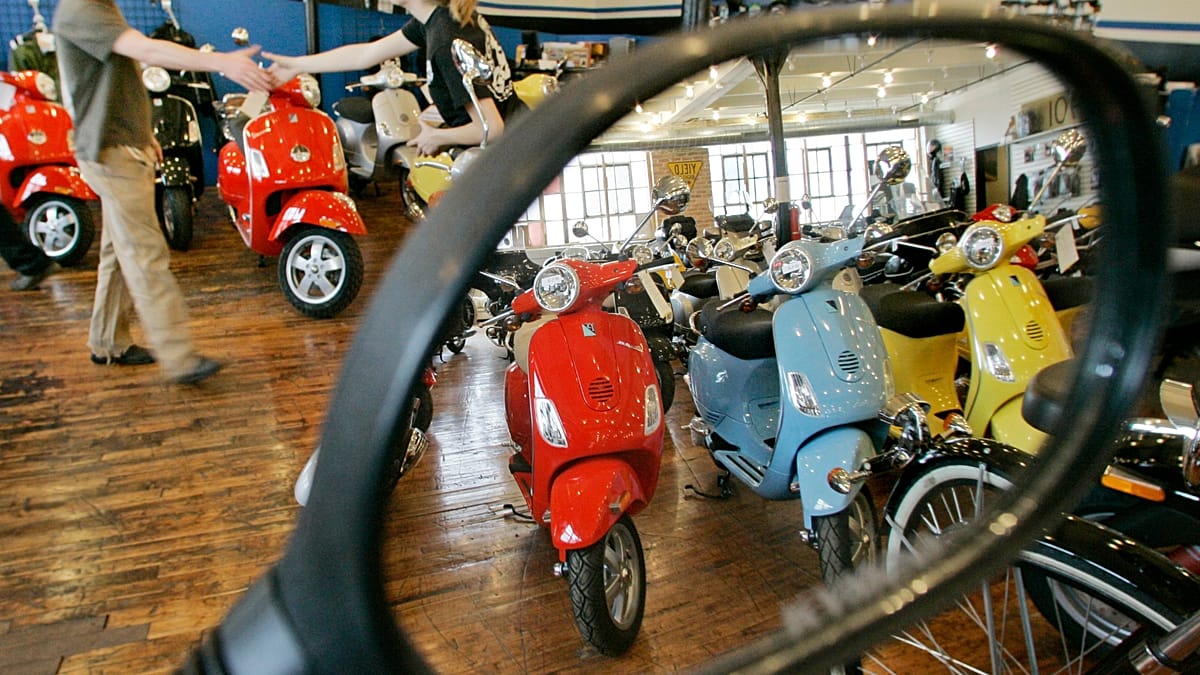
On 23 April 1946, a patent filed in Florence set in motion a revolution on two wheels. The Vespa, whose name means 'wasp' in Italian, was the unlikely brainchild of Corradino D'Ascanio, an aeronautical engineer who despised motorbikes, and Enrico Piaggio, the industrialist who saw its global potential. Originally dubbed 'Paperino' (Donald Duck), Piaggio chose the insect moniker for its narrow 'calf' and buzzing engine note.
D'Ascanio's design broke every convention: a load-bearing body, a flat footboard, handlebar-mounted gearbox, and easily replaceable wheels. The result was intuitive, clean, and democratic. In post-war Italy, where factories lay in ruins and the aeronautics sector had stalled, Piaggio needed a new direction. The Vespa, priced at 55,000 lire (often sold in instalments), became the vehicle of mass motorisation for students, workers, and families alike.
From Utility to Pop-Culture Stardom
The Vespa quickly transcended its practical origins. Its appearance in Roman Holiday (1953), with Audrey Hepburn and Gregory Peck zipping through Rome's streets, turned the scooter into a global symbol of carefree elegance. Later, it featured in The Talented Mr. Ripley (1999) and Lara Croft: Tomb Raider (2001), where Angelina Jolie reimagined it as urban-chic. Fashion campaigns and luxury brands have since adopted it to convey effortless style.
Politicians, too, have harnessed its visual power. Former Italian Prime Minister Matteo Renzi was frequently photographed on a Vespa during his tenure as mayor of Florence (2009–2014), projecting dynamism and proximity to citizens. In Spain, King Felipe VI was seen on a scooter in the 1980s and 1990s, reinforcing a modern royal image. The vehicle's narrative function—communicating informality, modernity, and accessibility—remains potent.
The Museum of Modern Art (MoMA) in New York celebrates the Vespa as an exemplar of industrial design: accessible yet revolutionary, democratic yet artistic. This duality—popular and sophisticated, everyday and iconic—is its enduring strength.
D'Ascanio, who had dreamed of vertical flight and pioneered helicopter prototypes in the 1920s and 1930s, ultimately left his most famous mark on the ground. The Vespa's spirit of absolute freedom, however, echoes his aerial ambitions. Eighty years on, with millions produced, it remains one of the few industrial objects instantly recognisable worldwide—no translation needed, just that unmistakable buzz and timeless silhouette.
For a deeper look at how European design icons intersect with global markets, see our coverage of the Loewe Craft Prize 2026 finalists. And as Europe's defence sector evolves, the Vespa's story of post-war reinvention offers a parallel to Thales' recent defence orders surge.