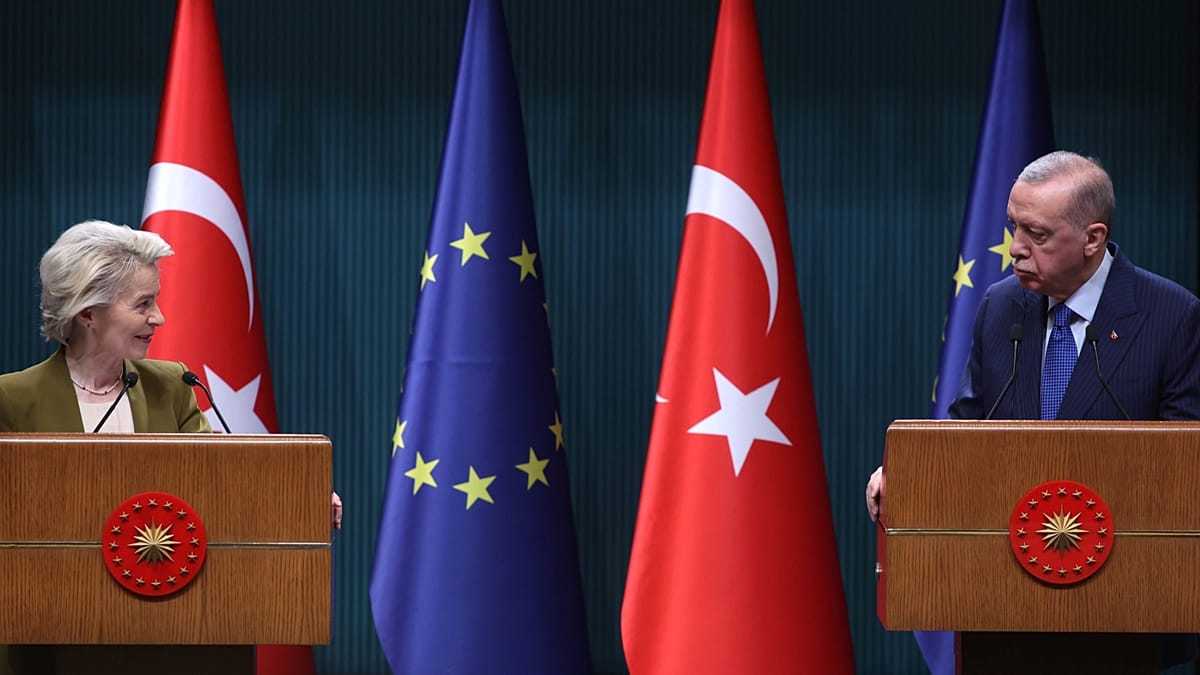
European Commission President Ursula von der Leyen will sit down with Turkish President Recep Tayyip Erdoğan for a working dinner in Ankara on Wednesday evening, a meeting that carries the weight of unresolved disputes and strategic necessity. The encounter, which follows the NATO summit in the Turkish capital, also includes European Council President António Costa, and is expected to test the EU's ability to balance geopolitical pragmatism with its core values.
Turkey has been an official candidate for EU membership since 1999, but relations have soured in recent years over democratic backsliding, press freedom crackdowns, and the arrest of opposition figures. In March, Turkish police detained Ekrem İmamoğlu, the mayor of Istanbul and a key rival to Erdoğan, triggering widespread condemnation from European capitals. Polish MEP Joanna Scheuring-Wielgus, who sits on the EU-Turkey Joint Parliamentary Committee, warned that any rapprochement must not come at the expense of the Union's principles. 'These are not a cherry on top of our partnerships, but the very foundation of the European project,' she told Euronews, citing the suppression of press, criticism, and opposition parties as fundamental obstacles.
Von der Leyen herself has personal reasons to tread carefully. During a 2021 visit to Ankara, she was left standing without a seat in a meeting with Erdoğan and then-European Council President Charles Michel—an incident dubbed 'sofagate' that she later described as 'hurtful.' When asked where she would sit at Wednesday's dinner, European Commission Deputy Chief Spokesperson Olof Gill replied dryly: 'I expect they will be sitting at the dinner table, as is usually appropriate for dinner.'
Defence Cooperation and Geostrategic Calculus
Beyond protocol, the dinner is a chance to reset a relationship that has become increasingly vital for European security. With the United States scaling back its military commitments on the continent, Ankara's role as a key NATO ally and a supplier of weapons to Ukraine has grown in importance. German MEP Engin Eroglu, who is of Turkish heritage, described the meeting as 'an attempt to reset relations' and a move toward a 'more pragmatic and security-oriented level.' He pointed to the possibility of Turkish involvement in the €150 billion Security Action For Europe (SAFE) defence loan programme, though full participation is blocked by Greece and Cyprus, limiting Turkey to providing up to 35% of component costs for any project.
Von der Leyen, speaking alongside NATO Secretary-General Mark Rutte at the summit on Tuesday, acknowledged the potential for closer ties. 'There's a wide opportunity to have a very close cooperation with each other,' she said, without specifying the framework. The EU's foreign policy chief, Kaja Kallas, visited Ankara last week with Commissioners Marta Kos and Magnus Brunner for what EU officials called a 'jumbo meeting,' resulting in a joint statement that stressed shared commitments to multilateralism and regional stability. Kallas later posted on X that 'Turkey is a key partner on security, migration, and energy, as well as an EU candidate country.'
Yet the path forward remains fraught. Roughly 200 people were detained in Turkey ahead of the NATO summit, and Erdoğan's government has continued to tighten its grip on the judiciary and media. As one analyst noted, Erdoğan 'is able to count on there being barely a murmur from the country’s European partners,' a silence that critics argue undermines the EU's credibility. The dinner in Ankara will test whether Brussels can maintain its principles while pursuing a strategic partnership with a nation of nearly 90 million people that sits at the crossroads of Europe, the Middle East, and Asia.