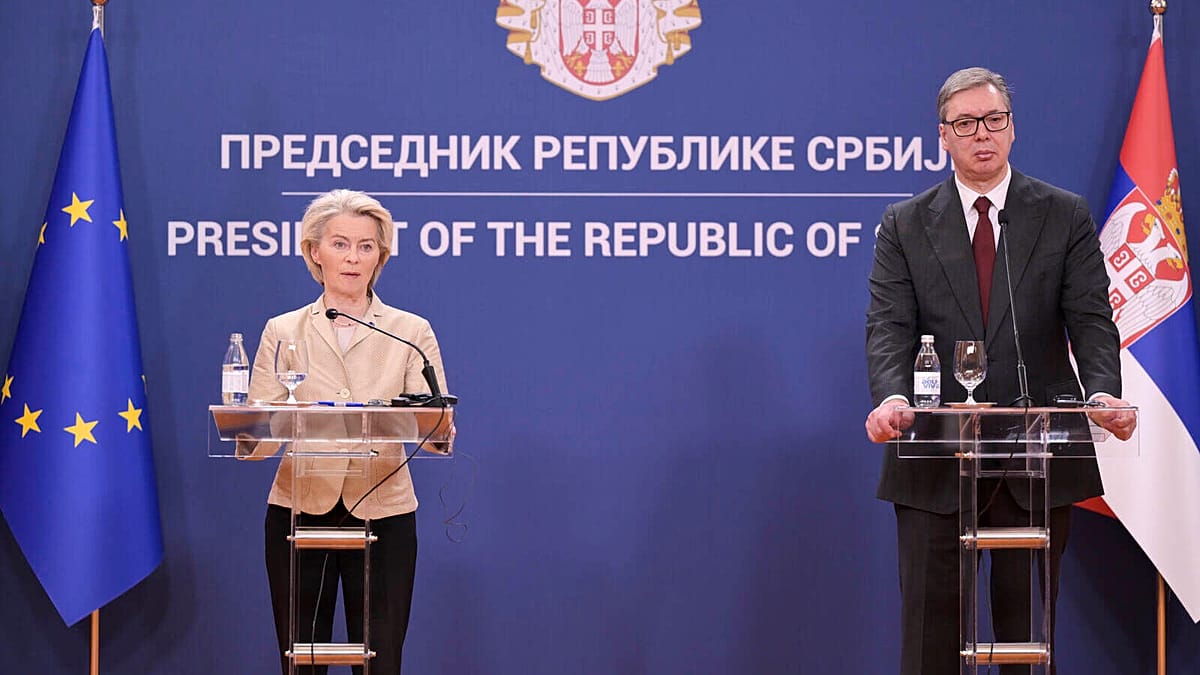
European Commission President Ursula von der Leyen told the European Parliament on Wednesday that she was "horrified by the images" of the funeral of convicted war criminal Ratko Mladić in Belgrade earlier this month, but she stopped short of announcing any punitive measures against Serbia.
Speaking during her annual State of the European Union address in Strasbourg, von der Leyen said: "The glorification of war criminals simply has no place in the European Union." Yet she refrained from directly criticising Belgrade, despite growing calls from EU lawmakers and national leaders for a firmer response.
Mladić, known as the "Butcher of Bosnia," died in August while serving a life sentence in The Hague for genocide, crimes against humanity, and war crimes committed during the Bosnian War in the 1990s. His body was flown to Belgrade on a state plane, greeted by an honour guard from the Serbian military and security forces, and commemorated by the public broadcaster and the Serbian Orthodox Church. His coffin was draped in the Serbian flag.
Officials in Belgrade had previously denied that Mladić would receive a funeral with state honours, but the images of the ceremony sparked outrage across Europe. Croatian Prime Minister Andrej Plenković was among those criticising the EU's muted response, saying the bloc should have reacted more forcefully.
Accession talks in limbo
The Commission under von der Leyen had been pushing to advance Serbia's bid to join the EU by unlocking Cluster 3 talks on economic growth. But EU capitals blocked the move, citing persistent concerns over democratic backsliding, even after the Venice Commission said Belgrade had implemented most of its recommendations on judicial reforms.
Diplomats told Euronews that the funeral has effectively put Serbia's accession push on hold. One diplomat said that "anyone even considering opening Cluster 3 will think twice." Henrik Dahl, a Danish lawmaker from the European People's Party (EPP), said on Tuesday that "Serbia has put themselves in the back of the waiting line (to join the EU) because they gave a state funeral to a war criminal."
Several EU lawmakers have also questioned the affiliation of Serbian President Aleksandar Vučić's Serbian Progressive Party to the EPP, the centre-right political family to which von der Leyen belongs. The EU's enlargement chief, Marta Kos, postponed her planned visit to Belgrade in response to the funeral, prompting speculation that von der Leyen could announce similar repercussions.
The episode has cast a shadow over the EU's enlargement strategy in the Western Balkans, where it seeks to counter Russian and Chinese influence. While von der Leyen's State of the Union pledges focused on competitiveness, security, and climate, the Mladić affair underscored the bloc's difficulty in balancing engagement with conditionality.
Critics argue that the EU's response has been too timid, given the gravity of glorifying a man convicted of orchestrating the Srebrenica massacre, in which more than 8,000 Bosniak men and boys were killed. The EU has previously made clear that respect for international justice and reconciliation are core values for membership, but translating that into concrete measures has proven contentious.
Some diplomats suggest that the Commission's reluctance to act reflects a desire to keep Serbia engaged in dialogue, particularly on issues such as Kosovo's status and energy cooperation. Yet the funeral has made it politically harder for EU leaders to advance Serbia's file without appearing to condone the glorification of war crimes.
As the EU debates its next steps, the contrast between von der Leyen's strong words and the lack of action is likely to fuel further criticism. The European Parliament is expected to hold a debate on the matter, and some MEPs are calling for a formal review of Serbia's accession negotiations.
For now, the bloc appears to be treading carefully, hoping that time and diplomatic pressure will lead Belgrade to distance itself from the symbols of the 1990s wars. But as the images from the funeral continue to reverberate, the question remains whether the EU can afford to let the issue fade without consequences.