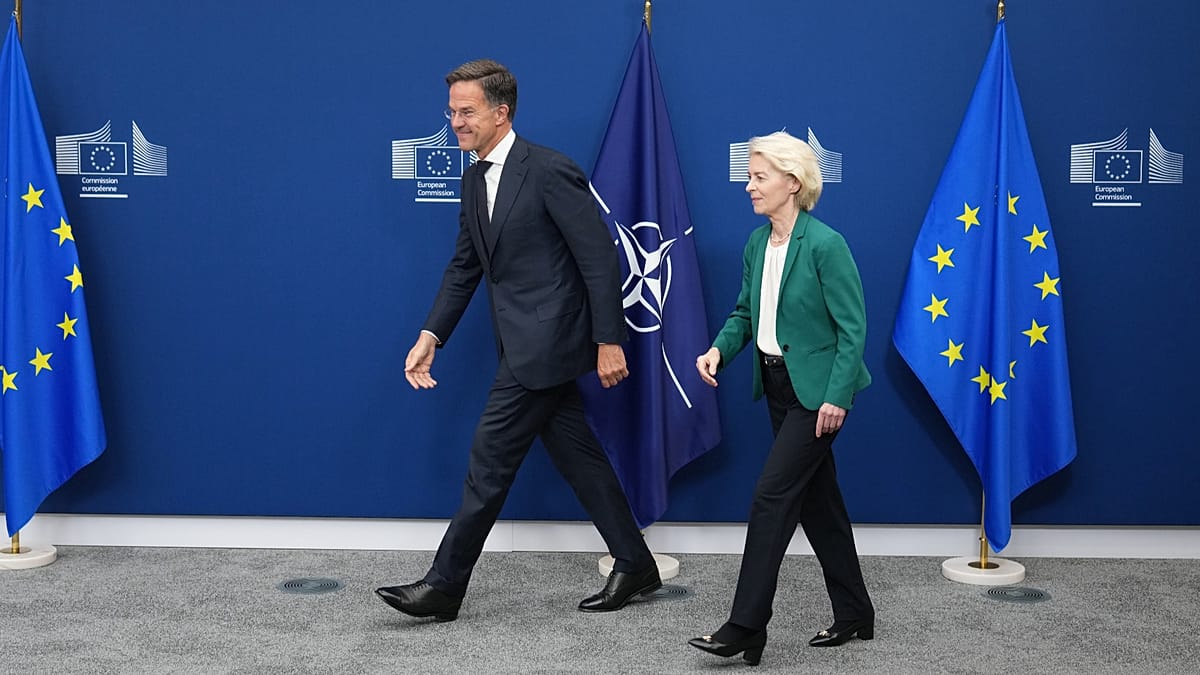
European Commission President Ursula von der Leyen has warned that incidents such as last month's drone sabotage at Leipzig/Halle Airport are no longer exceptional but have become the "new normal" in Europe's security landscape. Speaking alongside NATO Secretary General Mark Rutte in Brussels, she described the attack as a direct escalation on EU soil attributed to Russia, part of a wider pattern of increasingly dangerous hybrid operations.
"Leipzig marks a new escalation on European Union soil directly attributed to Russia, but it is part of a broader pattern of increasingly dangerous incidents," von der Leyen said. If the explosive-laden drone had detonated as intended, she added, "this would have resulted in enormous damage, and possibly even loss of life."
The German government formally blamed Moscow for the 4 August incident, which saw a drone packed with explosives discovered at the airport in the eastern city of Leipzig. Interior Minister Alexander Dobrindt said the device was "known to use from other hybrid operations conducted by Russia and its war against Ukraine," concluding that "Russia is responsible for the hybrid attack in Leipzig."
Berlin responded by ordering the closure of the Russian consulate in Bonn and terminating the operating agreement for the Russian House in Berlin. The Kremlin has denied involvement and vowed to retaliate, with Deputy Foreign Minister Alexander Grushko accusing Berlin of choosing a "path of escalation" and blaming European leaders for sponsoring what he called Ukrainian "terrorism."
A new era of European security
Von der Leyen stressed that Europeans must now treat everyday infrastructure as frontline targets and protect it accordingly. "We are in a new era of European security," she said, adding that the EU already has rapid response teams capable of reacting to such attacks and is prepared to expand sanctions against Russia. Foreign ministers meeting informally in Wicklow, Ireland, discussed adding further listings to the existing sanctions package.
Rutte echoed her assessment, noting that Russia has become "increasingly reckless" as its full-scale invasion of Ukraine continues, with the threat now extending to NATO territory. "The danger Russia poses is clear," he said. He dismissed any suggestion that the alliance might be divided or deterred from supporting Ukraine, insisting: "Our unity is unshaken."
The EU's top diplomat, Kaja Kallas, described the Leipzig incident as bearing "all the hallmarks of state sponsored terrorism." Speaking before the foreign affairs meeting, she said the bloc had already summoned Russian ambassadors and would discuss further measures. In response to the attack, the EU and Belgium summoned Russia's ambassador in Brussels, while France and the Netherlands called in Russian diplomatic representatives.
Kallas also highlighted that 1,600 individuals and entities supporting Russia's military complex have been proposed for new EU sanctions, with the possibility of more to come. The measures, part of the 21st sanctions package adopted in late July, target producers of long-range drones such as the Garpiya model. She cautioned that nothing would be finalised at Wednesday's informal meeting.
Ukrainian President Volodymyr Zelenskyy said he had spoken with German Chancellor Friedrich Merz and offered Kyiv's assistance, "with expertise, experience, or in other areas where Germany may need." He called the incident "yet another Russian escalation" and welcomed Germany's firm response.
The developments come as European leaders grapple with a broader surge in hybrid threats, from disinformation to sabotage. Von der Leyen's remarks underscore a growing consensus that the continent must adapt to a persistent and evolving challenge. As she put it, "Europeans are faced with a hard truth, that this is the new normal."