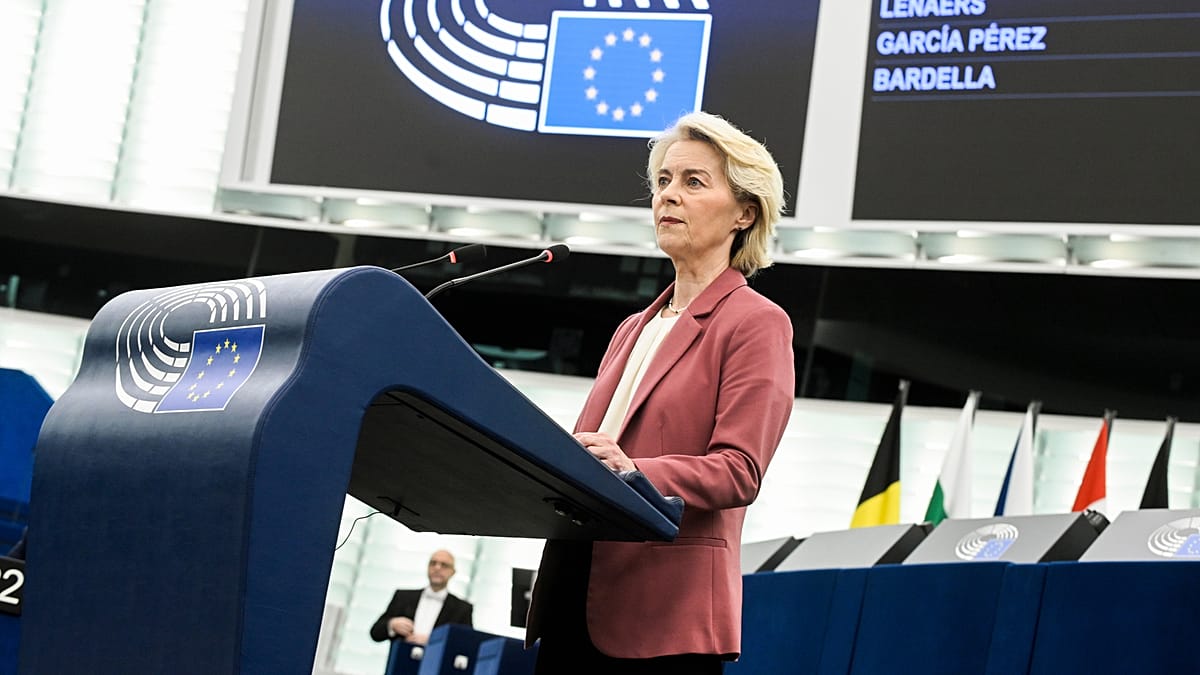
Strasbourg, bathed in late-summer sunshine, is the backdrop for what may be Ursula von der Leyen's most consequential State of the Union address. With her mandate winding down, the European Commission president is using this moment to define her legacy and set the agenda for the remaining years of her term.
In Brussels, a familiar adage holds: the first year of a legislative term is for reflection, the second for announcements, and the third to fifth for execution. By that measure, this is von der Leyen's last real opportunity to unveil initiatives she can still steer to completion before leaving office. The question is which proposals made the cut.
Three tipping points
Three forces are shaping the speech. First, climate change has shifted from forecast to lived reality, as wildfires and heatwaves across southern Europe force a reckoning with adaptation. Second, artificial intelligence is advancing faster than regulators anticipated, demanding a delicate balance between innovation and control. Third, the EU's industrial competitiveness is intertwined with its relationship with China, as Brussels seeks to reduce dependencies while maintaining market access.
On climate, von der Leyen must navigate a divided Parliament. Conservative lawmakers are pushing for a focus on preparedness—improving disaster response and closing the insurance gap—while progressive MEPs insist on maintaining the Green Deal's mitigation drive and a strong international climate diplomacy stance. The speech is expected to acknowledge both imperatives, though the emphasis will be telling.
On AI, the Commission president is expected to address the risks of frontier models—job displacement, cybersecurity threats, and loss of human control—while championing the benefits of wider technological uptake. The EU's AI Act, already in force, provides a regulatory framework, but von der Leyen may signal further steps to keep pace with rapid developments.
Economic and trade signals
On the economy, the speech will likely reference cutting energy import dependencies and boosting the EU's clean tech sector, particularly as the conflict in Iran pushes energy prices higher. Competitiveness will be a recurring theme, but concrete proposals may be scarce, given the ongoing negotiations on the bloc's next long-term budget.
On China, an October deadline looms for Beijing to make trade concessions in talks with Brussels. Von der Leyen is unlikely to pre-empt the negotiations, but she could send a strong signal about the consequences of a breakdown. The EU has been exploring measures to counter Chinese overcapacity in sectors like electric vehicles and steel, and the speech may hint at future actions.
Ukraine and hybrid threats
Ukraine will feature prominently, with the Commission bracing for Kyiv to endure a brutal winter as Russia intensifies its campaign of ballistic missiles and jet-powered drones against civilian infrastructure. Von der Leyen is expected to reaffirm EU support and condemn Russia's ongoing sabotage and drone incursions across Europe, including the recent attempted attack in Leipzig. These hybrid threats, once theoretical, are now a kinetic reality, and the speech will likely underscore the need for a coordinated response.
On sanctions against Moscow, a 22nd package is in the works but unlikely to be ready for announcement. Instead, von der Leyen is expected to double down on enforcement, pointing to ways of shutting down circumvention routes that allow Russia to bypass existing measures.
Social media and migration
In a move that has already leaked, von der Leyen will preview a proposal, due on Thursday, to restrict under-15s' access to social media and video-sharing platforms. This initiative, part of a broader push on digital child safety, is likely to draw both support and criticism from different corners of the Parliament.
On migration, the focus will be on implementation of the new migration pact, touting the recent drop in EU asylum applications while pledging to ramp up the bloc's crisis management capacity. The EU border agency Frontex is due for a review later this year, and the speech may set the tone for that process. Migration remains a raw nerve for von der Leyen's centrist coalition, especially after Tuesday's plenary debate on the Ceuta crisis descended into a shouting match between right-wing and left-leaning MEPs. References to the controversial proposal to finance return hubs in third countries with EU money are unlikely, given the complex negotiations on the long-term budget.
Canada and the unexpected
Canada will be the elephant in the room. Mark Carney's arrival in Strasbourg on Thursday could steal von der Leyen's thunder when he addresses the Parliament. Expect opening remarks on bringing Canada as close to the EU as possible, short of full membership, which is prevented by the treaties. The EU-Canada relationship, already deep through CETA, may see new avenues for cooperation.
Finally, von der Leyen likes to drop a surprise or two, jealously guarded until the very last moment. Last year, nobody saw the proposal to suspend the EU-Israel Association Agreement coming. This year, the unexpected could come from any direction—perhaps a bold initiative on defence, a new climate finance mechanism, or a fresh approach to enlargement. As the speech unfolds, the continent will be watching.