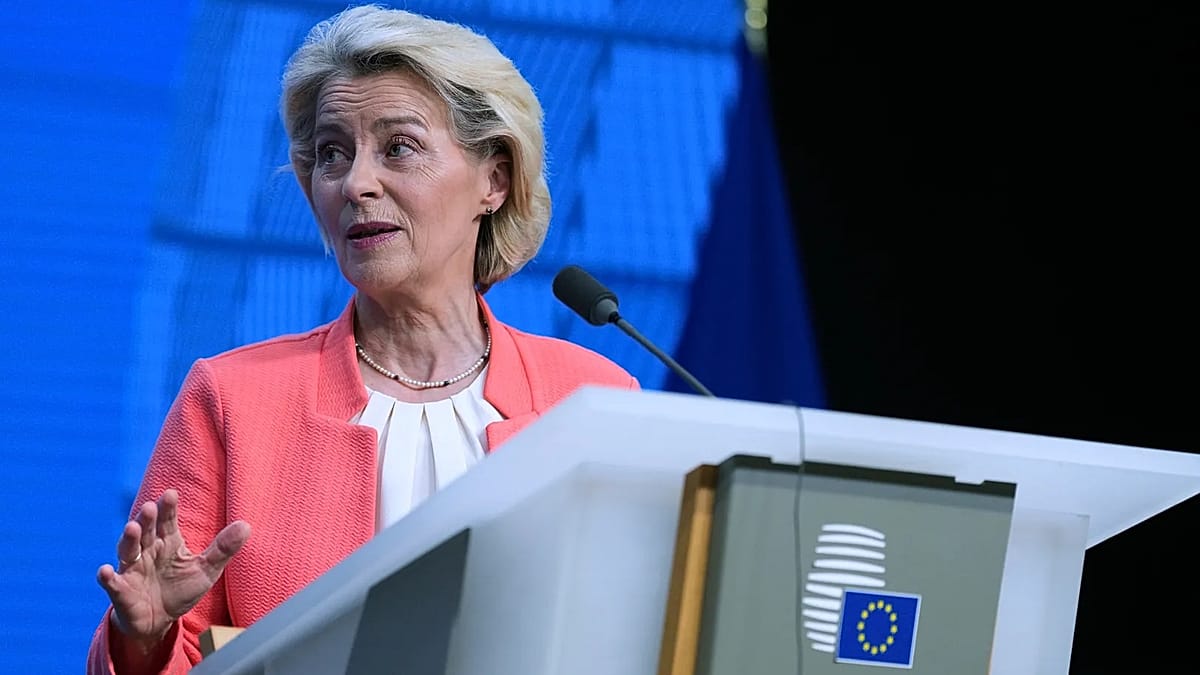
European Commission President Ursula von der Leyen is making her first trip to the South Caucasus since Armenia and Azerbaijan initialled a historic peace agreement last year. The visit, which includes stops in Baku and Yerevan, aims to deepen the EU’s strategic engagement with a region that has long been under Moscow’s influence.
In Baku on Wednesday, von der Leyen will meet President Ilham Aliyev to discuss energy cooperation and regional infrastructure. The following day, she travels to Yerevan for talks with Prime Minister Nikol Pashinyan, focusing on support for Armenia’s cautious pro-Western pivot amid Russian economic pressure.
The European Commission has outlined four priorities for the visit: backing the peace process, improving connectivity across the region and with Europe and Central Asia, deepening economic ties, and helping Armenia withstand Russian economic coercion.
Energy and Infrastructure at the Forefront
This is von der Leyen’s first visit to Baku since 2022, when the EU and Azerbaijan signed a strategic energy partnership to expand natural gas supplies via the Southern Gas Corridor. That deal was part of Europe’s urgent search for alternatives to Russian energy after the full-scale invasion of Ukraine.
Talks with Aliyev are expected to centre on increasing Azerbaijani gas exports to Europe. Currently, 16 European countries—including 10 EU member states—receive Azerbaijani gas, with Italy as the top importer. Italian Prime Minister Giorgia Meloni’s visit to Baku in May underscored the importance of this energy link.
Beyond energy, the EU is keen to develop the Middle Corridor, a transport network connecting China and Southeast Asia through Kazakhstan, Azerbaijan, Georgia, and onward to Turkey and Europe. This route, also known as the Trans-Caspian International Transport Route (TITR), offers a strategic alternative to the Northern Corridor through Russia, which has become unreliable due to geopolitical tensions.
European Commissioner for Enlargement Marta Kos, who will join von der Leyen on both visits, launched the EU’s new Connectivity Agenda Platform last week. She stressed the importance of securing trade, energy, and digital links via trusted routes. “Take a look at the plane map before and after the start of the recent war in Iran. Almost all planes started passing through the Caucasus. It’s through here, the Middle Corridor, that we can secure our trade, energy and digital links,” Kos said.
The Middle Corridor is about 3,000 kilometres shorter than the Northern Corridor and is seen as a modern version of the ancient Silk Road. It starts at the Chinese port of Lianyungang, runs through Xi’an, enters Kazakhstan, and then branches towards Uzbekistan and the Caspian Sea. From there, it connects to ports in Azerbaijan and Georgia before ending at hubs in Romania, Hungary, and Poland.
Azerbaijani political analyst Toghrul Mammadli, a representative to the United Nations Economic and Social Council, noted that the EU remains Azerbaijan’s largest trading partner, accounting for about 43% of the country’s foreign trade. “Energy continues to be the cornerstone of this partnership. In 2025, Azerbaijan exported 12.9 billion cubic metres of natural gas to Europe, representing more than half of its total gas exports, while also supplying around 8% of the EU’s pipeline gas imports,” he said.
The visit also follows European Council President Antonio Costa’s talks with Aliyev in March, when both sides agreed to work on a new framework for closer cooperation on defence, security, and digital development. This signals a broadening of EU-Azerbaijan relations beyond energy and infrastructure.
For Armenia, von der Leyen’s visit is a chance to solidify support for Yerevan’s cautious shift away from Moscow. The EU has already provided economic assistance to help Armenia cope with Russian sanctions and trade disruptions. The peace agreement with Azerbaijan, which ended decades of conflict over Karabakh, opens the door for deeper regional integration and EU investment.
As the EU seeks to diversify its energy supplies and trade routes, the South Caucasus is emerging as a critical partner. Von der Leyen’s visit underscores Brussels’ commitment to a region that is no longer in Russia’s orbit but is charting its own course towards closer ties with Europe.