For 27 years, Vibeke Andersen, a 53-year-old Dane, lived with relentless auditory hallucinations. Voices told her she was worthless, that no one cared, and that even her family could not love her. Diagnosed with paranoid schizophrenia, she cycled in and out of psychiatric hospitals, her life dictated by an invisible tormentor.
Then in 2020, she enrolled in an experimental treatment that seemed counterintuitive: instead of trying to ignore or distance herself from the voice, she would face a virtual embodiment of it, inside a headset.
Confronting the voice in virtual reality
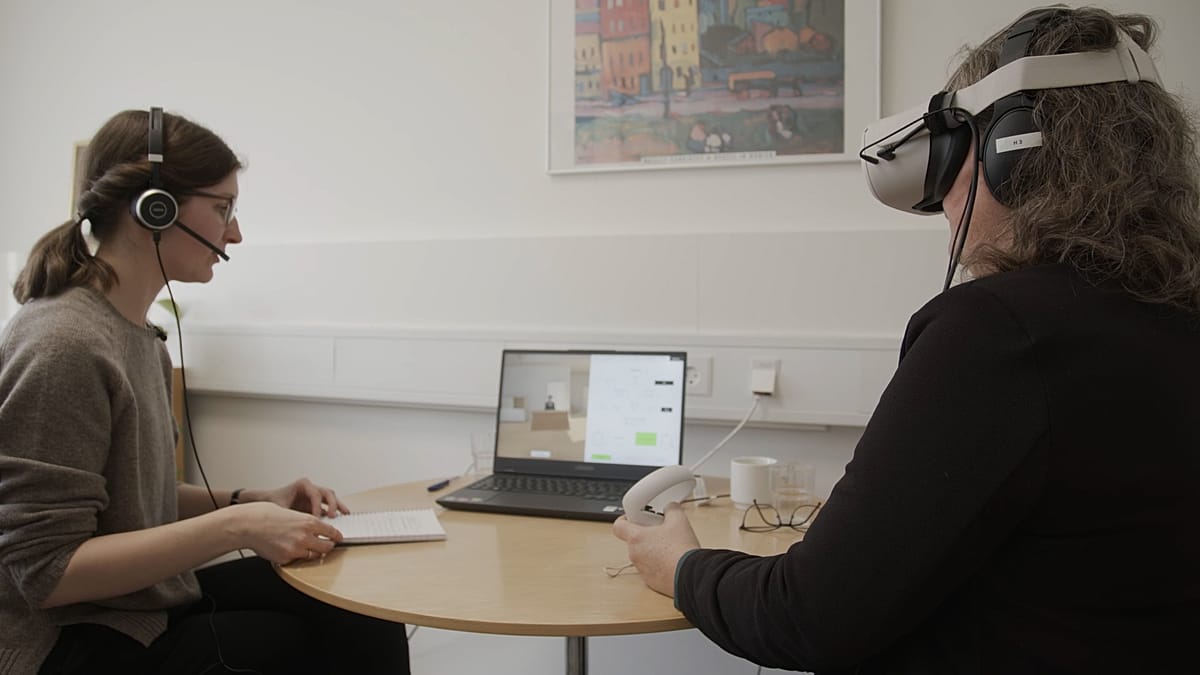
Therapists at the VIRTU research group, based at Copenhagen University Hospital's mental health services, used specialised software to build an avatar from Andersen's description of her dominant voice. They adjusted its appearance and sound until it matched her experience. When she put on the VR headset, the avatar stood before her, and her therapist spoke the kinds of phrases she normally heard, transformed by voice software to sound like the original.
“They engage in this conversation, talking back and forth, standing up against the voice, reclaiming the power and control over it,” said Louise Birkedal Glenthøj, head of the VIRTU group and associate professor at the University of Copenhagen's psychology department.
The process was gruelling. Around the fourth or fifth session, her therapists considered stopping. “They told me that I better drop off this treatment,” Andersen recalled. “I was still stubborn and I thought, 'No way. I'm going to do this treatment to the end.'”
In one pivotal session, she stood in a virtual forest and screamed at the avatar. “F**k off,” she shouted. “I don't want these voices anymore. They had to get out of my life. They had to leave me, leave my mind, and I had to be free as a person.”
A 'safe and tolerable' intervention
Andersen was part of the CHALLENGE project, a trial involving 270 people with schizophrenia-spectrum disorders and persistent auditory hallucinations. Participants received seven VR sessions, while a control group got standard care plus supportive counselling. Results, published in The Lancet Psychiatry in 2025, showed that VR therapy significantly reduced the overall severity of hallucinations after 12 weeks, and patients heard voices less frequently at both 12 and 24 weeks.
“We were very surprised. This was a very experimental study. Could it actually work? Was it feasible? What would the patients think of going into this simulated reality and confronting their symptoms?” Glenthøj said.
The broader VIRTU programme now involves around 1,000 participants across studies of several mental health disorders, and some VR treatments are already used in Denmark's psychiatric services. The conditions targeted affect millions: schizophrenia affects about 23 million people worldwide, eating disorders around 16 million, and anxiety disorders roughly 359 million, according to the World Health Organization.
“What is very rewarding now is to see that we can actually achieve quite a change by very short-term interventions,” Glenthøj said.
The confrontational approach is not for everyone. “For some, it is very overwhelming,” she said. “You might experience a deterioration or increasing symptoms for a period, but that will pass, and then you will hopefully have greater control over the symptoms.” Therapists adjust the pacing based on each patient's anxiety response, and some may need extra preparation or other therapy first. Overall, the research has found the treatment “safe and tolerable”.
Why it works: externalising the symptom
Researchers are still unravelling the mechanism. One hypothesis is that turning an internal experience into something visible, audible, and interactive gives patients a sense of control—a process called 'externalisation'. “With VR, we can kind of bridge patients' daily life and therapy,” Glenthøj said. “We can bring daily life into the therapy room.”
VIRTU is now expanding its work to psychosis, eating disorders, social anxiety, autism, and depression. For eating disorders, an avatar can represent the critical “eating disorder voice” some patients hear, while other projects recreate social situations to address paranoia or anxiety.
By the time Andersen arrived for what would have been her final session, the voice had vanished. “I came to my last treatment after Christmas and I said, 'I don't have to say goodbye to something which is not there'. So I left the session. I said, 'I think I'm cured',” she said. At a six-month follow-up, she was still free of voices—and five years on, she remains so.
Her story echoes a broader trend in European mental health care, where digital tools are being integrated into treatment, though experts caution that regulation must keep pace. For Andersen, the freedom is simple: “I'm free.”