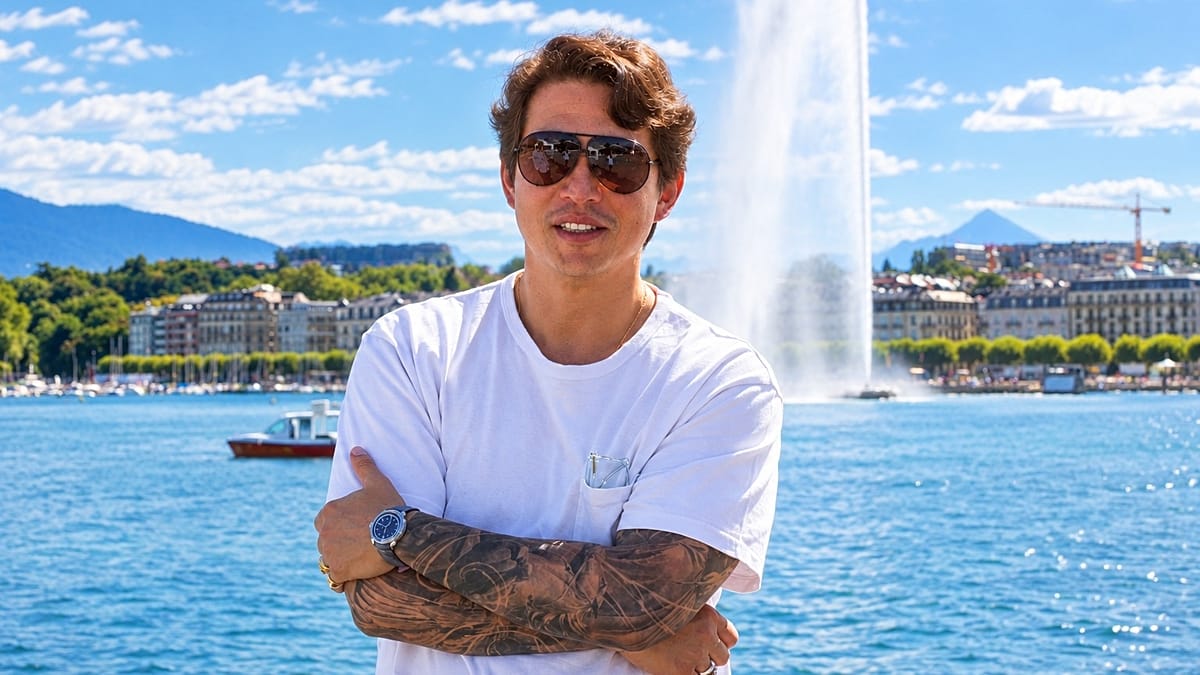
With just days to go before the Grand Prix d'Horlogerie de Genève (GPHG) ceremony, Wei Koh is easy to spot among the crowds at Geneva Watch Days. In a white T-shirt, sunglasses, and with visible tattoos, the 54-year-old Singaporean exudes a relaxed confidence that belies the weight of his new role: for the first time, he is president of the jury for the industry's most coveted awards, often called the Oscars of watchmaking.
Koh, who founded the media company Revolution in 2005, has been a jury member in previous editions. Now he leads a 24-member panel that will meet behind closed doors in Geneva in early November to examine all 84 nominated timepieces, debate their merits, and vote by secret ballot. The ceremony takes place on 7 November, and this year's edition introduces significant changes, including the scrapping of gender-based categories in favor of technical ones and, for the first time, an English-language ceremony.
What makes a winning watch?
Koh is characteristically effusive about this year's contenders. "The creativity is extraordinary this year. You've got watches that are executed at such a level of finesse that, as a watch lover, it makes you want to weep," he says. Among the nominees are a grand sonnerie that can play two different melodies for the quarter-hour chimes, a watch reviving a century-old balance-wheel technique thought lost, and a chronograph that reimagines how wearers interact with the complication.
But what sets a truly great watch apart? For Koh, it's about singularity. "Remember the first time you listened to John Coltrane, or Miles Davis, or Tupac? Even if that person was relatively young, they were making a fundamental contribution to music. It's the same with watches," he explains. He borrows a line from watchmaking legend François-Paul Journe, who described the craft as a continuous wall. "If you want to enter this métier, your mission is to add at least one brick, a vital contribution," Koh says. "That's what we're looking for."
The jury's deliberations are shrouded in secrecy, but Koh credits his predecessor, Nick Foulkes, for fostering a culture of rigorous debate. "Nick has always believed in debate," Koh recalls. "There are extraordinary moments where you're like, wow, I've just had a revelation. Someone explained it so well it completely changed my mind about a specific timepiece."
An industry in motion
The GPHG's shift away from gender categories reflects broader changes in the watch industry, which has seen historic highs over the past decade. Koh has spent two decades pushing for a more inclusive and global approach. "The whole idea with Revolution was to uplift the founding ethics and principles of watchmaking while connecting it with a much bigger audience," he says. "For this craft, for this industry to survive, we have to keep growing the audience and bring in the next generation."
That audience now includes some of the most powerful figures in tech. Koh points to what he calls "tech and AI oligarchs, the people who built the hyper-digitised world we now live in, who have become huge watch collectors." Mark Zuckerberg, for instance, has been spotted wearing high-end independents like Patek Philippe, F.P. Journe, H. Moser & Cie., and De Bethune. For Koh, this is no coincidence: "A mechanical watch is the opposite of everything ephemeral."
Koh's own journey mirrors the industry's evolution. In 2005, he was handing out magazines at Baselworld; today, he is one of the most recognisable names in watchmaking and the producer of Man of the Hour, one of the first documentary-style series dedicated to the craft. "What I've learned over these years is that this industry is a meritocracy," he reflects. "If you strive for excellence, if you're consistent and honest in your efforts, you will succeed. But what this industry really rewards is when you try to contribute meaningfully to its survival, by protecting its principles."
As the GPHG prepares to crown its winners, the changes—both in categories and language—signal a deliberate effort to modernise. The decision to drop gender categories was announced earlier this year, and the move to English reflects the global nature of the audience. Koh, who has long championed this evolution, sees it as essential. "We have to keep growing the audience," he insists, "and that means speaking their language."
With the ceremony just days away, the watch world will be watching closely. But for Koh, the real prize is not the trophy itself—it's the recognition of those who add a brick to the wall. "That's what we're looking for," he says, "and this year, there are plenty of bricks."