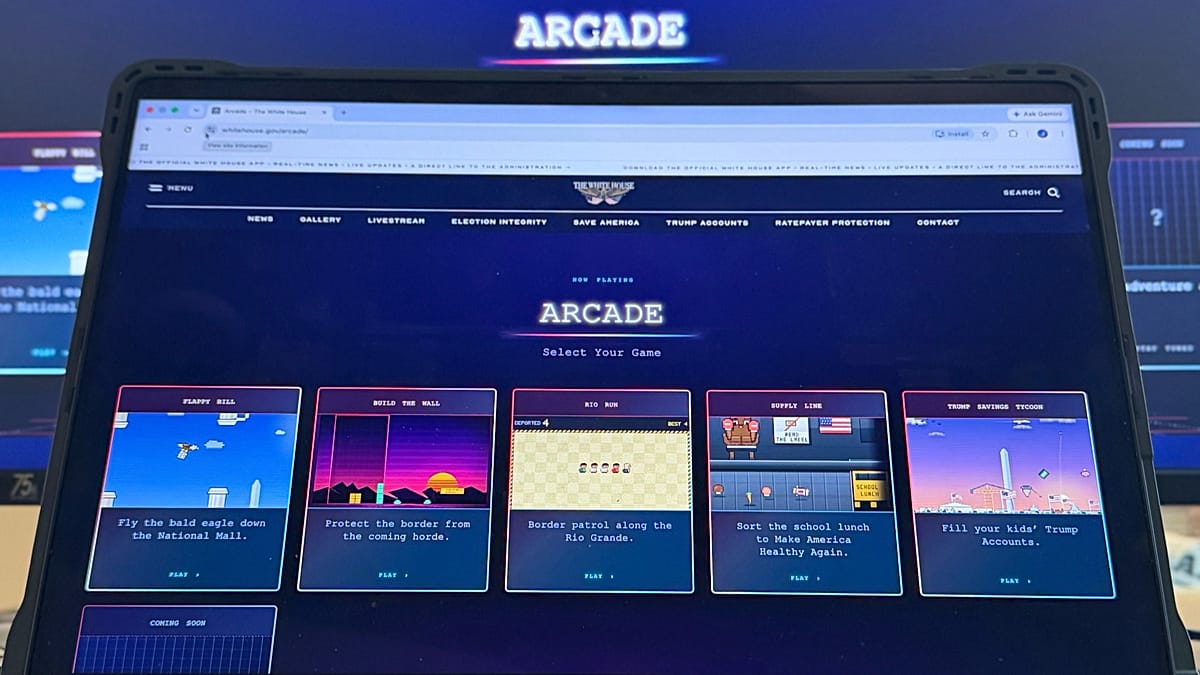
The White House has added a new section to its official website, dubbed “Arcade,” featuring five low-resolution games that repackage key administration policies as pixelated entertainment. The most controversial title, Rio Run, is a reworking of the classic Snake game, where players control a digital version of border czar Tom Homan as he chases migrants across a grid representing the Rio Grande. The game depicts migrants with varying skin tones, a detail that has drawn sharp criticism.
Another game, Build the Wall, borrows mechanics from Tetris, but instead of clearing lines, players stack sections of the border wall while an in-game message urges them to “protect the border from the coming horde.” The remaining three titles steer clear of the border: Supply Line has players sorting food on a conveyor belt to meet “Make America Healthy Again” standards, Flappy Bill features a bald eagle carrying legislation across the National Mall, and Trump Savings Tycoon lets players scoop up falling money to fill “Trump Accounts,” a reference to the administration’s savings scheme for children born during Trump’s second term.
Rights groups respond
Advocates working along the U.S.-Mexico border reacted with dismay. Amerika Garcia Grewal, co-director of the Frontera Federation in Eagle Pass, Texas, said the games made her feel sick, adding that the administration had “been playing games with people’s lives for years” and now “made a video game of what they’re doing.” She said the designers “have lost touch with what it means to be human and care for others.”
Adriana Jasso, a programme coordinator at AMIGOS San Diego Community, who works at the border, said the games betrayed a “lack of seriousness” at a time when people are dying in detention centres. “This presents the issue as if it were a game, when in fact it is not,” she said.
The launch comes as the administration intensifies its mass arrest and deportation programme for undocumented migrants, a central pillar of Trump’s campaign platform. The White House announced the arcade on social media with animations spoofing console loading screens, including a clip that morphs the old Sega logo into “MAGA.” The accompanying post declared: “CAN'T STOP WINNING. Build the wall. Deport. Fill a Trump Account.”
In a statement to AFP, the White House said the administration is “laser focused on ways to innovate and tell the story of the President's many accomplishments in a way that resonates with every American.” It added that the arcade was meant “to further contrast between a culture of fun and winning and the dark socialist vision Democrats have for America.”
This is not the first time the White House’s social media operation has drawn criticism for its handling of sensitive topics. Previous posts have set deportation footage to pop songs and shared ASMR-style videos of shackles, leading to complaints and occasional legal threats from musicians whose work was used without permission.
The arcade games have been widely condemned by human rights organisations, who argue that they trivialise the serious consequences of immigration enforcement. The use of different skin tones in Rio Run has been particularly criticised as racially insensitive.
While the games are clearly aimed at a domestic audience, they have implications beyond the United States. The deportation policies they celebrate have been a point of tension with European allies, who have raised concerns about human rights and the treatment of migrants. The EU has previously imposed sanctions over forced deportations of Ukrainian children, a separate but related issue that highlights the bloc’s stance on such practices. EU sanctions over child deportations reflect a broader commitment to accountability.
The arcade also comes amid other controversial moves by the Trump administration, including efforts to revive mail-voting restrictions and becoming the first sitting president on a circulating coin. These actions, like the arcade, are part of a broader strategy to consolidate support among his base.
For Europeans watching from across the Atlantic, the arcade is a stark reminder of the cultural and political divide that has widened in recent years. While the games may be dismissed as a trivial distraction, they reflect a governing style that prioritises spectacle over substance, and that has real consequences for people’s lives.