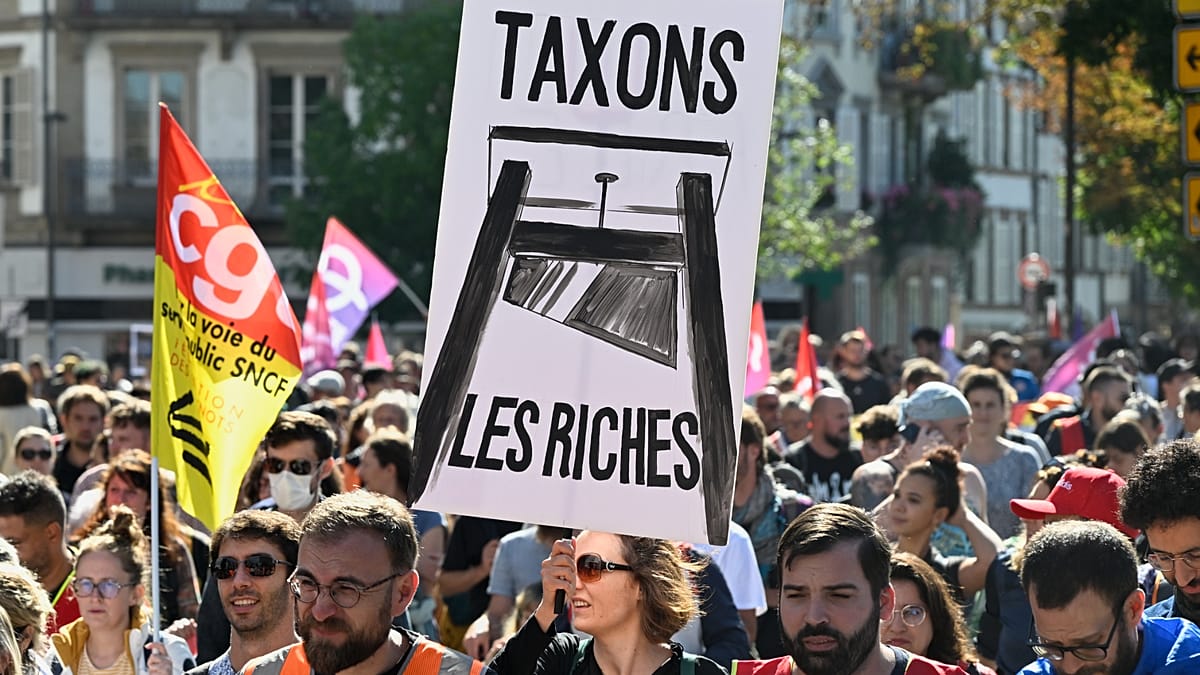
France lost a net total of 800 millionaires in 2025, according to the latest Henley & Partners Wealth Migration Report. While this represents a tiny fraction of the country's 2.4 million individuals with a net worth exceeding €1 million (as per the UBS Global Wealth Report), the outflow has drawn attention to the factors pushing some of France's top earners to leave.
Each departing millionaire took an average of €5 million in personal assets, amounting to roughly €4 billion leaving the country in total, reports the French Institute for Research on Public Administration and Politics (iFRAP). Economists note that even a small number of high-net-worth individuals can have an outsized economic impact, as they often own businesses, fund investment, and generate significant tax revenues.
Political Instability and the Tax Debate
France has seen six prime ministers in the last five years, repeated budget crises, and uncertainty over how successive governments plan to tackle the country's growing debt burden. The prospect of Marine Le Pen winning the April 2027 presidential election adds another layer of uncertainty. While her National Rally party has sought to reassure businesses and investors, economists question whether its spending commitments can be reconciled with France's strained public finances and the European Union's fiscal rules.
Another factor is the growing campaign to tax the rich. French economist Gabriel Zucman proposed a 2% annual tax on fortunes exceeding €100 million, including an exit tax that would apply for five years after relocation. Supporters argued it could raise €20 billion annually while affecting only around 1,800 households. The proposal passed the National Assembly last year but was blocked by the Senate and later defeated during debate on the 2026 budget. It was replaced by a 20% tax on luxury assets such as yachts, private jets, sports cars, and jewellery held inside passive family holdings worth at least €5 million.
French economist Thomas Piketty has argued that the risks of capital flight are often overstated and that greater international cooperation could make wealth taxes more effective. He maintains that rising wealth inequality has been fuelled by decades of tax cuts for the richest households and that carefully designed wealth taxes could reduce inequality without significantly harming investment. Critics, however, point to France's history with wealth taxes as a cautionary tale.
A History of Wealth Taxation
In 1982, President François Mitterrand introduced the Solidarity Tax on Wealth (ISF), which targeted net assets of high-net-worth individuals. Over its lifetime, the European Commission reports that the tax brought in €63.5 billion, but it also resulted in an estimated €200 billion in capital flight and reduced annual GDP growth by around 0.2%, according to French economist Eric Pichet. In 2017, President Emmanuel Macron scrapped the ISF and replaced it with the Real Estate Wealth Tax (IFI), which now raises roughly €1.1 billion each year.
There was also François Hollande's so-called 'Super Tax', a 75% marginal income tax on annual earnings exceeding €1 million. France's highest court, the Constitutional Council, struck down the original version in late 2012, ruling that it was unfair to tax individuals at such a high rate. The episode underscored the difficulty of imposing punitive taxes on the wealthy without triggering capital flight.
The current outflow is not unique to France. A recent survey found that over half of Germany's top earners consider leaving the country, reflecting broader European concerns about tax burdens and political stability. For now, France remains an attractive place for the wealthy due to its quality of life and joie de vivre, but the trend of departing millionaires—and their capital—is one to watch.



