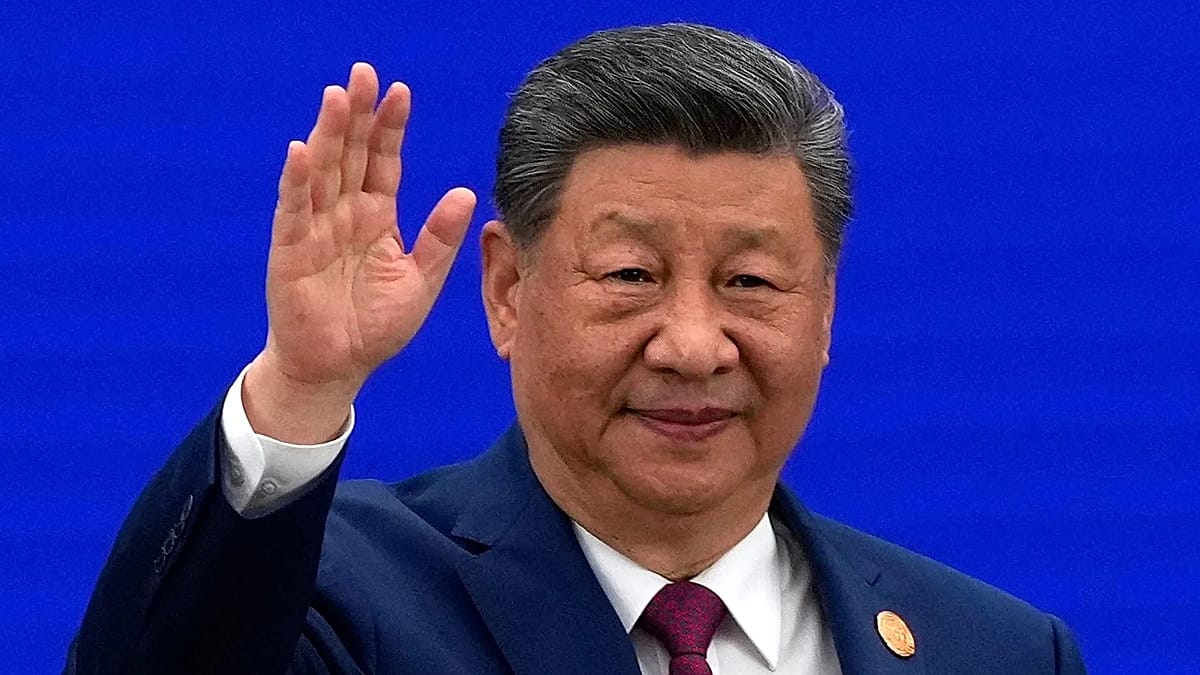
Chinese President Xi Jinping used the annual World Artificial Intelligence Conference in Shanghai on Friday to push back against US technology restrictions, calling for artificial intelligence to be developed and governed as a global effort rather than dominated by any single country.
Speaking to an audience that included the leaders of Kazakhstan, Cambodia, and Thailand, as well as UN Secretary-General António Guterres, Xi warned against what he called the “overstretching” of national security concerns — a pointed reference to American-led curbs that have cut China off from some of the world’s most advanced chips and AI technology.
“The development of artificial intelligence should not be a solo performance by any single country but rather a symphony of global cooperation,” Xi said.
China’s AI Diplomacy Push
The remarks come as Beijing intensifies its efforts to shape global AI norms and standards, particularly in the developing world where it sees a competitive advantage over Western companies. The day before the summit, 29 countries — including Russia, Pakistan, and Kazakhstan — signed an agreement with China to establish a new intergovernmental body, the World Artificial Intelligence Cooperation Organisation, to be based in Shanghai.
Xi also announced that China would offer 5,000 AI training opportunities to developing nations over the next five years and grant 30 countries access to a Chinese-built meteorological AI system with early-warning capabilities. These initiatives are part of a broader strategy to position China as a leader in AI governance, especially as the US and its allies tighten export controls on advanced semiconductors and AI hardware.
Tech giant Huawei is showcasing its Atlas 950 SuperPoD AI computing system at the conference, underscoring China’s determination to develop domestic alternatives to US-supplied technology.
The flurry of announcements reflects how seriously Beijing is competing for influence in AI, a field that European policymakers have also identified as critical. The European Union has been working on its own AI Act, which aims to regulate the technology based on risk levels, while also investing in research and development through programs like Horizon Europe. However, the EU’s approach has been more cautious, focusing on ethics and fundamental rights, whereas China is aggressively courting developing nations with concrete offers of training and infrastructure.
For European capitals, the Shanghai summit serves as a reminder that the global race for AI dominance is not just between Washington and Beijing. The EU has its own strategic interests, as highlighted by recent discussions among EU ministers who labeled China a “critical long-term strategic challenge.” The bloc is also grappling with how to balance its desire for technological sovereignty with the need for international cooperation, a tension that Xi’s call for a “symphony” of global governance seeks to exploit.
Xi’s speech also comes amid signs of economic strain in China. The country’s Q2 growth slowed to 4.3%, its weakest since late 2022, putting pressure on Beijing to find new drivers of growth. AI and high-tech manufacturing are seen as key areas for revitalizing the economy, but the US restrictions on chip exports have made it harder for Chinese firms to access the most advanced technology.
Meanwhile, the EU is also navigating its own relationship with China on technology. A top MEP recently warned that EU market restrictions could destabilize China’s economy, highlighting the delicate balance between protecting European interests and maintaining trade ties. The EU’s stance on AI governance will be closely watched, as it could influence how other regions, including the developing nations China is now courting, approach the technology.
As the World Artificial Intelligence Conference continues, the message from Beijing is clear: China wants to be seen as a partner, not a rival, in the global AI ecosystem. Whether that message resonates in Brussels, Berlin, or Paris remains to be seen.