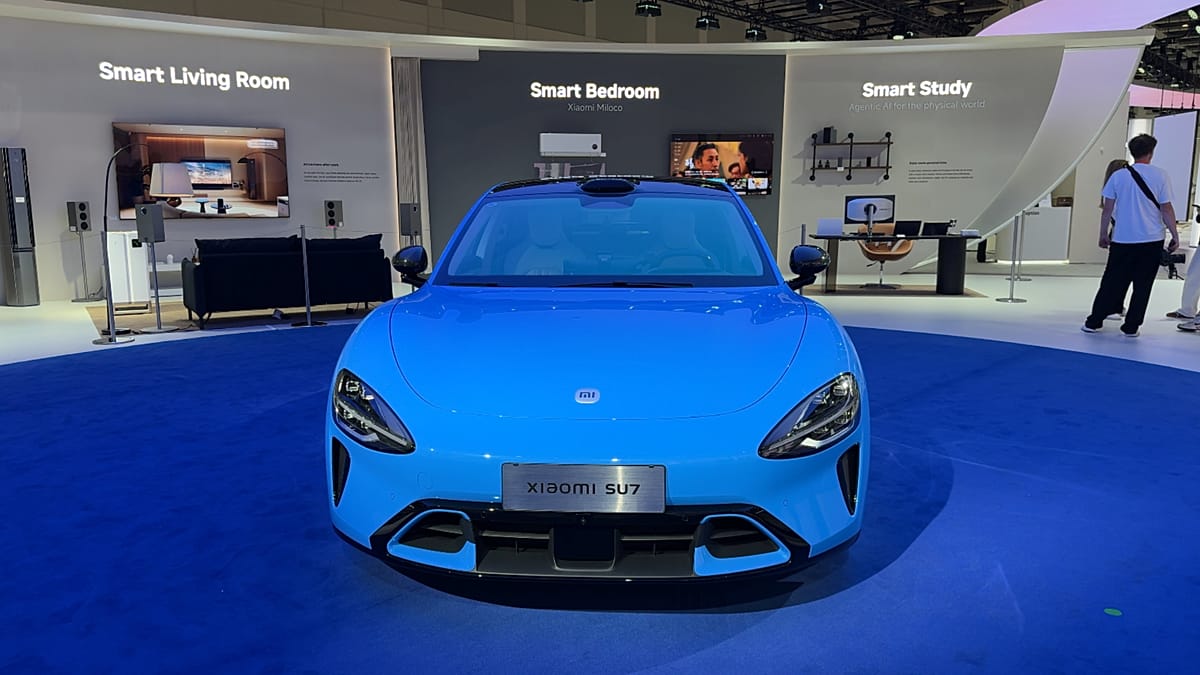
At this year's IFA in Berlin, Xiaomi made clear that its ambitions now extend well beyond smartphones. The Chinese tech giant used the trade fair to outline plans to launch its electric vehicles on European roads by 2027, with the cars designed to operate as an extension of its broader smart-home ecosystem.
Visitors to Xiaomi's exhibition space were greeted by a sleek electric car bearing the company's logo—a visual statement that the brand is shifting from pocket-sized devices to something considerably larger. While Xiaomi's cars are already a familiar sight in China, the European market represents a new frontier.
Human x Car x Home: A connected vision
Xiaomi's strategy revolves around what it calls the "Human x Car x Home" ecosystem. Rather than treating the car as a standalone product, the company aims to integrate it into the same connected network that already links its smartphones, home appliances, and other devices. The idea is that users can move seamlessly between their home, their car, and their personal devices while staying connected to the services they rely on daily.
During a demonstration at IFA, Xiaomi showed how drivers could control home devices from inside the car—opening connected curtains, switching air conditioning on or off, and managing other smart appliances. This effectively turns the vehicle into another control point for the smart home, allowing users to adjust their home environment before they even arrive.
The technological backbone of this ecosystem is Xiaomi's HyperOS operating system, combined with artificial intelligence. The company envisions a future where AI can coordinate devices across the car, smartphone, and home based on contextual information, rather than requiring manual commands. For instance, the system might automatically adjust the thermostat when it detects the driver is nearing home.
Beyond the practical applications, Xiaomi also showcased more experimental concepts at IFA, including the Vision Gran Turismo—an electric hypercar concept developed for the Gran Turismo racing game series. While this vehicle explores design and digital interaction ideas, it remains a concept rather than a preview of a production model.
European expansion begins in Germany
Xiaomi's European ambitions are not just conceptual. At a press conference on 3 September, the company signed letters of intent with eight German automotive retail groups: Emil Frey Germany, the Ernst Dello Group, Autohaus Dinnebier, Hahn Automobile, the LUEG Mobility Group, Fett & Wirtz, SPT Avior, and Penske-Jacobs. Germany is intended as the starting point, with similar partnerships planned for other European markets.
"Europe is a key market for our global strategy," said Xu Fei, Xiaomi's Chief Marketing Officer, during the press conference. The company has also announced plans to invest more than €24 billion globally in research and development between 2026 and 2030, focusing on AI, operating systems, semiconductors, intelligent vehicles, robotics, and smart manufacturing.
Xiaomi's entry into the European EV market comes at a time when the continent is seeing a surge in electric vehicle adoption, with established players and new entrants alike vying for market share. The company's strategy of integrating cars into a broader ecosystem could differentiate it from competitors, though it will face challenges such as building brand trust and establishing a service network.
As Xiaomi prepares to roll out its vehicles across Europe, the company is betting that its ecosystem approach will resonate with consumers who increasingly expect their devices to work together seamlessly. Whether that bet pays off remains to be seen, but the groundwork is clearly being laid.