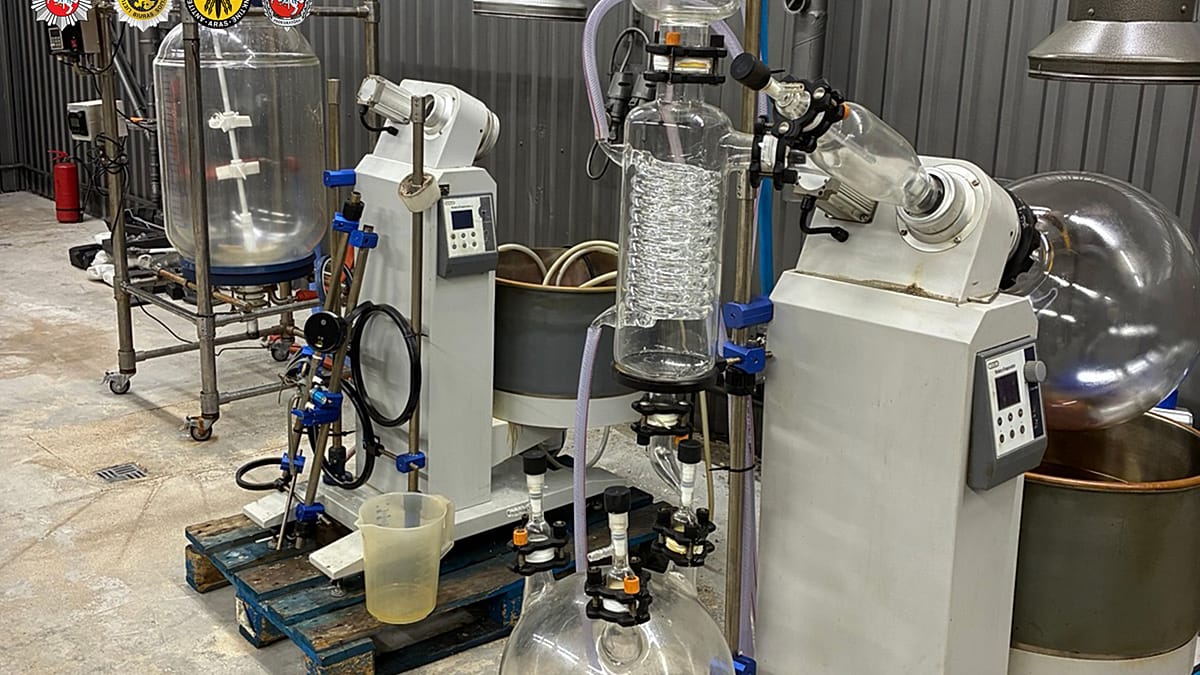
Lithuanian authorities have dismantled one of the largest synthetic drug production facilities ever found in the Baltic region, uncovering hundreds of kilograms of narcotics and thousands of litres of chemical precursors at a site near Vilnius. The operation, which spanned three days, was allegedly coordinated by a Dutch national of Turkish origin, according to police officials.
“Drugs were being produced on an almost industrial scale,” said Saulius Briginas, Deputy Chief of the Lithuanian Criminal Police Bureau, during a press briefing on Wednesday. The Dutch citizen is believed to have organised the laboratory’s workflow and directed its illegal activities alongside three Lithuanian accomplices.
Massive haul and estimated value
Preliminary figures from the investigation reveal the scale of the seizure: more than 3,000 litres of BMK, a key precursor for amphetamine production; over 500kg of methamphetamine; more than 300kg of amphetamine; and approximately 4.5kg of the synthetic cathinone 3-CMC. According to Briginas, this amounts to more than four million individual doses.
“On the wholesale illicit market, the drugs would be worth more than €2 million,” he said. “At street level, the value could be ten times higher.” Such figures, Lithuanian authorities believe, indicate that the drugs were not intended solely for the domestic market.
Instead, the operation was geared towards markets across Europe, with the Netherlands, Germany, Belgium and the Czech Republic among the likely destinations. This cross-border dimension underscores the increasingly international nature of synthetic drug trafficking, a trend also seen in recent seizures of cocaine destined for the Netherlands.
Industrial-scale chemical procurement
The investigation also exposed the group’s industrial-scale procurement of chemicals needed to manufacture synthetic drugs. The network sourced laboratory equipment and chemical substances from China, India and several European countries, while also purchasing some uncontrolled substances from specialist suppliers in Lithuania.
At the laboratory, police found 380 cylinders of hydrogen originating from China, a gas used in the production of synthetic drugs. Sulphuric acid was reportedly purchased in quantities of one tonne per transaction, further indicating the scale of the operation.
The crackdown extended beyond the laboratory itself. Police intercepted a shipment intended for the Czech Republic after discovering 17kg of amphetamine crystals in two plastic containers inside cargo handled by a Lithuanian logistics company. This suggests the network had established sophisticated distribution channels.
Authorities have not disclosed the exact location of the lab, but it is believed to have been operating in the Vilnius region. The arrests and seizures mark a significant blow to organised crime in the Baltics, though experts warn that synthetic drug production remains a persistent challenge across Europe.
This case echoes other recent European police actions, such as the detention of a teenager in Warsaw over a planned attack, highlighting the varied threats that law enforcement agencies must address. The Lithuanian operation demonstrates the effectiveness of cross-border cooperation in tackling drug trafficking networks that operate across the continent.