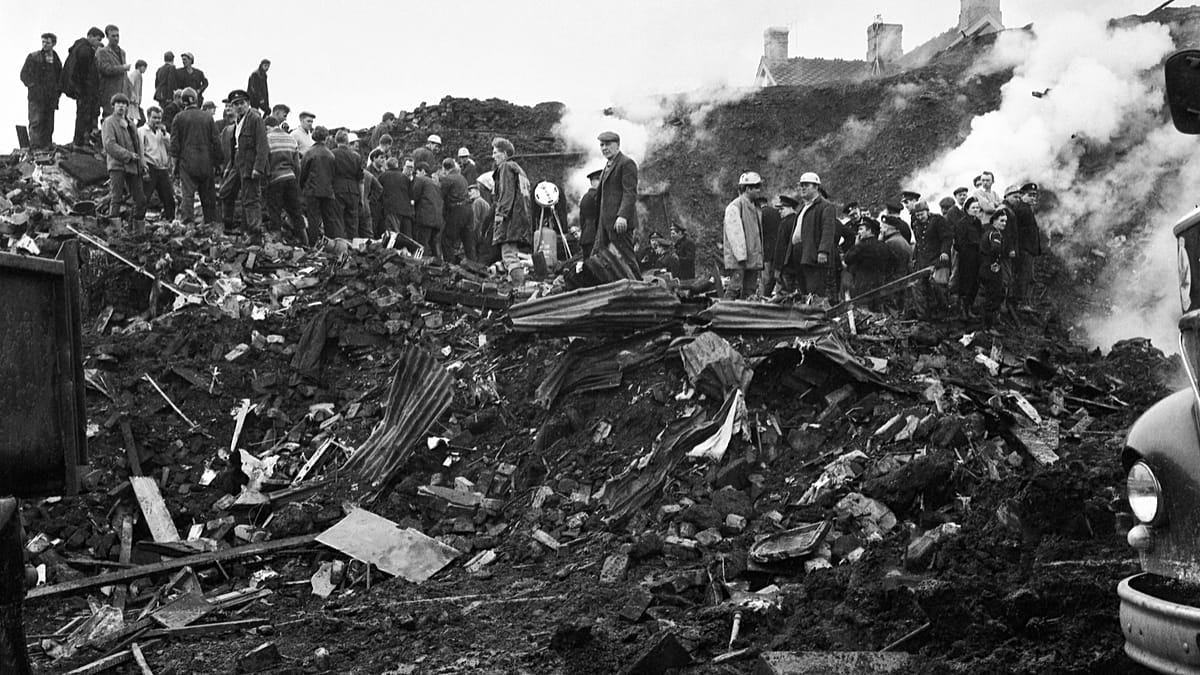
On a grey October morning in 1966, the village of Aberfan in south Wales lost an entire generation. Sixty years later, King Charles III returned to the valley to honour the memory of the 116 children and 28 adults who died when a colliery spoil tip collapsed onto Pantglas Junior School.
The King, accompanied by Queen Camilla and the Prince of Wales, met survivors and bereaved families in the village on 21 October 2026. The royal party laid wreaths at the memorial garden, and the Queen placed a posy. In a brief address, the King spoke of the stories shared by those who lived through the disaster: “We have heard stories of heartbreak, but also of heroism. We have heard of the most agonising grief, but also of the most inspiring grace.”
A disaster foretold
Aberfan, a small mining community in the Welsh valleys, had long lived in the shadow of the colliery waste tips that loomed above the houses. For decades, the National Coal Board (NCB) had dumped spoil on the hillside, creating unstable heaps that had shifted in 1944 and again in 1963. Despite warnings from miners and local residents, no action was taken.
At 9:15 on the morning of 21 October 1966, one of the tips gave way. More than 100,000 cubic metres of waterlogged debris slid down the mountain, engulfing the school just as lessons were beginning. The last child was pulled alive from the wreckage at 11:00, but the scale of the loss soon became clear: 144 people dead, most of them children aged between 7 and 10. The village was left in shock, its future irrevocably altered.
Official inquiry and a damning verdict
Within days, the UK government ordered a tribunal, led by Lord Justice Edmund Davies. Hearings took place in Merthyr Tydfil and Cardiff, and the findings, published in August 1967, were unequivocal: “Blame for the disaster rests upon the National Coal Board.” The state-owned body had ignored clear warnings, and no one was ever prosecuted or dismissed. The inquiry also led to the first comprehensive survey of all NCB tips across Britain.
The disaster prompted an outpouring of sympathy worldwide. Donations flooded into a relief fund, which eventually reached £1.75 million (€2.08 million). But the aftermath was marred by further controversy.
Funds diverted, families short-changed
In 1968, the government of Prime Minister Harold Wilson forced the disaster fund to hand over £150,000 (€178,000) to pay for removing the remaining spoil heaps—a cost that should have been borne by the NCB. The village had to wait nearly three decades for restitution; it was only in 1997 that Ron Davies, then Secretary of State for Wales, repaid the money. The Welsh Government later added a further £2 million to Aberfan charities.
The fund also faced pressure from the UK Charity Commission, which tried to block equal payments to bereaved families unless trustees could prove each parent had been “close” to the child who died. The trustees defied the Commission and paid every family equally. This was all the more necessary because the NCB’s initial compensation offer was a paltry £50 (€60) per family, later raised to £500 (€596) after public outrage.
The Aberfan disaster remains a sombre lesson in corporate negligence and the cost of ignoring expert warnings. As Europe grapples with the legacy of industrial pasts, the village’s story resonates beyond Wales—a reminder that the safety of communities must never be sacrificed for profit. The royal visit, while symbolic, also served to keep that memory alive for a new generation.